At exactly 7:30 on a chilly Thursday morning, frightened but determined schoolchildren gathered silently along the muddy shores of Lake Baringo, crowded together as they waited where a tarmac road once existed.
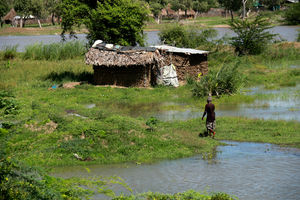
Today, the Loruk-Chemolingot road lies buried beneath floodwaters after it was swallowed by rising water levels two months ago.
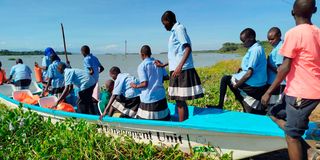
Clutching their school bags as some shivered amid the morning breeze from the lake, dozens of pupils from Loruk Primary School waited anxiously for a small wooden boat that was the only lifeline between their homes and classrooms barely 500 metres away.
Locals at Chesongo, Baringo Central, on May 12, 2026 carrying a footbridge that was swept away by floods on Sunday, hours after being commissioned.
Photo credit: Florah Koech| Nation Media Group
The children stared nervously into the murky waters as the overcrowded vessel struggled back and forth across the lake, ferrying them in small groups.
Nearby, danger lurked in plain sight. A herd of hippos grazed lazily in the shallow waters just metres from the children, their deep grunts echoing across the flooded shoreline.
Occasionally, crocodiles also emerged briefly before disappearing beneath the lake waters again, but for these children, this frightening journey has become part of their daily routine.
For learners from Cherelyo, Kakipich, Parichar and Kiplechony villages, the journey to school has become a daily gamble with death after the rising waters of Lake Baringo swallowed the Loruk-Chemolingot road two months ago, cutting off entire communities from schools, markets and health services.
What was once a short 500-metre walk to school has turned into a dangerous and costly struggle as more than 200 pupils now depend on a single boat to cross the flooded section every day.
The boat, which carries eight people in a single trip, is strained by the growing demand, ferrying children in batches as impatient pupils scramble to secure space onboard with no order, no life jackets, and no safety personnel — only fear, urgency and desperation.
When the Nation visited the area, children pushed and squeezed their way into the boat, each desperate to arrive at school before lessons began. Some stood precariously at the edges as the overloaded vessel rocked gently on the crocodile- and hippo-infested lake.
The lucky few make it to school early while others are forced to wait for several trips before their turn comes. By the time the final group reaches school, it is often past 10am, long after lessons have started.
The boat is not only dangerous, but it is also expensive for struggling families.
For some families, feeding their children is already difficult, and paying daily boat fare has become another crushing hardship.
There is an alternative route to school, but it involves a punishing five-kilometre trek around the flooded area, a journey too exhausting and unsafe for young children.
Locals trying to access Loruk shopping centre or seek essential services face the same nightmare, competing with schoolchildren for space on the overcrowded boat.
The schoolchildren not only grapple with the challenges of accessing the school, but they are also met with a dire situation at the institution — when they disembark from the boat, they have to wade through floodwaters that have swallowed part of their school compound as they go to class.
Residents of the flooded Ilbolei village in Baringo South try to evacuate goats and sheep that were stranded after the Perkerra and Milo rivers burst their banks.
Photo credit: Florah Koech | Nation Media Group
What was once a vibrant learning institution has steadily been swallowed by the rising waters, leaving children to study in conditions residents describe as dangerous and inhumane.
Large sections of the school are now underwater, including the playing field, five classrooms, eight pit latrines and a boys’ dormitory that previously housed more than 60 pupils.
Even basic necessities have become difficult to access. A plastic water tank installed outside the classrooms to harvest rainwater for drinking has also been submerged, forcing learners to walk through the flooded compound whenever they need water.
The compound itself paints a grim picture as thick shrubs and overgrown vegetation now cover much of the school, raising fears of snake infestations in the dilapidated classrooms, some of which no longer have windows.
With no perimeter fence, hippos and crocodiles from the swollen lake now roam freely within the compound, placing learners and teachers at constant risk.
To move around the school, pupils and teachers rely on a makeshift wooden ladder laid across flooded sections of the compound.
Boarding learners have also not been spared, as boys whose dormitory was submerged by floodwaters have been forced to seek shelter inside an Early Childhood Development Education (ECDE) classroom that now doubles as a dormitory at night and a learning space during the day.
The flooding crisis at the school dates back to 2006, when rising lake waters swallowed an ECDE classroom located more than a kilometre away from the main institution, forcing it to be relocated to the current site.
In 2020, another wave of flooding submerged key structures at the school, including the boys’ dormitory, pit latrines and the entire playing field. Roads leading to the institution also disappeared beneath the water, leaving learners dependent on canoes to attend classes.
In response, the government initiated plans to relocate the school to Cherelyo village, about five kilometres away, after residents donated more than 50 acres for the project.
Baringo County Commissioner Stephen Kutwa indicated they are touring schools in flood-prone areas to see which ones have been worst hit by the rising water levels in Lakes Baringo and Bogoria.
He said plans are underway to move the school to the alternative land next week, even if it means setting up temporary tents as authorities plan to rebuild new structures.
He said that the dormitory, which was constructed on the alternative land in 2020, will be partitioned to house the girls and boys, and temporary classes will then be put up in the short term, noting that once the report is out, they will write to the Ministry of Education and Interior Ministry to seek funds to construct permanent structures.
Residents say repeated appeals for help from both the national and county governments have yielded little progress, even as floods continue disrupting education and displacing families.
Samuel Chirchir recalled that Lake Baringo was once more than seven kilometres away from the institution.
“In 2006, the flooding swallowed a nursery school that was about a kilometre away from Loruk Primary School, forcing us to relocate it here. Then in 2020, the water advanced further and submerged part of the playing field and the boys’ dormitory. Before this phenomenon, the lake was over seven kilometres away,” said Mr Chirchir.
A submerged pit latrine at the flooded Loruk Primary School in Baringo North on May 8, 2025. The school has been marooned after Lake Baringo rose exponentially, swallowing structures at the institution.
Photo credit: Florah Koech | Nation Media Group
Charles Sirikwa, a coxswain who ferries pupils to school, said he makes more than 10 trips every morning transporting learners through the flooded area, a process that takes over three hours.
He warned that strong evening waves make the lake particularly dangerous for young learners travelling home.
School committee member Moses Cherutoi described the situation as a disaster waiting to happen, noting that some classrooms have already absorbed water through the floors and walls.
“These children are suffering as some have dropped out while others have transferred to different schools. We have pleaded for relocation for years, but all we continue receiving are promises,” said Mr Cherutoi.
School board chairperson Jeniffer Kiptuitich warned that rising water levels threaten to completely paralyse learning at the institution.
According to Ms Kiptuitich, the school’s 289 learners are exposed to attacks by wildlife as hippos and crocodiles encroach on the compound.
“During lessons, you can hear hippos grunting nearby, and sometimes they move around the school compound. At lunch hour, learners occasionally find crocodiles basking near classroom pavements,” she said.