The brown envelope never leaves David Samut's reach. Inside are two fading photographs of his daughter, Cherop Samut, the smiling Grade Three pupil whose life ended in the jaws of a crocodile on an ordinary afternoon in August 2021.
Five years later, the pictures are all the 58-year-old father has left of the child who disappeared beneath the waters of Lake Baringo while fetching water just a few metres from their home.
Sitting quietly outside his dilapidated mud-walled house in Chesesoi village, on the border of Baringo North and Tiaty East sub-counties, Samut stares at the photographs for several moments before speaking.
Behind him, the vast waters of Lake Baringo shine under the morning sun, stretching almost to his doorstep.
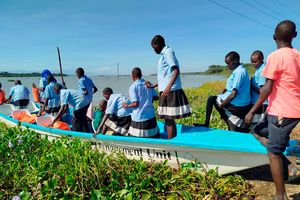
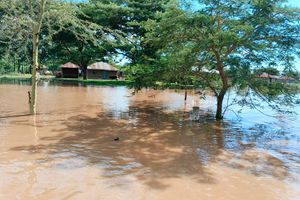
What was once a lake several kilometres away has steadily crept towards villages, swallowing grazing fields, homes, schools and roads, while bringing crocodiles and hippos into daily contact with communities that once lived a safe distance away.
“My daughter left school that afternoon full of joy. She promised her teacher she would be the first to report back the following morning. Instead, she never came home,” recalled Mr Samut.
Cherop, then an 11-year-old pupil at Katuit Primary School, had completed classes shortly after 1pm on August 9, 2021. Like many children in the area, she accompanied two friends to fetch water and bathe in Lake Baringo, the only reliable source of water for domestic use and livestock.
As she waded into the shallow waters carrying a container, a crocodile suddenly emerged from beneath the surface. Within seconds, it seized the helpless girl and dragged her into the lake.
Alfine Cherop, mother of Yvonne Chenangat, a Grade Nine learner from Loruk in Tiaty Constituency of Baringo County, during an interview on July 16, 2026, narrates how a crocodile from the nearby Lake Baringo attacked her daughter last year, biting her left leg. They are yet to get compensation from the government.
Photo credit: Jared Nyataya | Nation Media Group
Her friends desperately grabbed her hands and tried to pull her back, but the reptile proved too powerful. Their screams soon pierced the quiet afternoon, drawing villagers to the scene.
Residents, officers from the Kenya Wildlife Service (KWS) and rangers from Ruko Conservancy mounted an intensive search that lasted five days. Boats combed the lake while dozens of residents walked along the shoreline hoping the water would surrender the missing child.
For months afterwards, Samut says he walked to the lakeshore every morning before sunrise, hoping to recover his daughter's remains and give her a dignified burial.
“I refused to give up. Every morning I would go to the exact place where she was attacked. I kept believing the lake would eventually bring her back,” said the father of one.
Nearly a year later, fate appeared to answer his prayers. While fetching water at the same spot, he stumbled upon about ten tiny bones lying on the muddy shoreline. He was convinced they belonged to her daughter.
He collected the remains and reported the matter to Loruk Police Station before they were forwarded to KWS offices in Kabarnet and later to the Government Chemist in Kisumu for forensic examination.
However, the results shattered his hopes. According to Samut, the report indicated the bones did not belong to his daughter and even described the remains as male.
“It felt like losing her all over again. I could not understand how the report described the remains as male when my missing child was a girl. I still believe those were my daughter's bones,” he said, his voice breaking.
Convinced the remains belonged to her daughter despite the findings, he took them home and buried them near his homestead, where a modest grave covered with thorny branches now stands as the family's only place of mourning.
Five years after the tragedy, he said he has yet to receive compensation from KWS despite filing all the required documents, including the police Occurrence Book (OB) report.
“When I see children her age, I remember what I lost. My family has never healed. All I ask is for justice. Five years is too long to keep telling a grieving parent to wait,” said the distraught father.
The tragedy plunged the family into emotional turmoil. He said the loss affected his health, strained his marriage and came after the family had already lost two other children to illness.
For residents living along the shores of Lake Baringo, however, Cherop's death is no longer an isolated tragedy.
Across villages in Baringo North and Tiaty East, families recount chilling stories of crocodiles snatching children, hippos mauling residents and livestock disappearing into the expanding waters.
Many blame the rising lake levels, which they said have transformed once-safe villages into dangerous frontlines where every trip to fetch water can become a fight for survival.
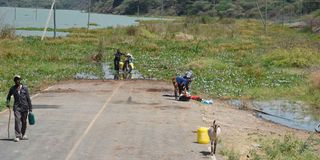
A view of the submerged Marigat-Loruk road in Baringo County, where rising water in Lake Baringo has cut off communication on July 16, 2026. Crocodiles and hippos from the lake are now a threat to people living around it.
Photo credit: Jared Nyataya | Nation Media Group
According to Samut, the shoreline that once lay more than three kilometres from his home is now barely 200 metres away.
“In the past, crocodile and hippo attacks were very rare. Today people have died, others have lost their limbs, many are nursing permanent injuries, and our livestock are constantly being attacked. My daughter became one of many victims,” said Mr Samut.
Just a short distance from his home lives Alvin Samut, David’s in-law whose family has endured another devastating encounter with the lake.
The widow's life changed dramatically in August 2023 when her husband, former Loruk Chief Charles Samut, died by suicide, leaving her to single-handedly care for their four children.
Barely a year later, tragedy struck again.
Her second-born daughter, then a Grade Nine student, was attacked by a crocodile while fetching water from the lake with her younger sister.
“The girls had gone to fetch water as they always did. As soon as my daughter stepped into the lake, the crocodile grabbed her left leg and tried to drag her into the water,” recalled Alvin.
The younger sister screamed and hurled stones at the reptile while the injured girl desperately clung to a nearby tree stump.
After a fierce struggle lasting several minutes, the crocodile finally released its grip.
Neighbours rushed to the scene and took the teenager to Loruk Dispensary before she was referred to Baringo County Referral Hospital and later to a specialized hospital in Nairobi.
Doctors fought to save her leg, but the injuries were too severe. The limb was amputated.
A view of the submerged Marigat-Loruk road in Baringo County, where rising water in Lake Baringo has cut off communication on July 16, 2026. Crocodiles and hippos from the lake are now a threat to people living around it.
Photo credit: Jared Nyataya | Nation Media Group
“When she was attacked, she was preparing to join Grade Ten. Instead, she spent months in hospital. She became traumatized and could not return to her former school,” she said.
The family later relocated to Chepnga'atit village, several kilometres away from the lake, fearing another attack.
Even then, life remains difficult. Because of her disability, the girl cannot walk the long distance to school. Every day, her mother spends Sh200 on motorcycle transport to take her to and from class.
“As a widow, it is extremely difficult. I struggle to feed my children and pay school expenses. I have followed up with KWS many times but I have only been told to wait. The compensation would help me buy a prosthetic leg and restore my daughter's dignity,” she told the Daily Nation.
She said rising water levels have worsened the danger because crocodiles and hippos now roam freely near homes even during daylight hours.
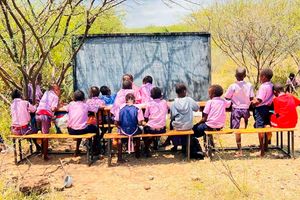
“Katuit Primary School used to be about three kilometres from the lake. Today it lies inside the flooded area. The lake has completely changed our lives,” said Alvin.
The nightmare does not end with crocodile attacks. In neighbouring Chesiran village, Richard Chelugo still walks with the aid of a stick after surviving a brutal hippopotamus attack in August 2024.
That morning, at around 7.30am, he headed to the lakeshore to fetch water, believing the hippos had already returned to the lake after grazing at night. Instead, he found himself face-to-face with one.
"I turned and ran, but the hippo chased me,” said Mr Chelugo.
He stumbled and fell into a thicket. While vegetation concealed the upper part of his body, both legs remained exposed.
Neighbours rushed him to Marigat Hospital before he was referred to Baringo County Referral Hospital, where he remained admitted for nearly a month.
Although he survived, one leg remains partially paralyzed while the other continues to develop painful wounds.
“I used to depend on livestock keeping. Today I cannot herd animals because I cannot walk long distances. Some of my livestock have since been attacked because I cannot watch over them,” said the father of four.
He said he borrowed money for treatment, hoping compensation would enable him to repay the debt but that compensation has never come.
“I have four children and two have dropped out of school because I can no longer provide for them. I only ask KWS to speed up the compensation because I have suffered enough,” he noted.
His story reflects that of Faith Kemei, another resident of Chesiran village who survived a crocodile attack in 2020.
She said residents now approach the lake with extreme caution. Before collecting water, they first throw stones into the lake or beat the surface with sticks to scare away lurking crocodiles.
“It has become part of our daily routine. You never know whether you are going to fetch water or walk into death,” said Ms Kemei.
She said the expanding lake has pushed crocodiles and hippos closer to homes, making encounters almost inevitable.
Lake Baringo Senior Warden Jackson Komen acknowledges that the expanding lake has heightened human-wildlife conflict.
He said Lake Baringo has grown from approximately 178 square kilometres to more than 260 square kilometres over the years, submerging infrastructure and bringing wildlife into closer contact with people.
Besides crocodile and hippo attacks, he says snake bites have also become more common in flooded areas.
For families living along the shores of Lake Baringo, however, the statistics tell only part of the story. Behind every figure is an empty classroom desk where a child will never return, a widow struggling to rebuild her family after tragedy, a father still clutching fading photographs of a daughter whose body was never found, and survivors learning to walk again after losing limbs to crocodiles and hippos.