Africa Climate Summit secures $150bn in commitments, urges global action
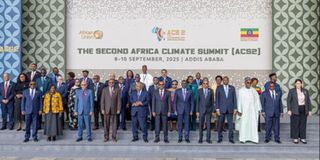
Delegates at the Second Africa Climate Summit in Addis Ababa, Ethiopia on September 8, 2025.

What you need to know:
- The perennial lack of financing, or poor financing, is one of the biggest issues that Africa is facing and one that is echoed in every global climate talk.
At every major climate summit, the air is rarely calm in the negotiating halls. Even outside the rooms, one can feel the tension. The meetings are littered with squabbles, backroom huddles, and even walkouts as blocs of countries pull in opposite directions over money, timelines and responsibility.
But, Africa climate summit, even with the geopolitical tensions, has the undercut of unity and a common goal to position Africa as a hub of homegrown solutions.
On Wednesday, the second Africa Climate Summit concluded in Addis Ababa with African leaders making the same call. Mahamoud Ali Youssouf, chairperson of the African Union Commission, said the summit had been “a space where we did not just ask the world to listen but we made ourselves heard.
Through the Fireside Chat with our Heads of State and Government, we called for a reformed global climate finance architecture that is just, equitable, and attuned to Africa’s realities.”
“As we adopt the Addis Ababa Declaration and launch the Flagship Report on Continental Climate Initiatives, we are not closing a summit. We are opening a new chapter,” he said during the closing of the summit
The draft declaration seen by Nation stresses that Africa is not waiting to be saved but “ its resource-endowed and proactive force in developing innovative, sustainable, and inclusive solutions that reflect the continent’s unique strengths and aspirations; thereby repositioning Africa to strive to be a global hub for low-carbon manufacturing and green intra-Africa trade.”
To make this happen, the statement called upon the member states to expidite the ratification process of the financial institutions with an aim to enhance their capacity to mobilise resources and support climate action financing in Africa.
The perennial lack of financing, or poor financing, is one of the biggest issues that Africa is facing and one that is echoed in every global climate talk. For instance, the leaders, through the declaration, expressed concern that the Adaptation, Green Climate Fund and other financial mechanism operating entities remain underfunded.
At COP29 in Baku last year, the 1.3 trillion US dollars demand by developing countries to wealthy nations, regarded as the historical polluters, was not met. “The New Collective Quantified Goal (NCQG) target of mobilising at least US dollars 300 billion per year until 2035 falls far short of the needs of implementing current NDCs in
Africa, estimated at US dollars 2.8 trillion until 2030,” read an excerpt from the declaration.
At the Africa Climate Summit, two investment initiatives on green industrialisation were launched. The summit announced a 50 billion US dollars through the Africa Climate Innovation Compact and the African Climate Facility in catalytic finance for local climate solutions. Investors, who include African financial institutions and Development Finance Institutions, announced a 100 billion US dollars to support the continent’s green industrialisation plans.
Abiy Ahmed, Prime Minister of Ethiopia, who was the summit’s host, rallied Africa nations to establish an African Climate Innovation Compact. “By 2030, the Compact should aim to deliver 1,000 African solutions— to tackle climate challenges in energy, agriculture, water, transport, and resilience,” he said.
He also reiterated that Ethiopia was keen on hosting COP32 in 2027. “We invite the world to Africa’s capital of diplomacy and climate ambition to witness our solutions and to help shape the future.”
Wamkele Mene, secretary-general, African Continental Free Trade Area Secretariat, described the signing of the African DFI Cooperation Framework as historic.
“By mobilising African capital first, we change the dynamic. We show the world we are not applicants, but investment partners inviting global capital to join an initiative that is already underway, structured and de-risked by Africa itself,” he said.
The Addis Ababa declaration will serve as a basis for the continent’s common position ahead of the UN COP30 climate talks in Belem, Brazil later this year.
Best example
Held at the Addis International Convention Centre, the summit drew thousands of delegates to a country that seemed to offer itself as a best case example for homegrown solutions—from electric vehicles to the launch of the Grand Ethiopia Renaissance Dam, the largest hydroelectric dam on Blue Nile.
However, the event’s message of unity was undercut by the absentia of many African leaders as only less than 10 African heads of states attended the summit.
Outside the convention centre and beyond Ethiopia, the question of whether the summits deliver especially to those most vulnerable to climate change lingers.
“We hear about these conferences all the time. Yet, we cannot even access finances for climate action initiatives like Flocca,” said Kenneth Nyaga, an environmentalist from Embu, and a participant at the the summit.
But observers say there’s no backtracking and that Africa is on the right path to creating climate solutions.
Ali Mohamed, Kenya’s Special Envoy for Climate Change in the Executive Office of the President, said: “The Second African Climate Summit in Addis Ababa has demonstrated, beyond doubt, that Africa is continuing to lead on the global climate agenda even at a time when the world risks backsliding.
Over the past three days, we have seen our continent, from all walks of life, come together in a spirit of unity and multilateralism rarely witnessed on the world stage.The outcomes speak for themselves: we have reaffirmed our commitment to climate-positive growth, founded on scaling renewable energy to 300 GW by 2030, fueling green industrialisation and value-addition. We have seen concrete steps to deliver on this vision, most notably, our homegrown financing institutions embracing this political mandate to mobilise $100 billion, harnessing the African Continental Free Trade Area to unlock the full potential of African markets.
Mohamed Adow, executive director of climate think tank Powershift Africa, said: The Africa Green Industrialisation Initiative is Africa’s most ambitious effort yet to turn our energy and resource wealth into engines of climate-smart industrial growth.
From a declaration at COP28 to the landmark Cooperation Framework signed in Addis Ababa this week, where the continent’s leading financial institutions committed over US dollars 100 billion to its implementation, we now have a framework built for speed, real projects, and jobs.”