Bees keep hippos at bay: A village’s unusual defence against deadly encounters
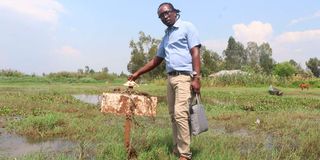
Environmentalist Willis Omullo at his uncle's grave on Chuowe beach in Rachuonyo North on January 31, 2024. The grave has been washed away by water.

What you need to know:
- Residents of Chuowe in Rachuonyo North are grappling with frequent hippo invasions after climate change-driven flooding altered Lake Victoria’s shoreline, pushing wildlife into human settlements and escalating deadly conflicts.
- As grazing areas disappeared, hippos began roaming into homes, forcing communities to abandon night-time activities and rely on emergency interventions from wildlife authorities.
- In response, residents have adopted nature-based solutions such as beekeeping and environmental restoration.
Living in the Chuowe area of Rachuonyo North is not for the fainthearted. For more than five years, residents have lived on constant alert, wary of wild animals whenever they step outside at night. The area is home to hippos, which roam the neighbourhood after dark and can easily maim or kill anyone unfortunate enough to encounter them.
To reduce the risk of attacks, residents now end their daily activities before sunset and lock themselves indoors thereafter. By the time the aquatic animals emerge from the water to graze, everyone is safely inside. This, however, was not always their way of life. Seven years ago, residents would stay out late into the night, some fishing while others excavated sand—the village’s two main economic activities.
Encounters with hippos were rare, occurring mainly when someone strayed into their habitat. That changed following a dramatic natural shift that altered the entire landscape and drove wildlife closer to human settlements. Around 2019, water levels in the lake began to rise. For several months through to 2020, the waters submerged homes and displaced thousands of families, not only in Chuowe but across communities around the lake.
The rising water levels are largely attributed to climate change, which has triggered heavier rainfall and increased inflows into the lake. Other contributing factors include land-use changes such as deforestation and urbanisation, the reduction of wetlands, and increased surface runoff, all of which have disrupted the natural balance and worsened flooding.
In Chuowe, a low-lying area along the shores of Lake Victoria, many families were forced to abandon their land and seek refuge on higher ground. When some residents eventually returned and began adjusting to a new reality, they found the village blanketed with stagnant water and undergoing profound physical changes.
Within three years, the area had transformed dramatically. Homes collapsed as their walls crumbled, trees withered from prolonged waterlogging, and wildlife shifted from its traditional habitats. Fish, once confined to the lake, could now be found swimming in pools inside people’s homesteads.
Hippos, accustomed to grazing along the lakeshore, also began venturing deeper into residential areas in search of food. As they grazed, residents increasingly found themselves face to face with the animals, triggering frequent human-wildlife conflicts. On several occasions, locals called rangers from the Kenya Wildlife Service (KWS) to intervene when hippos wandered into homes.
Willis Omullo, a resident, explains that the animals roam widely in search of food after their grazing areas were destroyed by flooding. Some hippos, he says, moved closer to homesteads where crops were growing. “Some animals would be found roaming the village by daybreak when they lost track of the rest of the herd. Encountering the animals was like coming face to face with death,” Willis says.
Wildlife experts add that illegal sand mining has also displaced some hippos from the lake. KWS warden Jackson Kibor explains that mining pits are often left open and later filled with water, forming pools. As hippos return to the lake after grazing at night, some fall into these pits and remain trapped there. “People complain about having the animals closer to them, yet it is their fault. The gullies they dig are filled with water and it confuses the animals into thinking they have reached the lake,” he said.
Hippos are herbivores that feed exclusively on plants. However, they can kill livestock and humans—not to consume them, but in self-defence. The animals possess large, ever-growing tusks—ivory incisors and canines—used to fight rivals and fend off predators. A single bite can be fatal.
Having witnessed lives disrupted by climate change and wildlife attacks, Willis has become an advocate for environmental protection. “I am an environmentalist and a climate change ambassador. My role is to help my community and other people overcome challenges caused by climate change,” he says.
He leads a community-based group known as Aluora Makare—Luo for “a good environment”. Earlier this year, the group launched a nature-based solution aimed at protecting residents from hippo attacks while restoring the degraded environment. Their approach relies on a biological deterrent to keep the animals away from homes.
Beehives have been installed along riparian land that separates the community from wildlife habitats. “Just like bees keep elephants away, insects can help us keep hippos at bay. This is besides offering the community an opportunity to engage in apiculture,” Willis says.
Residents report that areas with beehives experience minimal hippo activity, suggesting the insects are effective deterrents. The idea emerged after the group received Sh200,000 in funding from Slum Dwellers International and the Voices of Climate Action, which encouraged communities to seek support when facing environmental challenges.
Willis and his team installed 20 hives along routes commonly used by hippos to access homes. “The concept has other benefits as it will enhance pollination to support food production. Bees have reduced in number and this is one of the ways of saving them from possible extinction,” he says.
He adds that the bees also discourage sand harvesting along the riparian land while simultaneously blocking hippos from reaching homes. “It is like a buffer zone. It separates hippos from moving to homes. Besides, it provides an alternative source of livelihood and the community doesn't have to depend on fishing and sand mining anymore,” Willis says.
The hives were installed by professionals, who also trained residents in beekeeping. In addition, the community is restoring the local environment through other measures, including planting bamboo along River Miriu to curb flooding.
Willis says the interventions offer multiple benefits, particularly by creating alternative livelihoods. “We are requesting more partners to come on board and help us put more bee hives along the riparian land,” he says.
Jackson, however, questions the effectiveness of bees as a deterrent for hippos, noting that the approach works better with elephants. “Hippos are known to move out at night when bees are inactive,” the KWS official says.
Instead, he advises farmers to dig trenches to block the animals from accessing homesteads. Hippos, he explains, struggle to navigate trenches due to their short legs. “Hippos cannot climb out of a trench if it falls in. They will definitely avoid areas where trenches are dug,” he says.
KWS also faults community leaders in Chuowe for failing to fully cooperate with the agency in addressing human-wildlife conflicts. Jackson says the community has been reluctant to implement some of the recommendations offered by the agency.