Three generations, six cancer cases: Family's 30-year medical ordeal
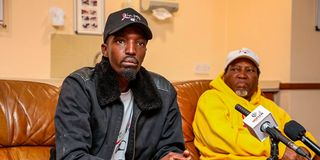
Harold Tende (left), 29 years with his father Brian Mwakero address journalists at Aga Khan University Hospital, Nairobi on February 4, 2026.

What you need to know:
- Cancer has been an uninvited constant in Brian’s life since 1993, when his first wife received a breast cancer diagnosis and died the same year.
- His mother was diagnosed with cervical cancer. His father followed with prostate cancer.
- His son had also battled three different cancers when he was diagnosed with prostate cancer.
Brian Tende Mwakuro and his son Harold Tende sit side by side in a hospital holding room, their matching yellow hoodie and T-shirt bearing an inscription that reads: "Hope Mode On." The words on their caps echo the same message. They look remarkably well for two people who have weathered multiple cancer battles—not just their own, but those of their family spanning three decades.
For Brian, cancer has been an uninvited constant in his life since 1993, when his first wife received a breast cancer diagnosis. She had noticed a lump on her right breast while breastfeeding their new-born daughter. At the time, cancer awareness was minimal compared to today. She died the same year she was diagnosed.
Years later, his mother was diagnosed with cervical cancer. His father followed with prostate cancer. But nothing prepared him for what came next.
In 2015, Harold began experiencing persistent neck issues. During high school, he suffered frequent nosebleeds and bouts of headaches. The family hoped the hospital visits would eventually taper off. When Harold returned home from college during the holidays, Brian noticed a swelling around his son's neck and insisted he see an Ear, Nose and Throat specialist.
The specialist took samples and sent them to a pathologist. "A doctor called me to share the results, and they found that he had head and neck cancer at an advanced stage," Brian recalls. Harold was only 19 years old.
Harold completed his treatment and waited five years for doctors to declare him cancer-free. At the fifth year, there were no cancer markers in his body. He resumed normal life, playing rugby and becoming living proof that people survive the disease.
But in the seventh year, strange symptoms returned — what initially felt like a common cold. His family teased him, saying he just needed to keep warm. He went to hospital alone and received a lung cancer diagnosis. He completed treatment for the second time. Throughout it all, Harold's composure gave his father strength. He refused to be pitied.
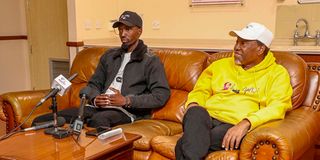
Harold Tende (left), 29 years with his father Brian Mwakero address journalists at Aga Khan University Hospital, Nairobi on February 4, 2026.
"This guy is a cancer soldier. His faith is as tall as he is," Brian says.
After Harold completed his treatment and started immunotherapy, a treatment that helps the body fight cancerous cells, Brian received his own prostate cancer diagnosis at stage one.
"I have been diabetic for about 17 years and I had issues with passing urine, but I didn't know that I would get cancer," he says.
His diagnosis came by chance. He had been admitted for complications from his diabetes when he mentioned his urinary issues to his doctor, who recommended additional tests. One of those tests confirmed cancer.
Brian initially received treatment in Mombasa but was later referred to Nairobi. He moved between facilities before settling at Aga Khan University Hospital for radiotherapy sessions. In December last year, he rang his bell to signify the end of radiotherapy.
"It was a big celebration and I didn't even anticipate it," he says.
Despite father and son undergoing similar treatments, particularly radiotherapy, their experiences differed significantly. Brian benefited from a new machine called a linear accelerator, which resulted in fewer side effects and shorter hospital stays. He experienced only lower back pains and itching. Harold's treatment had been far more severe—it affected his voice, skin, vocal cords and dried up his salivary glands.
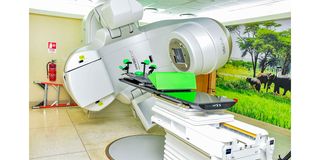
The newly acquired TrueBeam radiation therapy technology at Aga Khan University Hospital on February 4, 2026.
"My son has gone through worse and that has given me hope. Getting a cancer diagnosis is not the end of life. We just need to live positively," Brian says.
This year's World Cancer Day theme, curated by the World Health Organisation, is "United by Unique", a reminder that while cancer is a global threat, each country, community and person affected by cancer faces distinct realities.
As awareness grows, new technologies continue to emerge. Nation visited Aga Khan University Hospital, which has acquired a new radiotherapy machine that uses artificial intelligence for more precise cancer care.
Dr Angela Waweru, a Radiation Oncologist at the facility, explains that the linear accelerator radiotherapy machine enables precision and advanced radiotherapy. One major improvement she has observed is that prostate cancer patients who previously required eight weeks of treatment now complete only five sessions over two weeks, with fewer side effects.
For breast cancer patients, treatment that once took five to six weeks now requires only one week of radiotherapy.
"The biggest difference from other machines is the ability to track the tumour precisely. When a patient lies on the machine, they can move. In the past, we accounted for such movements by giving larger radiation fields, and that increased side effects. This machine goes off when there is any movement and comes back on when a patient is rightly positioned," she explains.
"We are seeing less urinary and stool changes as side effects, which were common before in prostate cancer patients. For breast cancer patients, we are seeing less radiation burns," she adds.
Other new advancements in the country include the deployment of robotic radiosurgery such as the CyberKnife technology, nuclear medicine for cancer treatment at the Kenyatta University Teaching, Referral and Research Hospital (KUTRRH), and AI-enabled diagnostics like the Digital Mammography equipment at the Jaramogi Oginga Odinga Teaching and Referral Hospital in Kisumu.
Follow our WhatsApp channel for breaking news updates and more stories like this.