Chain of infection: Tracing how the Ebola virus spread

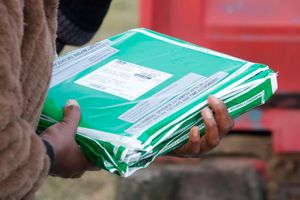
Blood sample drawn from patients suspected to be infected with Ebola should be tested within a short time to avoid further transmission.

When Kenya’s ninth Ebola case was announced this week, one question moved to the centre of the outbreak. Could the single imported patient, who died on October 5, have directly infected eight other people? Or has the virus passed from one person to another within the cluster, possibly even during quarantine?
Independent pathologist Dr Ahmed Kalebi said the tracing figures are encouraging, but they do not show how the virus moved between the nine people.
“Although most Ebola patients infect relatively few others, some transmit the virus to many people, a phenomenon known as superspreading. However, there is no indication from the press statements on when the new cases developed symptoms,” he said.
“Historical outbreaks have documented patients linked to substantially more than eight infections, particularly through close caregiving, healthcare exposure and unsafe funeral practices. Therefore, eight direct infections from one patient would be unusually high,” the expert said.
In Kenya, infections have involved close family members, healthcare workers and a hospital attendant who reportedly handled the index patient’s utensils and linen.
“Given his advanced illness when he arrived in Nairobi on October 3, and his death two days later, transmission to several close contacts is epidemiologically plausible. However, eight linked infections do not necessarily mean the deceased personally infected eight people; maybe they were infected by those who were infected by the deceased. The ministry needs to be clear on this,” Dr Kalebi said.

Pathologist Dr Ahmed Kalebi during a past interview in Nairobi.
Health Director General Dr Patrick Amoth has said that all the eight cases were known contact of the index case, and all fell ill while already in quarantine
“All nine cases belong to one cluster, and as today there is no evidence of transmission outside this group. The ninth case, a 24-year-old man, is also a close family member of the first case, was confirmed on October 19. He was isolated at the first sign of illness, tested and started on treatment immediately upon confirmation of his positive test result,” Dr Amoth said.
The Ministry says all eight surviving patients are improving. It says 134 of 135 identified contacts, or 99.3 per cent, have been traced and quarantined.
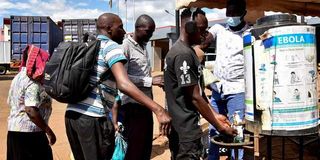
Travellers sanitize their hands before entering at the Kenya immigration services to access port health services at the Busia One Stop Border Post October 8, 2026.
The ministry’s description of a single cluster, he said, does not rule out onwards transmission.
“One cluster can contain multiple generations of infection. The index patient could infect a relative, who subsequently infects another person. Both remain within the same cluster, although the latter represents a tertiary infection,” he said.
The ninth patient was a known contact of the deceased. But the ministry has not said when he was last exposed, when he entered quarantine or when his symptoms began.
“His positive test on October 19 remains compatible with direct exposure before the death of the index patient on October 5, given Ebola’s 2–21-day incubation period. However, without those details, subsequent exposure to another infected contact cannot be independently excluded,” said Dr Kalebi.
The ministry has said there has been no spread within quarantine facilities. Dr Kalebi called this reassuring but said it leaves questions open.
“Quarantined contacts are not infectious before developing symptoms. However, transmission could occur if a symptomatic individual remained in contact with others before being recognised and isolated. Were contacts accommodated individually or together? Could they interact or share facilities? How promptly were symptomatic individuals separated?” He asked.
Blood sample drawn from patients suspected to be infected with Ebola should be tested within a short time to avoid further transmission.
His proposed remedy is an anonymised transmission tree. It would show likely sources of infection, exposure dates, quarantine entry dates and symptom onset.
“Science confirms that one Ebola patient can directly infect eight or more people. What remains unclear is whether that happened in Kenya or whether some infections resulted from onwards transmission within the cluster. Establishing that distinction is essential for determining whether all transmission chains have been successfully interrupted,” said Dr Kalebi.
Prof Shem Otoi, an infectious disease modelling expert at Daystar University, told the Nation the pattern points to how the patients were exposed, not to spread beyond the cluster.
He said the family cases most likely arose through caregiving and burial.
“The only possibility for this case is that these family members were involved in the care and were also involved in the funeral. It has been proved historically that funerals are super-spreaders. There were gaps, so they did not take infection prevention and control seriously. And if you look at the remaining five, those are family members,” he said, adding that there is no sign of community spread. But what is known depends on who is counted.
“So far, we haven’t had community transmission. We have only been told these are in one cluster, a cluster around the index patient. The modelling that is being done only considers data from patients who are in quarantine. With this new case, our modelling now shows that by the time we get to October 28 we could have 15 cumulative cases. The transmission model that is WHO-approved is saying that by October 28 we will have 48,” he said.
Amref Health Africa Group CEO Dr Githinji Gitahi raised concerns about infection control, especially the protection of health workers. He was speaking at the Africa Health Collaborative Annual Convening 2026. The infection of health workers, he said, raises questions about hospital preparedness.
Follow ourWhatsApp channel for breaking news updates and more stories like this.
Additional reporting by Collins Omulo