How should health workers handling Ebola patients protect themselves?
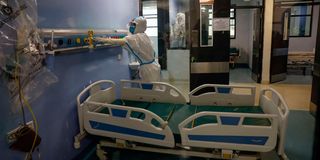
A nurse in protective gear in a ward at Nairobi Hospital where an Ebola patient from the Democratic Republic of Congo was isolated and treated shortly after arrival. The patient later died.

What you need to know:
- Infection can occur if infectious material reaches broken skin or the moist surfaces of the eyes, nose or mouth.
- People taking care of Ebola patients have to wear a full hazardous material (hazmat) suit.
The country’s eighth Ebola patient was announced on Sunday night. Health Director General Dr Patrick Amoth said about 38 samples were taken and only one turned positive.
The positive case is a 49-year-old patient attendant, who developed symptoms such as fever and muscle ache and was already in isolation. Dr Amoth said the government suspects he may have handled the index case’s linen and utensils.
Dr Ahmed Kalebi, a consultant pathologist, shares with us what is required for healthcare workers and support staff who work in highly infectious units such as an Ebola quarantine facility.
What risks exists in such units?
Ebola risk extends beyond doctors and nurses at the bedside to hospital support staff who handle patients’ used items. The key distinction is the risk of Ebola transmission which arises when items such as utensils, linen, or even toiletries and sanitary items get contaminated with infectious body fluids and those fluids reach another person’s broken skin or mucous membranes. These includes the eyes, nose or mouth.
Exposure through contaminated materials is therefore a plausible pathway. However, the exact item, timing and route of his infection have not been publicly established, so we cannot categorically state that utensils definitely caused it.
How then can contaminated items transmit Ebola?
Ebola spreads through contact with blood or other infectious body fluids from a symptomatic patient or someone who has died of the disease. These fluids could either be vomit, diarrhoeal stool, urine or saliva, and they can contaminate utensils, bedding, clothing and equipment.
Infection can occur if infectious material reaches broken skin or the moist surfaces of the eyes, nose or mouth. Examples include handling a soiled item and then rubbing an eye before handwashing, or receiving a splash while cleaning.
The virus is not known to penetrate intact, healthy skin. For transmission through an item to occur, viable virus must be present and find an entry point into the body.
Do we have evidence of this from other areas that have had Ebola outbreaks?
Yes, we have seen that in Uganda. It is suspected that there was a transmission through a blanket. During the 2000 Gulu outbreak, Francesconi and colleagues described a person who developed Ebola without reported direct physical contact with the patient considered his source. He had slept wrapped in a blanket left by his brother, who had recently died of Ebola. Contaminated material was considered the probable route.
Sharing a sleeping mat also remained associated with infection after adjustment for reported direct contact. However, washing patients’ clothes was not independently associated with infection after adjustment. This supports the possibility of transmission through contaminated belongings, while remaining a probable rather than laboratory-proven event for that particular blanket. This study was published in the journal; Emerging Infectious Diseases, 2003.
What about hospital items?
There is also evidence from Uganda that was published by Bausch and colleagues. They detected Ebola virus in 16 of 54 clinical specimens and 2 of 33 environmental specimens.
Those two positive environmental samples were blood-contaminated controls linked to a glove and an intravenous insertion site. Both were PCR-positive but culture-negative. This means that a viral genetic material was detected, but infectious virus was not recovered.
The authors concluded that the risk from contaminated objects in an isolation ward was low when recommended infection-control measures were followed. This supports the value of those precautions; it does not establish the safety of handling untreated, soiled items without protection.
In Sierra Leone, Youkee and colleagues detected Ebola virus RNA around patients’ beds in a Freetown Ebola holding unit and found evidence that viral material could be transferred beneath beds during cleaning.
These findings demonstrate contamination and the need for effective cleaning, but do not prove that particular surfaces caused infection.
Are there specific conditions in which the virus can remain infectious?
Yes, survival varies with the fluid involved, drying, temperature, humidity and surface type. There are experiments support the biological plausibility of transmission through contaminated items, but cannot establish how long a particular item remained infectious in this case. Much of this work concerns Ebola virus species other than Bundibugyo.
What should hospitals staff do to ensure they remain protected when handling Ebola patients?
According to the United States Centres for Diseases Control and Prevention (US CDC), cleaners, attendants, laundry workers, porters and waste handlers need training and personal protective equipment (PPE) appropriate to their tasks, hand hygiene, safe handling procedures, and effective cleaning and disinfection.
Safe removal of contaminated gloves and protective clothing is essential. Gloves alone are not a complete protective system. They need to learn proper ways of even de-gloving so that they will not come in contact with any fluid. They need an extra care.
And what does a PPE for a highly infectious disease look like?
People taking care of Ebola patients have to wear a full hazardous material (hazmat) suit. Anyone can get infected, so the precaution is to ensure that everyone in such a setting has zero unprotected contact with any fluid from an infectious patient.
The gloves are not just any glove but a medical grade nitrile glove. They are mostly blue, and thick and cannot allow any fluid to seep through it. They need boots that are waterproof. They also need to protect their neck but most importantly, is the protection of the face. This is because most of the contamination happens from the face.
For the support staff, in addition to wearing the medical grade nitrile glove, they should also add a heavy-duty rubber gloves when handling these items.
What message do you have to the public?
Ebola does not spread through the air like influenza or COVID-19, or simply because someone is in the same building. The concern is contact with infectious body fluids, either directly or through materials contaminated with those fluids.
Anyone with a possible exposure should contact the response team promptly, even while still well. Identified contacts require monitoring for 21 days after their last exposure, with immediate reporting of symptoms so that isolation, testing and care can be arranged.
Follow our WhatsApp channel for breaking news updates and more stories like this.