Paradox of Kenya hosting Ebola centre for Americans as US issues travel advisory
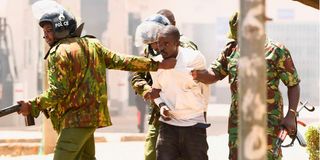
Riot police officers arrest a man during protests against a US-backed Ebola quarantine facility for Americans in Nanyuki town, Laikipia County on June 1, 2026.

What you need to know:
- On Monday, the US State Department raised its travel advisory for Kenya from Level 2 to Level 3.
- Other risks Washington cited are crime, kidnapping, terrorism, civil unrest and traffic safety concerns.
Earlier this year, the United States requested to build an Ebola quarantine facility in Kenya for American citizens exposed to the disease in the Democratic Republic of Congo and neighbouring countries.
But in a move whose irony did not escape observers, President Donald Trump’s administration has now warned Americans against travelling to Kenya over health and security concerns.
On Monday, the US State Department raised its travel advisory for Kenya from Level 2 to Level 3, telling its citizens to reconsider non-essential travel to Kenya. This was largely due to health risks, days after Kenya confirmed its eighth Ebola case.
The initial patient was a Kenyan citizen who had travelled from DRC, and died on October 5 while receiving treatment at Nairobi Hospital.
Other risks Washington cited in its advisory are crime, kidnapping, terrorism, civil unrest and traffic safety concerns.
Some parts of Kenya have a Level 4 advisory, which prohibits American citizens from travelling there. These include Nairobi’s Eastleigh and Kibera, as well as some northern and coastal counties. Areas bordering Somalia and Ethiopia are also included.
Kenya’s overall categorisation is just one step above DRC, whose Level 4 advisory means no travel is allowed directly to the US. Anybody who has been to DRC is required to stay in a different country for 21 days before being allowed in.
This is why the American facility in Kenya was considered important – to avoid leaving American citizens who had been to the DRC stranded.
As at mid-October, the World Health Organization reported 9,455 confirmed cases and 4,561 deaths since May in DRC, which has a broken health system and whose eastern part is largely controlled by the M23 rebel group.
On health, the advisory is blunt. It says medical services in Kenya are limited and often unavailable in rural areas, and that facilities often lack medicine and equipment.
“Outside a few private hospitals in the large urban centres, many health problems may require medical evacuation at the traveller’s own expense,” states the advisory, adding that facilities usually deny services unless payment is made up front.
A satellite image shows tents erected and vehicles at a new field hospital at Laikipia Air Base in Laikipia County, Kenya June 4, 2026.
Nairobi-based independent pathologist Dr Ahmed Kalebi read hypocrisy in the advisory. He said despite the challenges in Kenya’s hospitals, the reality is that even the health systems in America and Europea face challenges, especially in rural areas.
“When they start saying that medical services in Kenya are poor, they are targeting and spotlighting Kenya, yet the issues they are saying are not unique to Kenya,” said Dr Kalebi.
In June, the US sought to set up an Ebola quarantine facility for Americans at the Laikipia Air Base. Hundreds of residents marched in protest.
Despite the secrecy on the operations of the facility, there have been reports of American aid workers being housed there for the mandatory 21-day quarantine.
President William Ruto defended the facility, saying it was part of a broader national preparedness system.
After Kenya confirmed its first imported case on October 6, at least 130 contacts were traced, and 128 remain in quarantine. Eight positive cases have since been reported from this group, with no community transmission reported yet, according to Director-General for Health Patrick Amoth.
Health Cabinet Secretary Aden Duale addressed travel concerns two days after the first case.
“I wish to assure our partners and the international community that Kenya remains safe, open and vigilant. The confirmation of this imported case is a serious public health event, yet It does not, by itself, establish widespread transmission in the country. My Ministry, and the government at large, is treating the situation with the urgency it requires, guided by verified epidemiological information and established public health protocols,” Mr Duale said.
He emphasised that Kenya remains safe for travel, tourism, trade and investment.
“I urge the international community to base its decisions on verified epidemiological information, science and established international public health principles. Disproportionate restrictions on travel and trade can cause significant social and economic disruption without necessarily providing additional public health protection,” said Mr Duale.
The government has also said advisories are unnecessary because the country has no local transmission.
The US Centers for Disease Control and Prevention issued a Level 1 health notice for Kenya on October 19. It recommended usual precautions rather than advising against travel.
Prof Shem Otoi, an infectious disease modelling expert at Daystar University, pointed to what would change the picture. He said the greatest concern would be a new case that cannot be linked to the first patient.
“If we record any local transmission, then we will have problems, but as of now, we are safe, and there is no need for the travel advisories. It is discriminatory for the US to give such an advisory at this time,” Prof Otoi said.
Follow our WhatsApp channel for breaking news updates and more stories like this.