Choking fumes: Inside Lamu King Fahd Hospital incinerator poisoning homes
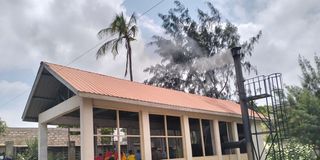
King Fahd County Referral Hospital's incinerator and its chimney in this photo taken on May 25,2026. Residents of Hidabo, a village bordering the facility, have complained about choking smoke and fumes produced by the incinerator.

What you need to know:
- Hidabo, home to at least 500 people, lies just beyond the perimeter fence of King Fahd County Referral Hospital, Lamu’s main health facility.
- The hospital relies on its on-site incinerator to dispose of syringes, biohazard bags, dressings, and pharmaceutical waste.
Fatma Alwy sits on the raised balcony of her house in Hidabo, a village on Lamu Island. Maintaining her posture, she pulls out a scarf and places it over her mouth and nose to block the acrid smoke drifting from a hospital’s medical waste incinerator.
Her action underscores the grim reality of daily struggles faced by Hidabo residents who live near the public health facility.
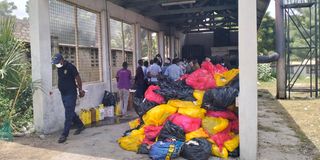
Medical waste gathered at the King Fahd hospital incineration unit ready to be burned on May 13,2026.
Hidabo, home to at least 500 people, lies just beyond the perimeter fence of King Fahd County Referral Hospital, Lamu’s main health facility. The hospital relies on its on-site incinerator to dispose of syringes, biohazard bags, dressings, and pharmaceutical waste.
However, the incineration unit appears either outdated or lacking the sophisticated scrubbers needed to fully neutralise emissions. Dark smoke visibly pours from it, drifting directly into the village, leaving residents like Fatma uncomfortable and sickened.
For years, the Hidabo community has lived in the shadow of biohazardous fumes from burning medical waste. Left at the mercy of fate, they inhale the hospital’s pollution daily, and many now suffer from breathing difficulties.
“We suffer every day because of the smoke and fumes from that hospital incinerator,” Fatma says, pointing towards the waste treatment equipment.
Recently, she was forced to wake up in the middle of the night fighting for air. Lately, her chest feels impossibly tight whenever she breathes the incinerator fumes.
“My chest also makes a whistling, wheezing sound. I went to the hospital just the other day and was diagnosed with new-onset, environment-induced asthma. I blame all these problems on the hospital’s incineration unit near us,” she says.
Dr Mercyline Ludindi, a specialist pulmonologist based in Malindi, highlights the dangers of inhaling smoke from burning items such as plastics, chemicals, and medical waste.
Dr Ludindi notes that smoke from faulty incinerators is often highly hazardous. She said repeated exposure to such environments can cause irritation and subsequent respiratory distress, ultimately leading to long-term complications.
“Continued exposure to potent irritants results in respiratory distress, which can lead to serious health issues like lung damage.”
She further explains that toxic gases produced by devices like incinerators directly attack the lining of the nose, throat, and lungs, causing swelling and inflammation.
“The persistent, chronic coughs experienced by some Hidabo residents are possibly triggered by the smoky environment created by that incinerator,” she says.
She adds that for individuals with asthma, exposure to such smoke acts as a major trigger.
“Asthmatic individuals already have a compromised respiratory system. When they inhale that smoke, the muscles around their airways become severely tightened, leading to shortness of breath,” notes Dr Ludindi.
Swaleh Babu, the Hidabo headman, says villagers have repeatedly complained about the incinerator’s placement near their homes, a location that has clearly continued to harm their way of life.
Cases of airway hyper-responsiveness and persistent coughs have become rampant in the village in recent years. Babu believes inhaling particulate matter and combustion gases from the incinerator worsens conditions like asthma, triggering chronic coughing, chest tightness, and sore throats. He notes that children, the elderly, and pregnant women are the hardest hit.
Babu says the incinerator sometimes emits dark smoke that looks like huge clouds.
"At times, the smoke isn't so visible, but exposure to the invisible fumes still triggers severe coughing fits among our people, especially the small children here," he says.
The village headman questiones whether proper guidelines were followed before the incineration unit at King Fahd was established. He demands proper medical waste management and environmental audits from public health authorities on the matter. He is also pushing for the incinerator's immediate relocation to a distant place to save the Hidabo community from impending severe health complications.
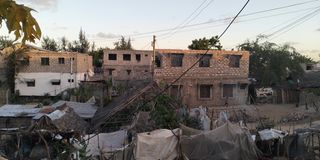
A section of Hidabo, a village bordering the Lamu King Fahd County Referral Hospital.
"We have lived with constant fear and psychological stress over the long-term impacts of toxic exposure from the incinerator on our families," Babu says.
Mariam Hamisi, a resident, notes that burning plastics and biohazardous materials at the incinerator always emits foul, acrid smoke. She says that depending on the day or nighttime wind direction, the smoke drifts directly into their residential windows, causing throat irritation and coughing fits that jolt them awake.
To avoid such inconveniences, Hidabo residents in recent years have stopped leaving their windows open for breeze despite Lamu's hot and humid tropical climate.
"As Hidabo residents, we are forced to keep our windows and doors permanently shut just to escape the heavy plumes of dark, unfiltered smoke from the hospital incinerator. It's suffocating," Hamisi says.
She adds: "The smell is always pungent and highly nauseating. At times, we are unable to cook or enjoy meals in our own homes due to loss of appetite caused by the irritating fumes."
Suleiman Yusuf, an elder, proposes that the hospital management consider burning hazardous biomedical materials at ultra-high temperatures instead of smouldering at lower levels as they currently do.
"Incomplete combustion always generates that thick, acrid grey plume we see from the incinerator. Now that it operates at lower levels, the emissions are blown directly over our homesteads whenever the winds shift. Let them raise the incinerator chimney higher to stop this," Yusuf says.
Ahmed Famau, a youth leader and community activist in Hidabo, says before the incinerator was installed, members of the public were invited to attend a forum where they were promised that safe methods would be applied. Famau questions why the promise was not fulfilled.
"They went back on their earlier promise and installed a high-emission incinerator that has now left many Hidabo residents with respiratory complications.
They used the public forum as an avenue to lie and avoid community resistance," Famau says.
He adds: "They promised to install an incinerator that would only release harmless steam. To our shock, we have been witnessing very thick black and toxic smoke from the installed incinerator. Let the government compensate the Hidabo people. They should also treat the health complications caused to the people free of charge."
Dickson Mbuthia, an environmentalist, cites the general implications of having faulty, smoky hospital incinerators in residential areas, noting that such scenarios represent a severe environmental and public health crisis. From an environmentalist's perspective, he says such facilities cause localised ecological degradation, disproportionately impact vulnerable communities, and generally undermine the shift toward sustainable healthcare.
"Having smoky incinerators is often a sign of incomplete combustion or broken filtration systems that can release toxic fumes like dioxins, furans, and mercury. Such fumes are dangerous to human health, especially for pregnant women and children.”
In severe situations, he warns that inhaling fine particulates from incinerator smoke can penetrate the lungs and bloodstream. This increases the risks of asthma, heart disease, and even cancer.
"These emissions from faulty, smoky incinerators can settle in nearby water bodies, potentially poisoning local drinking sources and crops if present," he says.
The environmentalist calls on hospitals to embrace safe, closed-loop treatment and disposal methods for medical waste and to completely phase out faulty on-site incineration units.
"Modern technologies such as autoclaving and microwaving can disinfect infectious medical waste without atmospheric burning. This prevents the release of dangerous dioxins, thus protecting both human populations and the surrounding ecosystem.”
Contacted for comment, Lamu Deputy Governor Dr Mbarak Salim, who also serves as the County Health, Sanitation and Environment Executive, acknowledged that the King Fahd County Referral Hospital incinerator had previously emitted smoke but said it was recently rectified.
"The incinerator is built to be fumeless. If it emits smoke, then it is faulty. It was rectified recently," Dr Salim said.
On the issue of relocating the incineration unit, Dr Salim said the residents came to settle in Hidabo after the hospital and the incinerator were already there, adding that they did so without following proper channels.
"We cannot move the incinerator now. Resettling those people as a county is a tall order. We do not have free land anywhere at the moment," he said.
According to Lamu elders and historians, Hidabo was once a bushy public land that was completely unoccupied. Because of the hilly and sandy nature of the area, local acrobats and beach soccer enthusiasts cleared parts of Hidabo in 2010 and established pitches for their activities. Steady population growth in
Lamu Old Town later pushed locals to migrate to Hidabo and its environs, where they established permanent settlements.