Dialysis patients forced to pay cash as SHA delays push hospitals to the brink
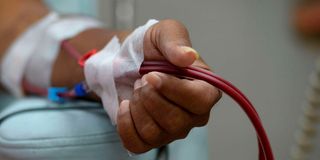
A patient undergoing dialysis.

What you need to know:
- Commenting on the issue, SHA Chairperson, Dr Abdi Mohammed, explained that charging SHA-registered patients for consumables out of pocket is illegal.
The message that would disrupt Oliver Chesula's life arrived on his phone on a Wednesday morning. It was a formal notification from a health facility in Bungoma, delivering news that would fundamentally alter his access to life-sustaining healthcare: the hospital now mandated that he pay Sh3,500 in cash for consumables for every kidney dialysis session.
Consumables include catheters, specialised bandages that protect against infection where the catheter is inserted, and sometimes special needles.
For over a year, Chesula, a medic diagnosed with kidney failure in 2022, had been attending two dialysis sessions per week. Until this message, Social Health Authority (SHA) coverage had handled the costs without requiring additional out-of-pocket payments.
With both kidneys having failed and a transplant not a viable option in the near future, these sessions are his only means of survival. The new financial requirement effectively doubles his burden as two weekly sessions now cost him Sh7,000 per week, or roughly Sh28,000 per month.
This demand is particularly controversial because patients are still required to process their insurance forms, leading to allegations that the hospital is collecting both government reimbursements and private cash payments for the same service.
Also read: SHA crisis: Hospitals threaten to stop dialysis, cancer treatment
The impact of this policy has been immediate and devastating. Chesula reports that a mass exodus has occurred at the facility as most patients simply cannot afford the weekly fee. This has forced a surge of patients toward Bungoma County Hospital, where resources are stretched to the limit.
"Bungoma County Hospital only has four dialysis machines. We now have a gruelling routine of waiting for off-peak days such as Wednesdays or Saturdays, often waiting hours for a call confirming an available machine," he says.
"The systemic failure and the high cost of consumables are quite literally costing lives. Over seven patients have died. We are caught between an unaffordable private system and an overwhelmed public one."
He adds that in some instances, kidney dialysis patients going to different facilities undergo the procedure for about three hours—one hour short of the ideal four hours—due to few machines and long queues.
Other patients have resorted to travelling to Eldoret hospitals for dialysis, a move that is costly both financially and physically.
"After dialysis, one usually feels very weak. Assuming that same person does dialysis on Mondays and Thursdays, they would travel on Sunday, get the dialysis on Monday, and probably travel back home on Tuesday. On Wednesday evening, they will be back on the road, only to return home on Friday. And the cycle continues. Some are giving up on it altogether," Chesula explains.
Joan Achieng, a kidney dialysis patient who also used to attend sessions at the same facility, says she is now forced to travel to St Mary's Mumias Hospital for services.
"I would rather spend Sh800 on fare weekly than pay Sh7,000 for dialysis consumables," she says.
At the new facility, she and other newer patients have been listed under those who do dialysis on the third session of the day, between 1pm and 5pm. The other regular patients do their sessions between 4am and 9am and between 9am and 1pm.
Achieng was diagnosed with kidney failure in 2022 after both her kidneys failed due to high blood pressure she was unaware of.
"Prior to that, I would experience frequent headaches and body swelling," she recalls.
Hospital's dilemma
The facility's director, who sought anonymity, explained that the hospital has been forced to undertake this measure as a result of a two-and-a-half-month delay of SHA remittances.
"We have served patients for about three months now, but we have not received the money since we started dialysis. A lot of the money we are still owed is pending—some of it from March last year, some from April, and other months. But for the past two and a half months or so, zero centres have been paid for dialysis," he said.
"We have to buy these consumables in cash. We buy close to seven items for each patient for every single session. And this is coming from our own resources. It is very draining, especially when they don't pay."
He added: "These are patients who are very sick. If they miss one or two sessions, they could die. So, it's a huge risk."
The director also revealed that other health facilities in the region are asking patients to purchase items like gloves, syringes, and infusion supplies from pharmacies outside the hospitals due to a cash crunch that has paralysed restocking efforts.
Dr Brian Lishenga, chairperson of the Rural and Private Hospitals Association, explained that many facilities are hesitant to reveal their situation due to possible repercussions.
He noted that if a hospital sends away a SHA patient, their contract is revoked and their portal closed. This puts hospitals in a difficult position. To avoid losing their contracts, hospitals tell patients they can offer care but lack certain supplies. If the patient can buy them, the hospital will provide the service.
This underground "cost-sharing," he observed, is likely happening with dialysis, surgeries, and other procedures requiring implants or prostheses.
"It is common knowledge in the industry that patients are incurring costs for care. This is a result of financial strain on hospitals. For instance, some facilities were owed
Sh7 million in December but were only paid between Sh25,000 and Sh51,000. Many hospitals are on their knees financially," Dr Lishenga said.
"Dialysis is a life-saving procedure required two to three times a week. Hospitals are often unable to purchase consumables because suppliers have suspended their accounts.
Hospitals are using coping strategies to manage the difficult cash flow situation. This is similar to what used to happen in government hospitals, where maternity patients were told to bring their own cotton and bandages."
Murang'a situation
While patients in Bungoma face rising costs, a different battle over medical financing has been unfolding in Murang'a.
Governor Irungu Kangata on Thursday announced that SHA owes the county Sh207 million, a significant portion of the Sh327 million initially claimed by the county government.
The governor specifically highlighted the impact of payment delays on renal care. Murang'a utilises a unique mobile dialysis service in the form of trucks that deliver renal care to facilities in Katanga and Baragua Level 4 Hospital.
Because 80 per cent of dialysis patients in the county are covered under the local medical scheme, SHA's failure to reimburse costs within the legally mandated three-month window has put immense strain on the county's partnership with service providers.
A critical component of this settlement also involves the Kangata Care programme, a specialised scheme designed to protect vulnerable households who cannot afford out-of-pocket medical expenses. Under the defunct NHIF, this programme included a "last expense" benefit of Sh100,000 for bereaved families.
"SHA has committed to releasing Sh47 million by January 14 to help the county replenish its stocks of essential medicines, reagents, and non-pharmaceutical supplies. SHA has also promised to disburse Sh11.3 million within one week to settle unpaid claims for 113 families who had been left in financial limbo," Governor Kangata announced.
Despite these systemic failures, the governor emphasised that Murang'a has maintained a "service first" policy. Unlike facilities that have begun charging patients cash for consumables, Murang'a County hospitals have continued to treat patients without denial of service.
"The burden has been on us, not on the patient. The county has been forced to divert funds from other sectors to cover the deficit left by SHA's breach of contract," he stated.
Commenting on the issue, SHA Chairperson, Dr Abdi Mohammed, explained that charging SHA-registered patients for consumables out of pocket is illegal.
"Under SHA, patients are not supposed to pay for any part of their treatment. Hospitals charging patients are in breach of their contracts and risk having those contracts revoked if found guilty," he said.
"We urge affected patients to come forward and file official complaints against specific facilities at SHA offices rather than complaining to the media."