Ebola cases: Health workers union questions system's readiness to protect them

Kenya Medical Practitioners Pharmacists Dentists Union Secretary General and CEO Dr Davji Bhimji Atellah (centre) addresses the media in nairobi on May 30, 2026.

What you need to know:
- The union is telling its members to check whether their facilities have isolation and quarantine units and PPE, and to report any gaps.
- According to the Health Ministry, about 4,000 health workers have been trained to handle Ebola. Dr Davji Atellah says that falls short.
A Kenyan fell ill in the Democratic Republic of Congo and came to Nairobi to seek care. The medics who met him did what medics do. They triaged, examined and treated him without knowing he was infected with the deadly Ebola virus.
In doing so, they became among the first people in the country to be exposed to Ebola, after his immediate family and others who received him at the airport.
According to the latest Ministry of Health data, eight Ebola cases have been recorded, including one in the past 24 hours.
Days later, the doctors’ union says the same health workers are still asking basic questions about whether the system built to protect them is ready. They say the Health authorities are not answering them.
Dr Davji Atellah, Secretary General of the Kenya Medical Practitioners, Pharmacists and Dentists Union (KMPDU), says they have no seat on the national Ebola task force. Professional associations sit on it. Unions do not. Dr Atellah said the difference matters.
Associations deal with professional ethics, regulation and welfare, he said. Unions have a legal mandate under the Constitution to negotiate and enforce workers’ rights.
The union, he said, was also not part of the inspections of isolation facilities carried out after the first case was reported at Nairobi Hospital. This means they have not been able to see where its members are working or are quarantined.
“When you sit on the task force as a union representative, your role is to speak as a worker in the hospitals. You check whether there are plans to ensure that the quality and quantity of Personal Protective Equipment (PPE) are adequate. When staff shortages or other measures come up, you ask whether there are budget plans to employ more health workers in the facilities. You look into all of that. Take medical insurance: during Covid-19, a doctor who had the virus did not have the money or insurance to access care. Is that part of the discussion on the task force? It cannot be,” said Dr Atellah.
“They must include somebody from the union in the task force. Otherwise, what will it mean? It means that we are just consuming third-party information. We are consuming the same information with the public. That’s why we are insisting that we must have somebody from the union that they’re procuring PPEs or pushing for employment. We want to know what is happening in reality, not public relations," he added.
The union’s concerns began with how contacts were handled at Nairobi Hospital. Health workers there complained that staff who had directly handled the symptomatic patient, such as triage staff and examining doctors, were in the same quarantine wing as people whose proximity was not close.
When the union took the complaint to the Ministry of Health, they said they were told everything was being handled according to World Health Organisation protocols
Under that protocol, staff with direct contact with the first patient were placed in isolation. They included nurses who did triage, the doctors who examined him and family members. Those with lesser exposure within the facility were also quarantined.
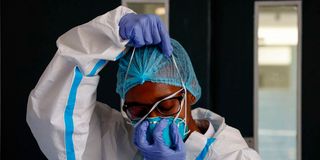
A nurse wears a protective mask at Nairobi Hospital where an Ebola patient was isolated immediately upon arrival and treated at the hospital's East Wing Isolation Facility, but later died, in Nairobi, on October 7, 2026.
“We want facts on matters of a disease like Ebola, we do not want stories. The moment you fabricate things, then somebody is going to get sick,” said Dr Atellah.
Dr Atellah said Ebola care is among the most labour-intensive work in medicine.
“A single patient in isolation can therefore need four or five health workers at once. Across a day, as many as ten may be needed on rotation. In a well-staffed setting, this could mean two specialists, three to four nurses working in the same room, and up to three support staff handling matters such as food,” he said.
Kenya, he said, is already short of health workers. He put the ratio at one doctor for every 16,000 or 17,000 people in some regions, against a WHO benchmark of one per 10,000. In some sub-counties, a single doctor or nurse serves the whole facility.
The last mass recruitment of health workers was during the Covid-19 response in 2019. The government’s agreement to employ 2,000 doctors, made during the last strike, has yet to be implemented.
“We are now in 2026, seven years later. When you’re telling us that we need to have soldiers to combat the war, those soldiers must be there. They cannot be virtual soldiers. They must be real ones,” he said
His wider demand is that protection be real rather than in words. That means quality protective equipment in sufficient quantity, isolation and quarantine units, and drugs for supportive care.
The union is telling its members to check whether their facilities have isolation and quarantine units and PPE, and to report any gaps.
Dr Atellah also said some health workers cannot access care at the hospitals where they work. Besides, county governments delay remitting to the Social Health Authority, which leaves them paying out of pocket.
“We will not allow doctors and healthcare workers to go to a mission of suicide,” he said.
He warned that shortages put workers at greater risk, because staff who stay beyond safe hours are more likely to be infected.
“The more hours you stay or get exposed, the easier it is for you to get infected,” he said. He also pointed to Liberia and the current outbreak in the Democratic Republic of Congo, where health workers were heavily exposed.
According to the Health Ministry, about 4,000 health workers have been trained to handle Ebola. Dr Atellah says that falls short.
Because the first case appeared in a private hospital, he said, training cannot be confined to the public sector.
He also called for training the country’s roughly 107,000 community health promoters. They work in villages and would be among the first to meet someone with symptoms and refer them to hospital.
The government has, however, reaffirmed its commitment to containing the outbreak through early detection, isolation and strengthened infection prevention and control, while urging Kenyans to remain calm and vigilant.
On Monday, the Health ministry announced reception of Ebola response supplies valued at Sh83.3 million from the Government of India to support health workers, treatment and isolation centres, rapid response teams and screening at points of entry and health facilities.
The donation includes 6,000 protective PPE kits, 60 powered air-purifying respirators, 30,000 N95 masks, over 86,000 sample transport kits, gowns, gloves, face shields, boots and infrared thermometers.
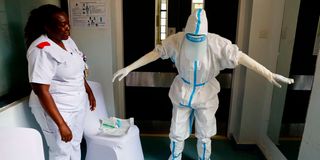
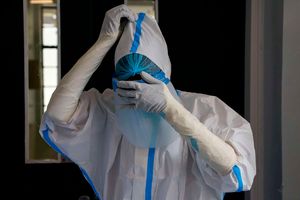
A nurse in protective gear at Nairobi Hospital where an Ebola patient from the Democratic Republic of Congo was isolated and treated shortly after arrival. The patient later died.
On October 8, the ministry also received a $1 million (about Sh129 million) cash grant from the Chinese government to support Kenya in strengthening Ebola virus disease preparedness.
Independent pathologist Dr Ahmed Kalebi raised a separate set of questions about the early cases.
He said three health workers who attended the index patient on October 3 and 4 did not enter quarantine until October 9. He asked what happened in between.
“Were they continuing to work or see patients in the intervening days? Were they under daily symptom monitoring, and did any develop symptoms before quarantine? Healthcare settings can amplify transmission if an infected worker develops symptoms while still providing care,” said Dr Kalebi.
He said it is essential to establish whether the three had any patient, colleague or household exposures after symptoms began and before they were properly isolated. He also asked whether those contacts have been traced.
He asked what gaps in early recognition, PPE availability or infection-prevention procedures allowed the exposure, and what corrective measures have since been introduced.
On the Ministry’s contact figures, Dr Kalebi asked whether the count of 130 covers only contacts of the index patient, or also people exposed to the seven later confirmed cases. He asked whether those patients had exposures between symptom onset and isolation.
The expert also said it was important to know when previously untraced contacts were located, whether they were symptom-free when found, and whether they had been getting daily checks before being found.
He raised a further concern about quarantine facilities themselves.
“What arrangements prevent exposure between quarantined contacts and protect their carers? These details would help the public understand what supports the ministry’s assessment of containment and where the remaining uncertainties lie,” he asked.
He noted that any new exposure would require an exposed person’s 21-day monitoring period to start afresh.
Follow our WhatsApp channel for breaking news updates and more stories like this.