Hospital detention: How a family lost their land and patriarch to ICU stay
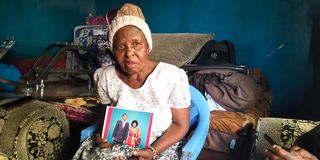
Alice Mumbua, who was detained at MegaLife Hospital in Ruai over a medical bill. She was discharged on January 9 after social media uproar.

What you need to know:
- While the Mumbua family mourns, legal experts say their suffering was exacerbated by illegal hospital policies.
When Ndinda Muoki found her mother, Alice Mumbua, gasping for air on her bed one early morning in September, she thought the battle was for her mother's breath. She did not know the real fight would be against a predatory healthcare system that would eventually claim her father's life and the family's ancestral land.
The Mumbua family's story offers a harrowing look at the "notorious" practice of hospital detention in Kenya—a cycle of debt so aggressive that it turned a medical recovery into a funeral procession.

John Muoki, the deceased husband of Alice Mumbua. John died in November 2025, while his wife was admitted in hospital.
The previous evening, Ndinda had called her father, John Muoki, to ask about her mother's welfare. He said she was fine and passed the phone to her. But Ndinda could only hear hollow breaths. Her mother made no sound. Frightened, Ndinda hung up and flooded her pillow with tears. She was kilometres away in Athi River, while her mother lived in Njiiru. When she arrived the next morning, she discovered her mother had sat in the same spot the entire night, struggling to breathe.
A week earlier, Ndinda had taken her mother to Fanaka Hospital in Athi River for a check-up after noticing her swollen feet and legs. After several tests, the doctors recommended a chest X-ray.
An hour after finding her mother in a critical condition that September morning, the three of them—Ndinda, her mother, and her father—were sitting in the doctor's room at MegaLife Hospital in Ruai.
"She was immediately placed on oxygen. X-rays showed fluid in her chest, a lung problem, and a swollen heart. The hospital said she would either be admitted or referred to another facility, but she would not be allowed to return home. She was admitted to the ward, then transferred to the ICU five days later when her condition deteriorated,"
Ndinda explains.
The nightmare deepened when doctors discovered Mumbua had suffered a stroke while in a medically induced coma. She was intubated and tethered to a ventilator. For three weeks, she remained in the ICU, with Ndinda poking her skin during each visit to confirm she was still alive. As the machines kept her heart beating, the hospital bill mounted. By the time Alice opened her eyes, the family faced a Sh1.7 million debt.
"The family had hoped the Social Health Insurance Fund would cushion the blow. Ndinda explains that while her mother was not personally registered, her father was, and his cover extended to her as a dependent.
"My father had paid Sh4,440 for the entire year's subscription. However, when we informed the hospital, they said the fund only caters for dialysis and maternity services at their facility," Ndinda says.
"That left us with no option but to dig into their own pockets."
To meet the demand, Ndinda's father made the ultimate sacrifice: he sold the family's ancestral land in Kitui.
"We surveyed the soil that was supposed to be our heritage and sold it for Sh2 million to keep the hospital at bay. The buyer deposited Sh1 million into my father's bank account, and a significant amount—about Sh800,000—was deposited directly with the hospital," Ndinda says.
"The remaining Sh1 million was to be cleared in instalments in November and December. However, that money is yet to be paid."
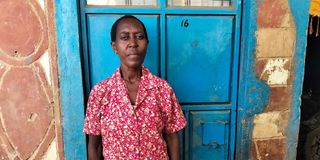
Ndinda Muoki, daughter and caregiver of Alice Mumbua.
But the land was not the only thing John lost. Under the crushing stress of the hospital's demands, the mounting debts, and the inability to run his shop at full capacity, his health began to nosedive.
"He would wake up early to go to the hospital to be with our mother, and I would relieve him in the afternoon before he came back in the evening. I did not know whether he was eating or not," Ndinda recalls.
In a tragic twist, while Alice was fighting for her life in the ICU, the man who sold everything to save her died from the sheer exhaustion of the struggle.
"One Saturday evening, I received a call from our church pastor asking me to get home as soon as possible because my father was unwell. I told him I was far away and asked him to take the necessary action. I said I would visit the next morning. By 5am on Sunday, I was standing outside his door. A neighbour and I knocked several times, but there was no response. I called my father repeatedly—he did not answer," Ndinda recalls.
Terrified, she opened his window, only to see her father seated on his chair, unresponsive.
"I knew instantly that he was dead. The neighbour who found me that morning had been sent by my mother to check on our father after he failed to answer her calls. It was as though she sensed something was wrong. We reported the matter at the police station, and officers broke down the door and took the body to the mortuary."
With her mother still admitted at the hospital, Ndinda had to devise a way to break the news gently, especially as her mother kept asking about her husband's whereabouts. Over four days, she told her that he had fallen ill, been admitted, that his condition had worsened, and that he had eventually lost the battle.
A plea for compassion
With burial plans underway, Ndinda sought the help of area Chief Genesio Anampin to facilitate her mother's temporary release so she could bury her husband. The chief wrote a letter to the hospital's director detailing the family's predicament.
In the letter, Chief Anampin explained that although Alice Mumbua had been medically discharged, her family remained unable to settle a substantial pending bill of Sh2.6 million. The bill had ballooned from the initial Sh1.7 million to Sh2.6 million as Alice's hospitalisation stretched on. He noted that the family's only viable means of payment was through the sale of their land—an effort already underway, with the buyer having deposited Sh1 million directly to the hospital's account.
However, the chief clarified that the remaining balance was withheld due to legal requirements. The buyer had stipulated that a formal succession cause must be filed in court to appoint Alice, as the next of kin, administrator of the estate before the land title could be transferred and the final funds released. This legal process remained stalled as long as Alice was confined to the hospital—she had to first preside over her husband's interment and fulfil her duties as his widow to satisfy the administrative
requirements.
With the burial scheduled for December 19, 2025, the chief emphasised the family's extreme poverty and the difficulty they faced in raising the balance without the land sale proceeds. He appealed to the hospital management to assist on humanitarian grounds, requesting Alice's release so she could join her family for the burial and subsequently finalise the legal proceedings necessary to settle the debt in full.
But the appeal fell on deaf ears.
"They read the chief's letter and gave it back to us, then said that my mother would not be allowed to travel home for the burial. We knew the bill was still high, so we asked the hospital to send one of their officials to accompany her and bring her back after the burial, but they refused. Our mother was forced to grieve her husband within the confines of the hospital and to give us blessings to bury the man she had spent over thirty years of her life with," Ndinda says.
Mumbua was eventually discharged in December but detained on the hospital premises awaiting clearance of the bill, which stood at Sh2.8 million as of Friday. She was finally
allowed to go home on Friday after the hospital waived the bill following public uproar.
However, the woman who walked out was not the one who went in. She is now physically disabled, mentally scarred, and living on the charity of her daughter and generous neighbours.
Mumbua describes a disjointed discharge process that felt rushed and unsupported. She claims she was told to "pack and go home" without receiving medical records, discharge documents, or prescriptions.
She also expresses concern over her husband's grave—one she is yet to visit but has been told sits on the very parcel of land that was sold in an attempt to purchase her freedom.
What the law says
While the Mumbua family mourns, legal experts say their suffering was exacerbated by illegal hospital policies. Margaret Nyambura, a lawyer from the Kenya Legal and Ethical
Issues Network on HIV and AIDS (KELIN), notes that detaining patients for non-payment is not just cruel—it violates the Constitution.
"The High Court has stated in numerous instances, including situations involving women or girls who have given birth, that detention of patients for non-payment of hospital fees is unconstitutional. When somebody approaches a health facility to access their right to health and then, because of non-payment, they are withheld, their freedom of movement and liberty is curtailed—that is unconstitutional," Nyambura explains.
"Instead, the High Court has advised alternative approaches, such as payment plans between the patient and the health facility. Public hospitals might take a different approach, but private hospitals are the ones mostly notorious for this practice."
Despite a 2025 legislative proposal by Senator Okong'o Mogeni to criminalise hospital detention, many private facilities continue to hold "recovered" patients hostage. Nyambura warns that these hospitals are operating on borrowed time, as courts are increasingly imposing massive damage awards for these human rights violations.
Hospital's response
In a formal response to public allegations made by the family, MegaLife Hospital issued a statement clarifying the circumstances of Mumbua's admission, treatment, and eventual discharge. The hospital firmly denies claims that she was detained due to unpaid medical bills, asserting that their primary commitment is to provide life-saving care regardless of a patient's financial standing.
The hospital stated that Mumbua was admitted on September 26, 2025, suffering from severe respiratory distress. Clinical investigations revealed a complex medical state, including acute heart failure, pulmonary thromboembolism, and complications from asthma.
Due to the severity of her condition, she required intensive care from October 2 to October 17, during which she underwent several critical procedures, including tracheostomy and PEG tube insertions. The hospital emphasises that at no point during this period was care withheld for financial reasons; rather, she was moved to a general ward only after her clinical condition improved.
Addressing the sensitive allegation that Mumbua was prevented from attending her husband's funeral, the hospital explains that this decision was rooted in both medical and familial concerns. According to the statement, Mumbua's daughter specifically requested that news of the death be withheld to protect her mother from the physical shock.
Furthermore, the medical team determined that Mumbua was not clinically stable enough to travel at that time.
Regarding the financial dispute, the hospital acknowledges receiving a payment of Sh1.1 million and notes that they remained in constant communication with the family to manage the balance. In a move to resolve the matter, the hospital has since waived the remainder of the bill in its entirety.
MegaLife Hospital concludes by reiterating its dedication to patient dignity and safety, expressing willingness to cooperate with relevant authorities to clarify the facts of the case.