How a Kenyan law is shielding hospitals from shock of donor aid cuts
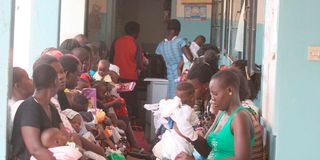
Mothers and their children at Lumumba Health Centre in Kisumu, awaiting clinic services. Even though Kenya’s maternal and neonatal care has been heavily reliant on external funding, the government has since increased domestic expenditure to protect citizens from out-of-pocket health expenses.

What you need to know:
- Kenya recorded the second largest decline in financial assistance, following South Sudan.
Sheryl Onyango struggled to get vaccines for her son on two occasions last year. When she gave birth, there were stock outs of the BCG vaccine, used to prevent tuberculosis.
She later received the vaccine after the government restocked it.
At the time, the delay was due to the Kenyan government’s failure to fulfill its financial obligation of co financing immunisation vaccines in good time.
“I was scared when my child did not get that first vaccine, but he is okay now,” she told Nation.
This year, the Health ministry announced a delay in the rotavirus vaccine, causing many children who needed it to miss out.
These challenges come a year after the United States government-imposed donor funding cuts that left some African countries flat footed.
A new report released on the sidelines of the International Maternal and Newborn Health Conference shows that since 2015, the largest share of health funding in about 10 focus countries, including Kenya, has come from donor funding and out of pocket spending by households.
The report indicates that government funding for routine immunisation has been inconsistent. Between 2019 and 2024, the 10 focus countries received an average of $1.66 billion annually in official development assistance (ODA) for maternal, newborn, and child health. However, the analysis shows that in 2025, such assistance may have decreased by nearly half (49 per cent).
Kenya recorded the second largest decline in financial assistance, following South Sudan.
“For every shilling, 66 cents go to debt servicing, leaving less than 30 cents not only for healthcare but also for other public needs like education, security and others,” said Dr Caleb Mulongo, a health financing specialist who presented the findings on behalf of PATH.
“This is particularly hard when more than half of the funding comes from sources that are not reliable and predictable,” he added.
Immunisation funds in the analysed countries dipped by about 32 per cent, explaining the series of stock-outs.
But their analysis shows that all is not lost.
As ODA from governments and international organisations continues to decline, Africa is finding new ways to bounce back and build resilient health systems.
Dr Mulongo said that even though Kenya’s maternal and neonatal care has been heavily reliant on external funding, the government has since increased domestic expenditure to protect citizens from out-of-pocket health expenses.
The analysis shows that different countries are finding new ways to fill the gap. These include allocating more money to health budgets, implementing health reforms like in Malawi, engaging philanthropic partners, as seen in South Sudan, or introducing new ‘sin taxes’ on items such as alcohol and channelling that revenue into healthcare.
In Kenya, the Facility Improvement Fund was lauded as one of the measures cushioning the country. The fund came into being in 2023 when President William Ruto enacted four health bills into law, with the Facility Improvement Fund among them. Its aim is to help hospitals retain, manage, and directly use generated revenue, giving them financial autonomy to improve service delivery and infrastructure.
Nation spoke to Dr Martin Wafula, chief executive of Mutuini Level IV Hospital in Dagoretti South, Nairobi. He said that before the law was passed, hospitals had to wait for budget approvals and the exchequer even to procure drugs.
“We just received drugs from the Kenya Medical Supplies Authority yesterday and that is because of this fund. It is the first time we are receiving drugs bought directly from the hospital,” he said.
“Because of that fund, we have built a 15-bed capacity newborn unit that takes care of neonates (children under 28 days) should they have conditions such as preterm birth or other complications. We also extended our maternity unit and added 15 more beds,” he explained.
As a result of the improvements at their facility, Dr Wafula said in the last one year and two months, they have not recorded any maternal deaths at Mutuini Level IV Hospital. In about 10 months, no newborn born at their facility has lost their life.
He added that their facility also offers telemedicine support and treats students in schools such as Lenana School without requiring them to travel to the hospital.“We bought those gadgets using the Facility Improvement Fund.”
“Before 2023, we used to rely on the money sent to us by the County Government of Nairobi. There were delayed reimbursements and so many pending bills, but this fund is helping us to reduce our pending bills,” he added.
He urged countries to continue finding new ways of financing their healthcare systems.“Any country that is independent and still depends on another country is still colonised,” he said. Dr Brian Lishenga, chairperson of the Rural and Urban Private Hospitals Association of Kenya, told Nation that the fund only works if money is being pumped into it.
“Revenue to the fund comes from multiple sources, and these sources are determined by each county’s provisions for how to raise own-source revenue from its hospitals.”
“This is to mean: it could be whatever services the county charges patients for, or SHA disbursements. If SHA disbursements are largely from the Primary Healthcare Fund; for
county level 2 and 3 facilities, then any delays in PHC disbursements directly affect that FIF kitty,” he added.
He said each county determines its own way of generating the revenue.
“For example, a county could charge Sh1,000 for all antenatal care visits. Some county hospitals have lab test charges, X-ray charges, or ultrasound charges.”