How farmers are using grafted tomato technology to boost food security
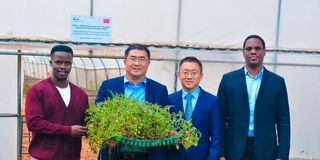
From left : Omwanda Brian, a student at Egerton University, Prof Yutao Liu, director at the Confucius Institute, Prof Feng Chungang from Nanjing Agricultural University and Steve Codjo, regional analyst for South-South and Triangular Cooperation, showing a sample of a grafted tomato that is grown inside a greenhouse at Egerton.

What you need to know:
- Through the collaboration between Egerton University and Nanjing Agricultural University, 18 demo sites have been established in Nakuru, Kisumu, Bomet, and Subukia.
- At these sites, farmers are planting and growing the grafted tomatoes, recording a six-month harvest period per planting season.
On a Thursday morning in Bomet County, Hellen Rono is already preparing her farm for a new planting season. She has just harvested a successful crop of tomatoes, a triumph that seemed impossible a year ago.
Like most farmers in the region, Hellen had long relied on rainwater. But for her commercial ambitions, it was never enough. The cold climate posed an additional challenge, leading her to invest in a greenhouse. She believed the controlled environment was the solution. However, her first attempt ended in disaster.
“I planted tomatoes inside my greenhouse, which is eight metres by 15 metres, and they started germinating and growing well, but in the middle, the tomatoes started withering one by one, just when they were about to reach the flowering stage," Hellen recalls. The withering continued until almost 10 plants were dying each day.
Instead of giving up, she reached out to agricultural officers in the region, who upon visiting her greenhouse confirmed the plants were infected with tomato wilt.
“We were told that there was no medicine. So, we were advised to irrigate the plants with a lot of water to avoid withering,” Hellen recalls.
Hellen, who depends on the Bomet County water for her domestic and farm use, says her water bill for that month was too high, with her farm record book showing she was using about 200 liters of water daily to irrigate the tomatoes.
"We did that and the whole farm inside the greenhouse remained flooded, but this did not help," she says. "By the time some plants started fruiting, the whole farm had withered. We did not have anything to harvest."
The loss prompted Hellen to research tomato wilt online, where she discovered tomato grafting, a technology from China that combats the disease. She also learned that scientists had found high temperatures inside her greenhouse were also a problem, causing flowers to drop and plants to stop producing fruit.
“When scientist supervised my greenhouse, they reported high temperatures. At the time, I could not work inside the greenhouse from as early as 10am because the temperatures used to be too high,” Hellen adds.
According to the scientists, when the temperature are high, flowers drop and plants cannot produce tomatoes.
Hellen and other farmers were trained to properly prepare their greenhouses to regulate the temperatures. She also reduced the number of tomato plants from 500 to 250. The difference was immediate.
"We planted both grafted and non-grafted tomatoes under the same greenhouse. After a month, the non-grafted tomatoes started withering, while the grafted ones started to flower one after the other," she explains. "They were not infected by the disease, while the non-grafted ones continued to wither. That is when we realised the grafted tomatoes did not have the disease."
Hellen observed continued fruiting from the grafted tomatoes, which led to a bumper harvest for the local market in Bomet. "It took 75 days for me to start harvesting grafted tomatoes. This is the same period as the non-grafted ones. However, the non-grafted ones finished faster, while I harvested the grafted ones longer," says the mother of six, adding: “My first harvest from the grafted plants was 6.8kg compared to 5.1kg from the non-grafted. The highest harvest from the grafted plants was an incredible 73.2kg, while the non-grafted yield peaked at just 8.7kg before the plants died.
Sustainable livelihood
According to Prof Yutao Liu, director of the Confucius Institute at Egerton University, using technology in farming produces positive results. The rootstalk for the grafted tomatoes is from China, while the seedling is from Kenya. This innovative approach is a result of collaboration between scientists from both countries.
Prof Liu was speaking to Climate Action during a recent China-IFAD South-South and Triangular Cooperation three-day training held at Egerton University on innovative technology from China, particularly for horticulture and tomato development.
"The graft seedling is resistant to the disease, and the normal one is not. It is sensitive to the bacterial wilt disease. This tomato is part of a result of the technology and evidence that the future of technology in agriculture is promising, especially with the partnership between the two countries," Prof Liu explained.
Through the collaboration between Egerton University and Nanjing Agricultural University, 18 demo sites have been established in Nakuru, Kisumu, Bomet, and Subukia. At these sites, farmers are planting and growing the grafted tomatoes, recording a six-month harvest period per planting season.
However, for any farmer to plant grafted tomato seeds, they must have a greenhouse. The China-IFAD South-South and Triangular Cooperation (SSTC) facility, funded by the Chinese Ministry of Finance, is the driving force behind this project. It aims to empower rural youth and farmers with innovative horticultural solutions.
"South-South cooperation is about knowledge exchange, but we did not just want experts from China to come to Kenya and then show this technology and go back," says Steve Codjo, a regional analyst for China-IFAD SSTC. "We wanted something physical that would serve a long-term capacity for the smallholder farmers."
For farmers like Hellen, that capacity has translated into food security and a sustainable livelihood, proving that innovative technology, when adapted locally, can break cycles of loss and empower rural communities.