How legal loopholes are driving donkey population to the brink of collapse
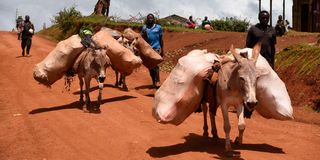
Beasts of burden: Donkeys laden with cabbages at Korng’otuny village in Chebyuk Settlement Scheme, Mt Elgon, in Bungoma County.

What you need to know:
- Despite continental bans, fragmented laws, weak penalties, and cross-border trafficking continue to fuel a devastating underground trade.
Nearly 700 donkeys are slaughtered for their skins globally every hour, the vast majority in Africa, amounting to roughly 16,000 animals daily. According to The Donkey Sanctuary’s 2025 Donkeys in Global Trade report, the annual death toll now exceeds 5.9 million.
These animals are not merely commodities; they are economic lifelines. In Ethiopia, researchers estimate donkeys contribute $2.2 billion annually, about two per cent of the country’s GDP. As drivers of rural economies across the continent, their value is especially acute for women and children. Women rely on them for water collection, farming, and transporting goods, tasks that, when eased, boost productivity, free up caregiving time, and support food security. For children, particularly girls burdened with domestic chores, the loss of a donkey can mean dropping out of school entirely, undermining education, independence, and gender equality.
With two-thirds of the world’s estimated 53 million donkeys residing in Africa, the continent has become the primary target for a sprawling underground trade. The driving force is ejiao, a traditional Chinese gelatin made from boiled donkey hides. Marketed globally as a cosmetic and health supplement for anaemia, insomnia, dizziness, and ageing, ejiao has created seemingly insatiable demand in the world’s second-largest economy, leaving behind carcasses and shattered livelihoods.
The crisis has its roots in China itself, where the domestic donkey population collapsed from 11 million in the 1990s to just six million by 2013. With an industry consuming over four million skins annually, Chinese traders turned to Africa to fill the gap. The effects were immediate: in Niger, skin exports nearly tripled between 2015 and 2016, and donkey prices quadrupled; in Mali, a Chinese company was reportedly slaughtering 300 donkeys daily.
In 2024, the African Union issued an Executive Decision on Donkey Preservation, imposing a 15-year moratorium on commercial slaughter for skins. Yet more than a year later, implementation remains an uphill battle. The moratorium is not self-executing; it requires domestication into national law, a loophole that has created trafficking corridors, moving animals from countries with bans to those with legal gaps.
Regional efforts have been piecemeal. The East African Legislative Assembly passed a motion to strengthen protections and curb cross-border trade, but the region is witnessing a dangerous game of legislative cat-and-mouse. When Tanzania banned the skin trade for 10 years in 2022 to protect its 650,000 donkeys, it simply shifted the problem: stolen donkeys are now driven across porous borders into Kenya, where they are laundered into the legal meat supply or slaughtered in the bush for export.
Kenya itself faces a legal paradox. Donkeys are treated as "livestock" rather than "wildlife," shielding offenders from the harsh penalties applied to poaching elephants or rhinos. The crisis deepened in 2012, when donkeys were gazetted as "food animals", making them commodities without adequate protections. The consequences have been devastating: the national donkey population has plummeted from 1.8 million in the 2009 census to just over half a million today. Data from the Kenya Veterinary Association shows a decline of more than 40 per cent between 2016 and 2019 alone, driven largely by ejiao demand.
A report by the Kenya Agricultural and Livestock Research Organisation in collaboration with Brooke East Africa puts a stark price tag on that collapse. Between April 2016 and December 2019, income foregone by donkey owners and users amounted to Sh28.3 billion, a figure 15 times higher than the Sh1.82 billion in gross revenues generated from exporting donkey meat and skins during the same period. The numbers expose the trade for what it is: a catastrophically bad deal for Kenya and the continent.
In 2020, the Kenyan government banned commercial donkey slaughter, leading to the closure of several abattoirs. However, a licensed facility contested the move. When the state attempted to reinforce the ban through Legal Notice 63 of 2020, the High Court quashed it in 2021, citing a violation of commercial rights. The ruling created a persistent "grey zone": official discouragement against technical legality in licensed facilities.
This loophole provides cover for the illegal bush slaughter industry. Traffickers obtain legitimate movement permits, designated for "rearing" or "domestic use", to transport thousands of stolen donkeys to unregulated sites. Compounding the problem are weak penalties under outdated laws. The Meat Control Act (Cap 356) imposes a maximum fine of just Sh10,000 for illegal slaughter or transport of uninspected meat, a negligible sum that organised syndicates treat as a routine business cost. The law also fails to recognise the donkey's socio-economic value; a single animal can support a household of six, yet its theft is treated as a minor stock offence. By the time the crime is reported, the animal is often already slaughtered, its meat quietly entering the local beef supply.
Kenya's animal welfare framework remains fragmented. The Kenya National Animal Welfare Strategy and Action Plan (2017–2022) acknowledges that over 25 pieces of governing legislation are old, disjointed, and difficult to enforce. Even key statutes, such as the Prevention of Cruelty to Animals Act (amended in 2012), fall short of World
Organisation for Animal Health (standards, leaving significant protection gaps.
Preserving Africa's donkeys is a socio-economic and moral imperative that demands collective action, political will, and effective enforcement. This requires fully domesticating the AU's moratorium, harmonising laws across borders, and strengthening regional enforcement. Governments must match commitments with action, funding veterinary services, strengthening judicial responses, and embedding animal welfare into education. Targeted reforms, including dedicated donkey protection laws, reclassifying theft and the skin trade as serious economic crimes, and digitising movement permits, are essential to bridge the gap between policy and reality. If the illicit trade continues at current levels, Africa's donkey population could shrink from an estimated 26 million to 14 million by 2040.