How the deadly Ebola virus slipped into Kenya

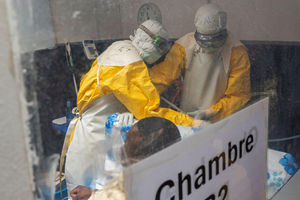
A medical officer sanitises a car believed to have picked up an Ebola patient from the Jomo Kenyatta International Airport.


Kenya’s first Ebola patient had been sick for about a month before he travelled through the Democratic Republic of Congo (DRC) and Uganda, boarded a plane and landed at Jomo Kenyatta International Airport where he was cleared by Port Health Services.
Three days later, he was dead.
The Ministry of Health says the patient went through the normal public health screening and immigration procedures. The big question now is: “How did a man who had been seriously ill for weeks pass through every checkpoint undetected?”
Does that mean that Kenya’s much-hyped screening system did not work as intended?
A Nation spot check of travellers, including one of the writers of this story who returned to the country last Monday, found no Ebola screening at the airport.
On arrival through an international gate, there was no visible Port Health Services screening, and no form requiring travellers to declare their recent travel history.
According to the Ministry of Health, the patient was a Kenyan who had lived in the DRC for seven years. He fell ill about a month ago, and was treated in several hospitals before travelling by road to Kampala in Uganda.
From Entebbe, he boarded Jambojet flight 8523, which landed in Nairobi at 1.10pm on Saturday, October 3. Yesterday, the airline’s officials said that they were working closely with the Ministry of Health and other relevant authorities to support the response to the incident.
“This includes the identification and management of the other guests and crew who may have been in contact with the individual,” Jambojet said in a statement.
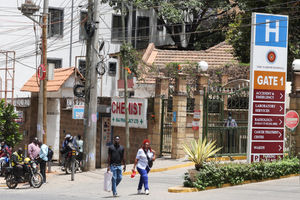
After going through the airport procedures, a relative and a friend drove the patient directly to Nairobi Hospital where he was isolated. He died late on Monday.
The Health ministry says it has been on high alert since May and that all systems are in place. Yet the first patient arrived at the country’s busiest airport while seriously ill and died in Kenya three days later.
On May 30, the government designated Gate 16 at JKIA for enhanced screening of passengers arriving from countries affected by Ebola and other outbreaks. Port Health officials were to screen travellers there, while airlines were required to alert Port Health before landing if a passenger fell ill during a flight.
In June, Health Cabinet Secretary Aden Duale told Parliament that Kenya had activated its National Ebola Incident Management System and intensified screening at airports and land border crossings.
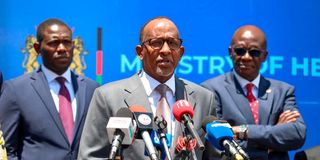
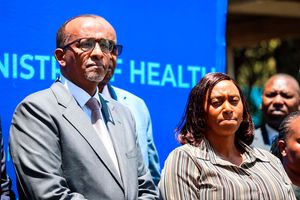
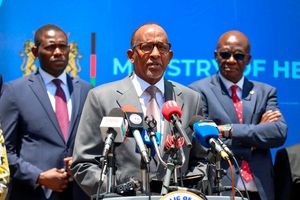
Cabinet Secretary for Health Aden Duale, accompanied by other government officials, addresses journalists during a press briefing at Afya House in Nairobi on October 6, 2026, after Kenya confirmed its first case of the Ebola virus.
The ministry says it has screened 652,584 travellers and tested 267 samples since the outbreak began. Only one test has returned positive.
It is not clear whether passengers arriving from Entebbe were routed through Gate 16. Uganda was declared Ebola-free in August, meaning travellers from that country may not have been treated as high risk. The ministry has not explained whether that affected the screening of the patient.
Prof Omu Anzala, a virologist and member of the National Task Force for Ebola, said this was not the time to apportion blame but to strengthen surveillance.
He said Kenya had prepared well but appeared to have lowered its guard.
“We had all these border points sealed, and screening was going on, but somewhere in between laxity set in and we thought the situation was under control,” he said.
Ebola-free
Prof Anzala linked the lapse to Uganda’s declaration that it was Ebola-free.
“When Uganda was declared Ebola-free, we thought the border was further away. If this person had to cross all of Uganda all the way to Kenya, they would have actually been screened somewhere in between,” he said.
Prof Anzala said the patient’s fever should have been detected at the airport, and criticised the failure to prioritise border surveillance.
He also said protests over the planned Ebola facility at Laikipia Air Base had focused attention on the wrong issue.
“We knew that Ebola would come through the border; that is what we should have emphasised. When Kenyans were protesting over the Laikipia facilities, they were aiming at the wrong thing. We should have had that centre up and running. I knew it was just a matter of time,” he said.
Prof Shem Otoi, an infectious disease modelling expert, said the patient’s condition should have raised the alarm.
“I think we allowed this disease in the country because the patient had been to several other hospitals in the DRC but had shown no improvement. If somebody was brought in on Saturday, and succumbed in the morning, that person had clear symptoms. They should not have been allowed within the borders of our country. There are Ebola management facilities in the DRC; he should have been managed there,” he said.
Prof Otoi said Uganda should also investigate how the patient travelled through the country without raising concern.
“Uganda should now be tracing the people he met on the way, including the people he travelled with on the bus to Kampala, and also the ones he interacted with on the way to the airport. By now, Uganda should be doing contact tracing for people this individual likely encountered and checking how the bus got into Kampala and then to the airport,” he said.
Prof Otoi said Kenya’s immediate responsibility was to trace the passengers and crew aboard the Jambojet flight.
“Everyone on that flight should be rounded up and quarantined for at least 21 days,” he said.
Contact tracing is now Kenya’s first line of defence against one case becoming an outbreak.
Ebola spreads through contact with the body fluids of an infected person. Prof Anzala described Ebola as an infection of contact and said the virus can also be transmitted through the skin.
“The worst bit about Ebola is that it is also secreted on the skin. So, if you shake hands and touch someone, you may be infected. That’s why they tell people not to touch a dead body,” he said.
A person can remain without symptoms for up to 21 days after exposure. Contact tracers therefore identify people who may have been exposed, isolate or quarantine them and monitor them for symptoms.
“A person can carry the virus for up to 21 days before falling ill. Tracers find everyone who was exposed, take them out of circulation, and watch them. A person already in quarantine when symptoms begin cannot pass the virus in a matatu, a market or a funeral,” Prof Anzala explained.
Health Director-General Patrick Amoth said the ministry had identified 28 contacts, including family members and health workers who attended to the patient.
The Ministry of Health is also pursuing 23 other passengers and four crew members who were on the Jambojet flight. The contacts are being held at the National Police Service Referral Hospital.
Prof Anzala said the list of primary contacts should extend beyond family members and health workers to include the passenger who sat next to the patient, anyone who attended to him at immigration, people who handled his luggage, the driver who picked him up and health workers who treated him.
He said some people who had direct contact with the patient could become infected, making quarantine and monitoring essential.
“The facility he went to should undergo massive sterilisation,” he said.
Prof Otoi said suspected contacts should be isolated in facilities where they can be safely tested and monitored.
Testing positive
“You have to isolate them in a place where you can test them, wear personal protective equipment to go and get a blood sample and leave. Because you can’t take anything for granted,” he said.
Prof Otoi said contacts could only be cleared after completing the 21-day monitoring period without developing symptoms or testing positive.
“During testing, you will also look for fever and monitor all the other clinical symptoms,” he said.
Being identified as a contact does not mean a person has Ebola.
An EbolaMap explainer says teams during the 2018-2020 outbreak in eastern DRC monitored about 130,000 contacts, of whom 3,481 became confirmed cases — roughly 2.7 per cent.

Gravesite of Kenya’s first Ebola patient, who travelled from the Democratic Republic of Congo through Uganda before arriving at Jomo Kenyatta International Airport in Nairobi.
But Prof Otoi said the speed of contact tracing was more important than simply reaching a high percentage of contacts.
“Finding 80 per cent of contacts within two days does better than finding 95 per cent in five,” he said.
He said Ebola’s reproduction number of about two to three meant that each infected person could infect two or three others. One missed contact could therefore start a new chain of transmission.
“Contact tracing must begin. For all the 23 passengers who were in the plane, the person who picked him up at the airport, the people he met later, the travellers on the bus, let their records be available. They should be traced, tested, and isolated wherever they are,” Prof Otoi said.
He urged Kenyans contacted by health officials to cooperate with the tracing exercise.
“For Kenyans, this means, if tracers call you, you have not been diagnosed. You may have been near someone who was sick. Cooperate, even if it costs you 21 days of income, because people who hide their exposure are how outbreaks grow,” he said.
Prof Otoi called for an immediate review of surveillance at ports of entry and renewed training and simulation exercises for health workers.
He also urged the government to improve public communication so that people understand how Ebola spreads and what they should do if they are contacted by health officials.
“People must be told what to do, how to protect themselves from any infection. And this should be done in both national TV stations and local media to the people,” he said.
But he cautioned against allowing the first confirmed case to trigger public panic.
“One thing we must never do is let panic set in. Communication must be concise and clear to avoid confusion and mass panic,” Prof Otoi said.
Follow our WhatsApp channel for breaking news updates and more stories like this.