Kemri and Israeli scientists pioneer natural solution to snail invasion devastating Mwea farmers

Roseline Njeri, 48, a farmer at Mwea Irrigation Scheme, where golden apple snails have invaded farms, during the interview on September 15, 2025. Kemri and Israeli scientists are piloting a biocontrol method using freshwater prawns that will eat the snails and also reduce bilharzia in the rice paddies.

What you need to know:
- The idea is to tackle two issues with one solution. The researchers will be using freshwater prawns that will naturally feed on the snails and, at the same time, help in reducing bilharzia cases in the scheme.
Roseline Njeri, 48, kneels deep in the muddy water of her rice paddy at Mwea Irrigation Scheme in Kirinyaga County, a place she has farmed for 23 years.
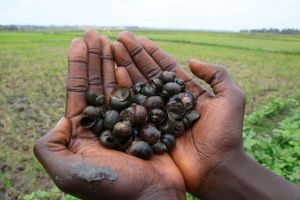
We find her manually removing weeds from her section of the paddies. She has no farm gear, and this is not her biggest worry. We notice that she is picking up something else –golden apple snails, an invasive species that is affecting rice farmers’ public health and their production. The snails derange her.
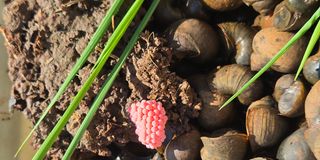
Golden Apple snails (in black) with a sample of a freshwater prawn (in pink) that devours on the snails invading Mwea Irrigation Scheme.
“We started seeing these snails in 2020 and they’ve been a menace here. The moment you plant, they’re always ready to devour,” she tells Nation.
Her section of the paddy is not as dense as her neighbours’. She says all the spaces in between were once rice saplings. She has tried to control this invasion on her own, but the snails seem to outsmart her.
“We use chemicals (duduz) to finish them, but there are just too many,” she says.
When the chemicals fail, Rosemary picks the snails manually using her hands and places them in a basin to dispose of them far away from the rice fields. In the process, she gets hurt since the snails’ shells are sharp. She shows us an old wound on one of her fingers, one which she says took forever to heal, slowing down her farm work.
“I used to harvest eight bags for this section alone, which is about 100 kilogrammes, but now I manage about six bags. I may get only five from this harvest,” she says.
Bernard Maina, another farmer and mobiliser at the Scheme, says this invasion affects everyone in their community, even those that are not actively farming.
He notes that the chemicals they use to try and control the snails ends up in their rivers.
“People drink that water, and we don’t know what effect that has on their health,” he worries.
They appear black from a distance, but a closer look at the golden apple snails reveals a rustic golden sheen. They are soaked in mud and appear harmless. Five years ago, these species found their way to the rice farms and have since become pervasive in most parts of the scheme. Mwea is Kenya’s largest rice irrigation scheme, with about 30,000 acres under paddy rice production.
A study published in the journal CABI Agriculture and BioScience in 2024 found that about 80 per cent of the scheme has been infested with the snails.
“There were no adult or egg masses recorded in any of the other irrigation schemes,” the researchers say.
The study reveals that since it is a new pest in Kenya and Africa, its management has mainly relied on cultural and physical approaches, and, in desperation, a trial-and-error approach with chemical practices.
“Although no adult P. canaliculata (the golden apple snails) or their eggs were found in the Ahero, Bura, Hola or West Kano schemes, the extensive material transfer, including the aromatic Basmati rice seedlings and farm machinery (especially the combine harvesters and rotavators) from Mwea (an infested area), could facilitate the spread into these areas,” they warn.
Save farmers
To try and curb any further damage, scientists from the Kenya Medical Research Institute (Kemri) in collaboration with scientists from Israel’s Ministry of Agriculture are piloting a project that could potentially save farmers from this invasion.
Dr Geoffrey Maina, a principal lab analyst at Kemri, tells Nation that these species are originally from South America, but no one really knows how they found their way to Mwea.
Apart from feeding on the rice seedlings at the scheme, he explains that the snails are intermediate hosts for the rat lungworm, which causes a brain infection scientifically known as eosinophilic meningitis.
“They are easy to find, especially along the canals of the paddies. They are seasonal, and their peak time is usually during onset of the long rains in Kenya,” he explains.
He says the snails are more aggressive when the rice is at the seedling stage.
Prof Amir Sagi from the Ben Gurion University, who is the lead scientist of the project, says it is the first time in the world that they are exploring a biocontrol project (using natural means of control) in a rice field.
He explains that their idea is to tackle two issues with one solution. They will be using freshwater prawns that will naturally feed on the snails and, at the same time, help in reducing bilharzia cases in the scheme.
He says that while this is a first time in a rice irrigation scheme, a similar project helped in tackling diseases in fish ponds where prawns managed to reduce the snails and prevalence in disease.
“We are looking for two sites: one for bilharzia and another for golden apple snails. We are trying to find an appropriate location for a prawn hatchery that we will test on a small scale level,” he says.
Dr Amit Savaya explains that they will use the prawns because they are voracious predators of freshwater snails.
“They can eat dozens of them in a few minutes,” he says.
He explains that bilharzia, caused by small microscopic worms that cannot be seen by human eyes, lives inside a snail so, when the prawns eat the snails, they will have partly solved the public health issue.
They specifically use monosex freshwater pawns populations in order to reduce any future implications.
“This technique does not involve genetically modified organisms (GMO). They are safe for human consumption and the environment. We use female prawns only because they are
less aggressive than males,” he explains.
“You can use them in high numbers and they will remain an effective biocontrol agent,” he adds.
He says local production of the prawns will yield better results than importing them.
Dr Ibrahim Mwangi, a microbiologist from Kemri, tells Nation that while over the years they have tried to manage bilharzia (schistosomiasis) using mass drug administration, the new proposal will help in tackling the disease at source.
“Bilharzia is transmitted between a human and a vector snail host. The common meeting point is the freshwaters. People get infected when interacting with the waters,” he says.
He says that even though there is an existing drug called praziquantel, which is given as a one-off dose, the rates of re-infection are quite high because of high transmission rates.
“The use of prawns and existing drugs will complement one another,” says Dr Mwangi.
“We are seeking collaboration from local aquaculture farmers so that we can rear these prawns here in Kenya.”
The scientists hope that if successful, they will integrate prawn biocontrol into the country’s agricultural and public health strategies.