On a hot afternoon in February 2020, a group of people who claimed to be scientists gathered farmers at Tebere in the Mwea Irrigation Scheme, Kirinyaga County. They said they were introducing a new tool to help control weeds.
According to Mr Andrew Wagura, a farmers’ leader at the scheme, the group released a bucketful of golden apple snail eggs into the canal and told farmers to expect results on their farms within weeks.
They assured the farmers that apart from feeding on weeds, the snails could also be harvested for the manufacture of animal feeds.
Five years later, what was presented to the rice farmers as a solution to weeds has now become a nightmare. The snails have turned into a destructive force, threatening the scheme that produces 80 per cent of Kenya’s rice.
The worst-hit areas include Kimbimbi, Mathanguuta, Mutithi, Kiandegwa, Murubara, Karaba, Mutitu, Nguka, Kiorugari and Thiba.
Farmers now fear that the introduction of the snails may have been and want the government to clarify what transpired.
“We don’t know what the intention was because nobody consulted us before the snails were introduced. We even suspect rice import cartels may have been behind it to disrupt local production and protect imports,” said Mr Wagura at Tebere.
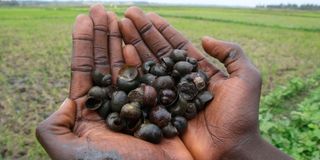
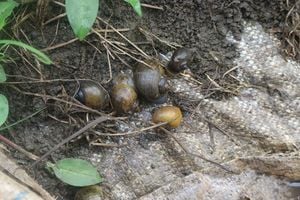
A farmer displays golden apple snail eggs collected from a rice farm in Wang’uru, Mwea Irrigation Scheme, Kirinyaga County, on August 14, 2025.
Photo credit: Joseph Kanyi | Nation Media Group
“There were no tests or feasibility studies to confirm whether the snails would only feed on weeds. How were they expected to avoid rice? We were shocked when they began feeding on rice seedlings instead,” he added.
The destruction begins as soon as farmers transplant seedlings as millions of snails descend on them, wiping them out.
“We are forced to replant, incurring huge costs. At the moment, we drain our farms for the first three weeks after transplanting since the snails cannot survive on dry land. But this also encourages weeds and insect pests,” said Mr Anthony Muriuki, a farmer.
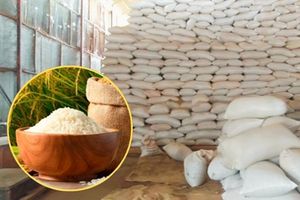
He added that hiring labour for weeding further raises production costs, making local rice less competitive against cheap imports.
A government-supplied biograde chemical introduced last October and said to be effective against the pests, has also failed. Farmers say the snails have developed resistance and continue wreaking havoc.
The snails, now spread across the 30,600-acre scheme, are among the world’s most invasive pests. Farmers say they can wipe out an acre of rice in just 24 hours and consume between 30 and 40 per cent of the crop each season.
A farmer tills a rice paddy at Mwea Irrigation Scheme as egrets flock behind the tractor, feeding on insects and snails unearthed from the wet soil on August 13, 2025.
Photo credit: Joseph Kanyi | Nation Media Group
The scale of the crisis has forced the National Irrigation Authority (NIA), the Kenya Plant Health Inspectorate Service (KEPHIS), the Kenya Agricultural and Livestock Research Organisation (KALRO) and the Kirinyaga County government to collaborate on finding a lasting solution.
Scheme manager Dennis Okinyi said farmers have been advised to use preventive measures rather than chemicals.
“At the moment, we are not using chemicals. Farmers have been asked to keep drying their farms after transplanting because the pests cannot survive on dry land. Once the rice matures, the snails do not eat it,” he said.
He added that the government had engaged private firms to research and manufacture suitable chemicals, but gave no timeline for when a solution would be ready.
Agricultural scientists warn that if unchecked, the snails can destroy an acre of rice within a week.
Dr Paul Kinoti, a research scientist, said the golden apple snail is invasive and destructive but can be managed.
“We conducted research using plant extracts toxic to the snails. These extracts suppress their appetite until they die. The solution is organic, safe for aquatic life and the environment, but it has not yet been introduced to farmers,” he said.
A farmer displays a can of pesticides from a golden apple snail-infested farm in Wang’uru, Mwea Irrigation Scheme, Kirinyaga County, on August 14, 2025.
Photo credit: Joseph Kanyi | Nation Media Group
The dead snails, he added, could be collected and processed into livestock feed.
Another scientist, who requested anonymity due to the sensitivity of the matter, confirmed the pests were introduced without proper consultation.
“At the time, farmers were told the snails would control weeds and could also be used as animal feed. But after the experiment failed, no one has taken responsibility,” the scientist said.
Meanwhile, farmers continue to struggle and remain suspicious.
“We believe the snails were introduced deliberately to sabotage the scheme and pave the way for cheap rice imports,” claimed Mr Dominic Kinyua, a farmer at Tebere.