Kenya calls for plastics pollution deal as global talks grind on
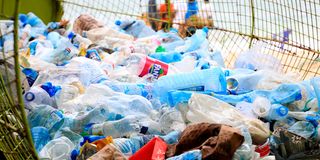
A plastic recycling point at the Nyali Public Beach in Mombasa.

Outside the main Assembly Hall at the Palais des Nations in Geneva where negotiations of a possible global treaty to end plastic pollution is taking place, civil society organisations staged a silent protest on Saturday morning.
Their A4 size placards sent a message to the negotiators who walked into the hall for a first stock take on the process so far.
“Keep your Promise. Fix the Process. End Plastic Pollution,” the placards read.
The first week of plastic treaty negotiations is over, and it feels like reading the first chapter of a long, complicated book.
Negotiators, like dedicated students, have been carefully sounding out the words, understanding the characters, grasping the basic plot and ensuring that they note down the themes that they find important.
Despite them being familiar with the text, it feels like they are reading it for the first time and in a new language. In the rooms, known as contact groups, every delegate’s view is taken seriously and is recorded.
Observers, however, are like younger readers. They are not allowed to make any comment, but to listen to their ‘seniors’. They are looking forward to the close of the chapter, but they are not happy with the back-and-forth that is delaying the process.
Plastic pollution
On the floor of the plenary Saturday afternoon, Ababu Namwamba, Kenya's Permanent Representative to the United Nations Environment Programme (UNEP) and the United Nations Office at Nairobi (UNON), expressed the need to hasten the process since time is running out.
“We are no closer to getting an agreement. We are still very far. Plastic pollution is not waiting,” he said.
“We take note that some progress has been made on some articles. We must, at the bare minimum, agree on the essential elements that will constitute an all-inclusive, ambitious, effective and implementable treaty,” he added.
Kenya has been drumming support to host the Secretariat of the Plastics Treaty at the United Nations Environment Programme in Nairobi.
Mr Namwamba on Saturday noted that Kenya’s request to host the secretariat had not been captured in the assembled text dated August 8, 2025.
“We request the Chair to reintroduce the inputs already uploaded for further iteration,” he said.
Sunday Nation spoke to Dr Ayub Macharia, National Environment Management Authority (Nema) director of enforcement who is the technical lead negotiator representing Kenya in Geneva who offered hope in the outcome of the process.
“Things are good. We don’t have a lot of hostility so far. When the chair gave the audience to member states on Tuesday during the opening plenary, you could see goodwill,” he said.
He said that it could have even been tougher because there was a divide on whether a final decision should be made by consensus or voting.
As of Saturday, this decision was still obscure.
“This is just the beginning. A time is coming when we have to clean the text. That is when we shall know now what members are not willing to compromise on,” he said.
Kenya, which is part of the Africa Group of Negotiators, has been on the journey to end plastic pollution for some time now.
In 2007, the country proposed the introduction of a 120 per cent levy on plastics to help in reducing pollution. The proposal didn’t quite achieve its goal. 10 years later, the government introduced a ban on single use plastics such as polythene bags, which again took time to be effective because of the porous borders that reintroduced the bags in the market.
As of last year, Nema data shows an 85 per cent compliance to the ban of single use plastics in the country.
In June 2020, this ban was extended to protected areas including national parks, forests, and beaches.
“We are here because we want to have a level playing field, so that we can work together to reduce illegal movement of plastics across the borders,” said Dr Macharia.
He further explained that the complexity of plastic demands global regulation. In Kenya for instance, he explained that the plastic in the country exists but no one really knows what chemicals were used to make them.
“These are toxins, they are poisonous products, poisonous waste,” he said.
In one of the articles that negotiators have in the past week been discussing, is the place of existing plastic – like the ones currently dumped on our landfills.
Kenya is also backing the need for having recyclable plastics but looking at it from a full life cycle approach.
Raw materials
“If you look at the issues of recyclability, it has several components. It could be the type of product, its design and also the raw materials used to make the plastic,” explained Dr Macharia.
Henry Msuya, a Mechanical Engineer from the Tanzania Bureau of Standards who is also a negotiator, told Sunday Nation that as of Friday last week, there were differences on issues like definitions of the full life cycle approach on plastics.
“Some countries say that it starts from the extraction of the oil to the use of plastics, while others say that it starts from the production of plastics,” he said.
“We are still negotiating on issues like product design, chemicals of concern and the financing mechanism,” he said.
Bjorn Beeler, Executive Director and Founder of International Pollutants Elimination Network (IPEN) told Sunday Nation that the first four days generated a lot of frustration.
“It’s a marathon. Each day is like running around the track and we have observed that countries were just putting more ideas back into the treaty,” he said.
Beeler worries that the exclusion of observers in Geneva especially during informal meetings only benefits countries with larger delegations.
“It is better that they give us something that is thin to be built on, than compromising a future with a meaningless agreement,” he said.
Next week, the ministers will be in Geneva, taking a cue from delegations but with the same stance on their interests.