Kenya is Africa's biggest importer of second-hand clothes. These students are upcycling the waste

Margaret Kaikai works on a garment at Kenyatta University on August 4, 2026. The fashion student is part of a project which promotes environmental stewardship in fashion design.

What you need to know:
- A 2022 United Nations report blames unsustainable patterns of consumption and production for climate change, biodiversity loss, and pollution.
Inside an unassuming hall at Kenyatta University, the occasional chatter of youthful fashion designers sitting behind electric sewing machines pierces the quiet atmosphere. These budding designers sit at the cusp of a revolution in the fashion and textile industries.
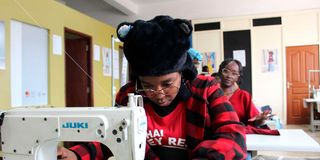
Ivy Rutinu works on a garment as Hannah Munini (background) looks on at Kenyatta University on August 4, 2026. The fashion design students are part of a project which promotes environmental stewardship in fashion design.
"We prolong the lives of used garments by giving them a second life," Margaret Kaikai told Healthy Nation. The fourth-year fashion design and marketing student is part of a team that adds value to used clothes through upcycling. They convert second-hand garments into valuable products such as bags, curtains, dresses, shirts, and trenchcoats by applying the design skills they have acquired.
A two-piece bag and African-themed dresses are among the finished products on display in a corner of the workshop. The work begins beyond the university campus: Kenyatta University acquires assorted used clothes from African Collect Textiles, a Nairobi-based company that champions upcycling. The company has set up collection points for used garments in several residential areas of the capital.

Malika Namiba displays a garment at Kenyatta University on August 4, 2026.
The upcycling project, dubbed the Nairobi Circular Design Hub, is undertaken jointly by Kenyatta University and the Estonian Academy of Arts. It is funded by the Estonian Centre for International Development, which promotes sustainable ventures. Beyond supporting designer training and knowledge exchange, the project encourages the reuse of textile waste while fostering sustainable innovation.
The initiative comes at a time when the country is grappling with a garment waste challenge. Although Kenya has been trying to revive its struggling textile industry, it continues to import second-hand clothes. A recent study by the US-based Massachusetts Institute of Technology shows that Kenya is the biggest importer of second-hand clothes in Africa. The 2023 study indicates that Kenya has overtaken Nigeria, whose economy is four times larger, in importing used garments. While this trade creates huge business opportunities, it has also given the country the dubious distinction of being an easy dumping ground for second-hand clothing.
"Waste from second-hand clothes and the textile industry either ends up in landfills or is incinerated, contributing to greenhouse gas emissions as well as soil and water pollution," said Jacqueline Kisato, a Kenyatta University lecturer who is at the centre of the Nairobi Circular Hub project.
A 2022 United Nations report blames unsustainable patterns of consumption and production for climate change, biodiversity loss, and pollution.
To address the environmental menace posed by the fashion and textile industries, scholars and industry players are betting big on a mindset shift and the upcycling of used clothes. "The traditional linear model of the fashion, textile and apparel industries is not sustainable. It produces a lot of waste. We have to embrace the circular model, which emphasises upcycling and recycling. It exerts less pressure on the environment," said Dr Kisato.
At the centre of the anticipated mindset change is training budding fashion designers in environmentally friendly business models.
"To reduce the amount of fabric waste that ends up in landfills, fashion designers and consumers of textiles play critical roles. We should design with the end in mind, so that we create garments that will last long and can be reused. Fashion designers should move away from fast fashion and focus on designing long-lasting clothes," Kaikai said. Dr Kisato concurred.
Beyond upcycling, Paula Kigarriff, a lecturer at the Technical University of Dublin who is involved in the Nairobi Circular Hub project, champions technology as key to making the fashion industry more environmentally friendly. "We need supply chains that respond to market pressures such as pricing, and market demands such as climate change.
Technology can actually help us to build circular textile supply chains," she told Healthy Nation. She cited a new policy that requires all garments entering the lucrative European Union market by 2028 to have a digital product passport. "A digital product passport is a QR code scanned onto a garment. It carries 45 different data sets, which include the material that has gone into the garment, its environmental footprint, and the available opportunities for reuse. Kenyan fashion designers should take advantage of this shift in the consumption of clothes in the European Union," she added.
Interviews with fashion and marketing students in the Nairobi Circular Design Hub project reveal that they have learned to intercept a linear waste stream and bend it into a circle for sustainability. Students involved in the two-year project blame consumerism for the environmental pollution associated with the fashion and textile industry, and they call on designers to be responsible.
"Visiting the Dandora dumping site in Nairobi reveals that the culture of wearing a garment once and throwing it away contributes immensely to environmental pollution. It is about time that we learn to slow down when it comes to how much we are consuming. We should buy products that last long," said Hannah Munini, a fourth-year fashion design student at Kenyatta University.
[email protected]