Kenya shines with bold pitch for clean energy investment at global summit
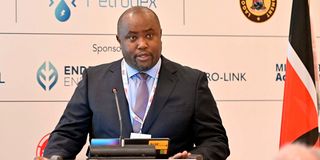
Energy PS Alex Wachira addresses the 11th Powering Africa Summit in Washington DC on March 19, 2026.

What you need to know:
- Kenya positions itself as reliable clean energy hub with investor-friendly policies and strong infrastructure.
- Geothermal dominance and digital innovation make Kenya attractive destination for global energy investments.
The 11th Powering Africa Summit held in Washington, DC, on March 19 and 20, served as a high-stakes meeting ground for US investors and African energy leaders. While the event celebrated a decade of bilateral cooperation, Kenya took the spotlight for its readiness for investment, especially in energy.
Kenya arrived not just with a plea for partnership, but with a data-backed portfolio showing it is already a clean energy heavyweight, currently generating about 90 per cent of its electricity from renewable sources.
Global companies and financiers heard that Kenya has moved past the potential phase and is now a plug-and-play platform for green industrialisation. The summit highlighted a shift in how the country presents itself to the world. In addition to wind and solar, it is selling a sophisticated, unbundled energy market designed to protect private profits.
By splitting its energy sector into four distinct areas—generation, transmission, distribution, and independent regulation—Kenya has removed the middleman risk that often plagues emerging markets.
This structure allows private companies to build power plants and sell electricity through bankable power purchase agreements and cost-reflective tariffs that international banks trust. This structural transparency was a key selling point for the high-level delegation present, which included the leadership of Kenya Power, KenGen, and the Geothermal Development Company.
At the heart of this results-oriented pitch is Kenya’s geothermal goldmine. Ranked first in Africa and sixth globally, the country sits on an estimated 10,000MW of steam power buried beneath the Rift Valley. Energy Principal Secretary Alex Wachira noted during his keynote address that this renewable base provides a stable, fast-growing platform, backed by the government's commitment to clean energy expansion and electrification.
This stability is reinforced by the fact that roughly one-third of Kenya's installed capacity is already managed by independent power producers, such as the American firm Ormat, which operates a 150MW plant at Olkaria.
Other private investors have successfully scaled wind and solar projects, including the 300MW Lake Turkana Wind Power project in Marsabit, currently the largest singular wind farm in Eastern Africa.
To ensure these investments remain secure over decades, Kenya has implemented a rigorous planning framework known as the Least Cost Power Development Plan, managed by a multisectoral technical committee that reviews the nation’s energy needs on a short-term (two-year), mid-term (five-year), and long-term (20-year) basis. This level of institutional predictability is rare in emerging markets and ensures that new power plants are built only when demand is guaranteed.
Wachira explained that the government has established “Integrated National Energy Planning, which is multisectoral and covers all the aspects of energy planning at the national and county level” to maintain this balance. This planning is further protected by a commitment to continuous policy updates, such as the recently reviewed Energy Policy (2025–34), which was designed to encourage more competitive private-sector participation.
Beyond planning, Kenya is using home-grown technology to solve the collection risk that often scares away foreign capital. By integrating the global game-changing mobile money platform M-Pesa into the national grid, Kenya has enabled real-time, automated billing and collections. This digital shift has been led by Kenya Power, the country’s main distributor, which has migrated all electricity applications and outage reporting to an online system.
According to the PS, this innovation enables real-time automated billing and collections, significantly reducing the risk of non-payment for investors. This system has set a regional benchmark for efficiency, with global private companies and neighbouring countries now visiting Kenya to learn how to replicate the model.
The modernisation of the grid is moving even further with the implementation of smart metering. While all large industrial customers are already on smart meters, the government is rolling out the technology to small and medium enterprises nationwide. These meters allow the utility to remotely disconnect service for non-payment and instantly reconnect it when a payment is made via mobile phone, eliminating the need for expensive manual labour.
This technological moat makes Kenyan energy projects look less like traditional utilities and more like reliable digital services. The opportunities for US tech firms are abundant here, particularly in providing cleantech hardware, Internet of Things energy devices, and decentralised energy systems to support these vibrant downstream markets.
For industrial investors, the most significant news from the summit involved Kenya’s diversification into nuclear power to provide a steady baseload for heavy manufacturing. The government is moving forward with the 123 Agreement with the United States, a legal framework that allows Kenya to access advanced American nuclear technology and fuel. Kenya is building a grid that is both green and capable of running heavy factories 24/7.
PS Wachira stated that the government remains “keen on promoting e-mobility initiatives, green industrialisation and special economic zones” such as Dongo Kundu, which will offer specialised tariffs to manufacturers that utilise these renewable resources.
The financial side of these opportunities is also becoming more sophisticated. Kenya is moving towards energy auctions to ensure the market gets the best technical capacity at the lowest possible price.
To manage the perceived risks, the country uses blended finance, a mix of government support and private capital, and innovative tools like sustainability-linked bonds. One such tool is the liquidity support facility provided through the African Trade & Investment Development Insurance, which manages project costs and reduces the government's direct liability.