Kenya to seek US permission to use Laikipia Ebola isolation facility
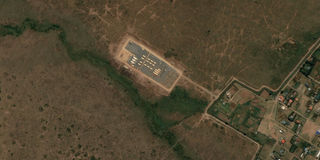
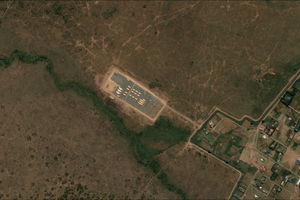
A satellite image shows tents erected at the US-backed Ebola quarantine facility at Laikipia Air Base in Laikipia County, Kenya, on June 22, 2026.

What you need to know:
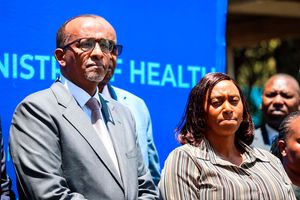
- On Wednesday, Health Cabinet Secretary Aden Duale declined to say whether Kenya will need to use the facility, saying "the matter is in court."
The Kenyan government will have to seek permission from the Americans before using the Laikipia facility to isolate or treat any Kenyans, it has emerged.
The US government confirmed in a statement to the Nation that no request had been made for the facility to be used for any patient, and that there are currently no patients in it.
A day after Kenya confirmed its first Ebola death, the US declared it was ready to support the response as needed.
In the statement, a US State Department spokesman revealed that since the outbreak began, the country has poured in a staggering $887 million (about Sh115.17 billion) in direct health and humanitarian assistance to combat the deadly virus. That includes over $10 million (about Sh1.29 billion) in fresh, direct support to Kenya's efforts to detect Ebola and prevent its spread.
"The US is aware of reports of a Kenyan citizen who died of Ebola in Nairobi after apparently travelling there from the Democratic Republic of the Congo.
The Kenyan government quickly responded and is conducting contact tracing on more than 50 individuals. The US remains in close coordination with the Government of Kenya, which has been an effective partner on health-related issues, on how to best respond to this threat and protect US citizens," said the spokesman.
"The US stands ready to support the response in Kenya as needed. It has partnered with Kenya for decades to help build capacity to jointly combat epidemics," he added.
The statement comes amid growing concern over whether Kenya will be able to use the US-backed Laikipia bio-isolation facility and the services of US physicians if the situation escalates and contacts overwhelm the country's isolation centres.
The spokesman said the "bio-isolation facility in Laikipia is part of the US government's holistic response to prevent the spread of the disease and lessen health risks for the region as a whole."
"The Kenyan citizen with Ebola did not use the facility, nor did we receive any requests for the facility to be used for this patient. There are not currently any patients in the facility," he said.
On Wednesday, Health Cabinet Secretary Aden Duale declined to say whether Kenya will need to use the facility, saying "the matter is in court."
"On October 6, Kenya reported its first confirmed imported case of Ebola virus disease. I will emphasise that there is no Ebola outbreak in Kenya. What we have is an imported Ebola incident in Kenya, and we can account for the pathway journey of that patient from Buri to Kisangani to Beni, to Kinshasa to Kampala to Nairobi, and finally to Nairobi Hospital," said CS Duale during a tour of the isolation facility at the Nairobi Hospital's eastern wing.
Duale also addressed the question of why confirmation took about two days after doctors at the Nairobi Hospital noticed the symptoms. A blood sample first had to be sent to the National Virology Laboratory, then to the Kemri laboratories for confirmation, and was then counter-checked with the Africa Centres for Disease Control (Africa CDC) to get the most accurate test results.
"By Sunday, we had the confirmation from all labs that the results of the samples from the patient were all positive. International regulations give countries 24 hours to report to the World Health Organization (WHO), and Kenya did so on Tuesday before the press conference," said CS Duale.
According to Duale, 57 contacts have now been accounted for and placed under quarantine, up from the initial 55 identified on Tuesday. Ten of them are undergoing daily symptom monitoring at the National Police Service Hospital in Nairobi, and efforts to trace the remaining contacts have been intensified.
"The airline that the patient used had 23 passengers and four crew members. Those are 27. They have been contacted, and they should be in a facility by the end of Wednesday or Thursday. We have the names, we have the manifest, and we have the contacts. A multi-agency team of government under the guidance of the Kenya National Public Health Institute is working on that," said the CS.
He said the list of contacts is likely to keep rising as efforts intensify.
"The list of contacts will not close. After that flight, how many other flights did that same aircraft make locally or outside? Jambo Jet is giving us that information. Even the people who cleaned the aircraft after it landed on Saturday and immigration and customs officials who served that patient will also be part of the contact tracing. So, the contact tracing number will keep on increasing," said CS Duale.
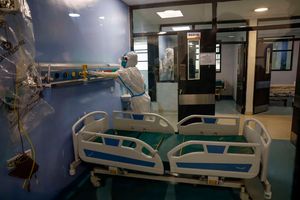
"We have designated five health facilities to manage Ebola, including Kenyatta National Hospital (KNH) with eight beds; Moi Teaching and Referral Hospital with 50 beds; National Police Hospital with 49 beds; Portreitz Hospital in Mombasa with four beds; and The Nairobi Hospital with 133 beds, of which close to 45 are High Dependency Unit and Intensive Care Unit beds," said CS Duale.
"The capacity in all these hospitals will increase as we are making sure that public, private and faith-based facilities increase their capacity in the event the situation evolves. In addition, five facilities, namely Malaba Health Centre, Busia Border and Kocholia, have been designated as temporary isolation centres for suspected cases. Alupe Sub District Hospital in Busia County is undergoing renovations to manage Ebola virus disease," added CS Duale.
The government has intensified screening of travellers from the Ebola epicentre at Gate 16 of the Jomo Kenyatta International Airport (JKIA) and at all points of entry, Duale announced.
The epicentre, he revealed, covers 10 countries: the Democratic Republic of the Congo (DRC), Uganda, Ethiopia, Angola, Zambia, Rwanda, Burundi, South Sudan, and the Central African Republic.
"We are not closing borders, which is why we have designated Gate 16 at JKIA for aircraft and the same at the border to make sure there is free flow of goods and services, but also to take a deliberate measure to screen everyone coming in. JKIA Gate 16 is where our healthcare workers are, where our scanning facilities have been placed, and where immigration forms are checked," said the CS.
"Declaration forms must be filled with all the truth required. If you falsify that document, you are lying under the Kenya Public Health Act and committing a crime. We are going to screen all passengers. I want to ask passengers coming into the country to be as truthful as possible. It is in your interest and the interest of public health and the interest of our global family," added CS Duale.
On funding, Duale pledged to put Ebola first, declaring that the government is ready to make sure resources are available before Kenya engages its partners.
"As minister for Health, I will rearrange my budget and ensure that I deal with the emergency before I deal with other normal health lines. As government, we are committed, and we have the resources."
Nairobi Hospital CEO Felix Osano said a tour of the facility was meant to show Kenyans and the region that the hospital is fully prepared. The hospital, he noted, treats patients from as far as Malawi, Uganda, Rwanda, South Sudan, and Ethiopia.
"As a healthcare provider, we don't choose who walks through our doors. Anyone can fall sick any time, but the point we are making is that if and when someone gets sick, we can take care of them," he said. He stressed that the hospital operates two facilities; the main campus and an isolation and treatment centre that is "totally segregated from the main hospital."
"At the moment we don't have any patients who are here and unwell. We are showing you that the facility is there, the infrastructure is there, and we have the expertise and specialists. We are ready," Osano said.
Director General of Health, Dr Patrick Amoth, said all systems have been put in place to ensure that the virus is not transmitted, and appealed to health workers to observe strict infection prevention measures regardless of the patient they are treating. He also moved to dispel fears about how the virus spreads.
"Ebola is not spread by aerosols. It is spread by direct contact with a person suffering from Ebola, or a deceased person who has died from Ebola, or touching contaminated surfaces and equipment, for example, linen, towels, and plates. It doesn't spread through the air," said Dr Amoth.
He said officials would hold a call with the DRC, Uganda, and the US Centers for Disease Control on Wednesday afternoon to establish how the patient evaded checks across three countries.