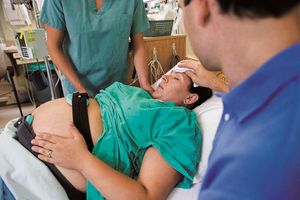
Kenyan doctors turn to virtual reality to tackle leading cause of maternal deaths

University of Nairobi's Human Anatomy and Medical Physiology Department Chairman, Prof Moses Obimbo, during the interview at the institution on February 17, 2026.

What you need to know:
- Last year, the World Health Organization updated its guidelines, recommending early intervention for postpartum haemorrhage (PPH) when blood loss reaches 300 millilitres or if vital signs become abnormal; moving away from the traditional 500 millilitres threshold.
- PPH remains the leading cause of maternal deaths in Kenya.
We arrive at Human Anatomy and Medical Physiology Department at the University of Nairobi a few minutes past 11am. Medical students in white lab coats stride through the halls, moving to and from class, though the corridors are quiet.
We are here to meet Prof Moses Obimbo, the chairperson of the Human Anatomy department, for an interview. He is about to give us an immersive look at a technology poised to transform how doctors are trained and retrained in Kenya: virtual reality (VR).

Prof Moses Obimbo and his team from the End Post-Partum Haemorrhage Initiative are now introducing the virtual reality tool to help retrain experienced doctors in managing excessive bleeding during childbirth
While new to Kenya, the technology is being used for medical education in countries such as the United States, the United Kingdom, several European nations, Canada, India, South Korea, among others.
When we enter the department’s boardroom, Prof Obimbo hands my colleague and I headsets and a VR cursor. The equipment is white, similar to the kind you might have seen used for gaming. The word ‘VRiMs’ is printed on it, short for Virtual Reality in Medicine and Surgery.
After helping us set it up, he advises us not to move around. The device, he explains, has built-in boundaries that also serve as a safety feature. Anytime you step beyond them, you lose the ongoing session.
I have been in the operating theatre before, covering real-life surgeries. But this is different.
The session features pre-recorded videos of real patients in an actual operating theatre. I choose to watch craniotomy surgery, the surgical removal of part of the skull to expose the brain. Using the cursor, I zoom in to observe every detail. Everything is in three dimensions.
When I look up, I see the surgical lights directly above me. Cameras capture the procedure from multiple angles. A senior surgeon, the one performing the operation, explains each step in detail. The sound is clear. I have no trouble identifying which part of the body is being incised. I hear clearly as he requests instruments during the surgery.
I watch him extract something from the head, then carefully stitch it back up, all while describing his actions.
The images have stayed with me to this day. I can recount the process step by step.
Prof Obimbo and his team from the End Post-Partum Haemorrhage Initiative are now introducing this tool to help retrain experienced doctors in managing excessive bleeding during childbirth
This condition is called postpartum haemorrhage (PPH). Last year, the World Health Organization updated its guidelines, recommending early intervention for PPH when blood loss reaches 300 millilitres or if vital signs become abnormal; moving away from the traditional 500 millilitres threshold. PPH remains the leading cause of maternal deaths in Kenya.
Prof Obimbo notes that while managing such cases is taught in medical school, skills can decay if doctors are not regularly exposed to these emergencies.
How does this work?
Virtual Reality (VR) and Extended Reality (XR) create immersive, high-fidelity environment for life-threatening emergencies such as PPH and preeclampsia. These technologies allow healthcare providers to repeatedly practise rare but critical scenarios in a safe environment, without putting real patients at risk.
"It is like what pilots do during simulation training," Prof Obimbo explains. "You realise that accidents in the air industry are not frequent, and the reason for that is regular training. Pilots are always prepared on how to navigate turbulence, bad weather, or stormy conditions."
In medicine, he notes, doctors often rely on a patient presenting with a complication for them to respond. If they haven't performed a procedure in a while, there is a real chance they might fumble.
VR and XR can simulate escalating blood loss, hypertensive crises, or seizure events with real-time feedback, reinforcing rapid recognition, protocol adherence, and teamwork.
They use a system called metaverse, which is the convergence of physical and virtual space accessed through computers and enabled by immersive technologies.
Prof Obimbo explains that unlike traditional didactic lectures, immersive training recreates the urgency and cognitive load of real emergencies, strengthening decision-making under pressure.
"Knowing the protocol is not the same as executing it under pressure," he says.
Once content is developed in one centre, VR and XR can n democratise its access and make them accessible to peripheral centres without actual simulation labs. Teams can therefore rehearse coordinated responses, refine communication, and build muscle memory.
“Repetition reduces knowledge or skill decay; immersive practice improves retention; structured digital modules ensure standardised quality across settings,” he says.
About 35 per cent of maternal deaths in Kenya resulting from pregnancy-related complications are caused by postpartum haemorrhage, while 22 per cent are due to preeclampsia.
Together, they are the leading causes of maternal mortality in the country.
"If you tackle the first two, then you are able to reduce almost 60 per cent of maternal deaths," Prof Obimbo says.
He and his team have developed specific modules for PPH that can be used by healthcare providers dealing with maternal health; from community health promoters and midwives to medical officers and consultant gynaecologists. The modules, he explains, have been curated to address the challenges commonly experienced across Africa.
He goes on to explain that there is also an augmented reality component to the technology. This means that trainees can use the cursor to select virtual tools and practise performing actual surgical procedures they may never have encountered.
"If you have a patient with a tear, for example, one of the causes of postpartum haemorrhage, the system will show you how to identify the tear, how to place the stitches, and how to ensure you stop the bleeding," he explains.
The initiative will work with a team from the United Kingdom called Brinks, which will help introduce this digital model of virtual and augmented reality and assist in developing the content. The goal is to establish something akin to a PPH school, structured as a Continuing Professional Development programme.
"Our initial target is consultants, medical officers, and midwives," Prof Obimbo says.
The team is also working with the government. In partnership with the Kenya Obstetrical and Gynaecological Society (KOGS) during its conference in Mombasa last week, they have since integrated the Basic Obstetric Protocols into their curriculum.
They plan to launch the school by April. The initial idea is to have interested clinicians join the school free of charge as the founders are seeking funding to cover the training costs.
The content will have basic information step-by-step on what to do in case of an obstetric emergency, and building up to a final module on team leadership.
"Team leadership is so important. If you do not provide good leadership in clinical care service, you cannot achieve excellence and quality," says Prof Obimbo.
An analysis published in the journal Multimodal Technologies and Interaction shows that virtual reality has emerged as an effective educational tool capable of enriching and transforming health sciences education, including healthcare, nursing, and medical training.
“Increased learning outcomes in areas such as performance, engagement, clinical skills development, knowledge acquisition, critical thinking, and decision-making were observed,” shows the study.
However, it also notes a limitation: a small number of students reported adverse effects, including blurred vision, dizziness, and headaches.
Another study, published in the scientific journal Frontiers of Digital Health, recommends that as virtual reality and augmented reality technologies become more entrenched in the educational landscape, it is crucial to navigate the accompanying ethical considerations and privacy concerns surrounding patients.
"Subsequent research should rigorously examine these aspects, with a particular focus on the ethical handling of simulated patient data and the implications of using such technologies in student evaluation and training," the study states.
Dr Loise Nyanjau, maternal lead at the Health ministry, says that the government is highly receptive to high-impact research and has a long-standing history of adopting evidence-based findings into national policy, such as the PPH prevention and management interventions developed in collaboration with the University of Nairobi.
"Regarding the pilot programme by the End Postpartum Hemorrhage Initiative, the Ministry regards VR as a promising resource for clinical capacity building," she says.
She adds that the ministry continues to operationalise the Digital Health Act and professional guidelines, pathways for such innovative technology-based simulation-based training to be integrated into Continuing Professional Development mechanisms for healthcare providers.
"The ministry actively encourages robust local clinical trials and implementation research on VR training modality to build a strong evidence base that informs national health outcomes. Once implementation research from this pilot provides a robust evidence base, the Ministry of Health welcomes the dissemination of findings to all stakeholders," she says.