Kenyan scientist wins Sh187m grant to predict disease outbreaks
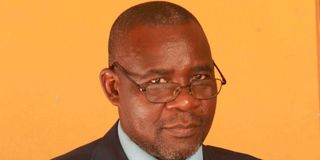
Dr Samuel Oyola has received a grant from the Gates Foundation to predict diseases using wastewater.

What you need to know:
- Dr Samuel Oyola, senior scientist, received the $1.45 million grant from the Gates Foundation.
- He will work with two PhD students who will use artificial intelligence (AI) to analyse the data.
Kenyan scientist Samuel Oyola has received a Sh187 million grant to develop an artificial intelligence-powered public health tool that can predict disease outbreaks and track drug-resistant pathogens.
Dr Oyola, senior scientist and head of genomic science at the International Livestock Research Institute, received the $1.45 million grant from the Gates Foundation. He will work with two PhD students who will use artificial intelligence (AI) to analyse the data.
The researchers will collect wastewater samples from 30 sites, 18 in Kisumu and 12 in Mombasa, as part of a follow-up study that began during the Covid-19 pandemic.
The two cities were selected because Nairobi already had a similar wastewater surveillance project, while Kisumu and Mombasa had the country’s other well-connected sewer networks.
In an interview with the Nation on Wednesday, Dr Oyola explained that during the Covid-19 pandemic, they discovered that it is possible to detect some pathogens from wastewater and use that information to quantify the disease burden circulating within a community.
“In Africa, generally, our health-seeking behaviour is very poor. People can get ill and stay at home even when the disease they have could cause an outbreak,” he said.
The researcher said that wastewater surveillance fills this gap because virtually everyone uses the toilet, regardless of whether they seek medical care.
“If they are infected, they can shed the pathogen in the wastewater. Environmental surveillance is then able to detect the pathogens that have been shed by a given population,” he added.
The new funding will enable the team to use AI tools to analyse the data faster and identify pathogens and their characteristics more efficiently.
Dr Oyola added that each wastewater sample they pick provides a snapshot of the pathogens circulating among people living in the area served by that section of the sewer system.
Risk of an outbreak
Already, they have analysed data and have generated profiles of pathogens in different populations over time and they are now trying to develop the wastewater environmental surveillance tool as an early warning system for public health.
“This project is concerned with using wastewater data, overlaying it with the clinical data or clinical cases and then using that to model disease burden and transmission dynamics within populations,” he explained.
Once the tool has been developed, they will use dashboards to relay the information to public health officials. The dashboards will help the officials to identify diseases circulating within communities and prioritise interventions.
Apart from detecting the pathogens and their profiles over time, the tool can also show where the disease burden is highest and flag areas at risk of an outbreak.
The tool will also be capable of detecting the levels of antimicrobial resistance from the pathogens that will be analysed.
Dr Oyola noted that when the scientists get a sample, they extract the genetic component and sequence it, they are then able to use that information to depict what type of pathogens have antimicrobial-resistant genes.
“We use that information, quantify its burden and then that information is given to the public health officials. They can then choose to either change the prescriptions available in hospitals or they can find ways of circumventing the increase of antibiotic resistance within the facilities that are connected to the regions covered,” said Dr Oyola.
The researchers are using a method known as high-throughput sequencing, which allows them to analyse all pathogens present in a sample rather than testing for one specific organism.
This is why they use an agentic AI model, which they programme and tell it what exactly to do in order to get the best results from a huge data set.
“This is still a new area and that is why we want to deploy new PhD students, who will be able to study this and become experts in these tools,” he said.
Dr Oyola said he hopes the tool will enable Kenya to detect outbreaks earlier, improve public health responses and strengthen preparedness for future pandemics.
Follow our WhatsApp channel for breaking news updates and more stories like this.