Homa Bay Senator Moses Kajwang has urged the government to establish screening points along Lake Victoria to monitor people entering the country through its vast waterways, warning that the lake could become a gateway for the spread of Ebola.
The senator said Lake Victoria is flooded with numerous porous routes that are used daily by travellers and traders moving in and out of Kenya, often beyond the reach of formal border controls.
Of particular concern, he noted, is the movement of traders from neighbouring countries, including Uganda and the Democratic Republic of Congo, where cases of the virus have already been reported.
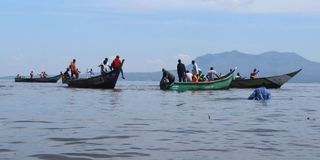
Fishing boats docked offshore at Litare Beach in Rusinga Island, Homa Bay.
Photo credit: File | Nation Media Group
Business operators regularly converge on islands such as Remba and Mfangano in Suba West, as well as Migingo in Migori, where they engage in vibrant cross-border trade and daily commercial activities.
Many traders travel between these locations and the mainland through unofficial crossings and communal waterways, interacting with large numbers of people along the way. This, leaders fear, heightens the risk of the disease spreading and evolving into a regional health crisis.
In doing so, many bypass the formal health screening points staffed by health and customs officers at recognised border crossings, making surveillance and containment efforts significantly more challenging.
Mr Kajwang warned that the extensive trade network operating across the lake exposes Kenyan communities to the threat of infection.
“Most timber used in boat making is sourced from Congo. Fishing communities also get a lot of products from Uganda, and many of them are brought into the country through the lake,” the senator said.
He called on the government to take adequate measures around the lake to prevent the virus from spreading through the region’s waterways.
“Let the government not only concentrate on taking care of the interests of people from the US. Kenyans too should be safeguarded from the disease,” he said.
The senator was speaking during a prayer service at Malela Seventh Day Adventist Church in Ndhiwa, where he challenged Members of Parliament to put Health Cabinet Secretary Aden Duale to task over whether sufficient resources have been allocated to contain the disease and protect communities whose livelihoods depend on the lake.
Senator Kajwang was accompanied by National Assembly Health Committee Chairperson James Nyikal and committee member Martin Owino, both of whom endorsed the measures already undertaken to prevent the virus from spreading into the country.
Homa Bay Senator Moses Kajwang at Bunge Tower in Nairobi on June 4, 2026.
Photo credit: Dennis Onsongo | Nation Media Group
Dr Nyikal commended the government for establishing quarantine centres across the country, describing them as a vital line of defence against any potential outbreak.
He explained that anyone who comes into contact with an infected person or a suspected case should immediately be isolated to prevent further transmission.
“The only issue is there is only one centre and we don’t know where it is.Again, will it admit people who are sick,” he said.
The Seme MP opposed proposals for patients from other countries to be treated in Kenya, noting that public health experts recommend containing outbreaks at their source whenever possible.
“The 23 quarantine centres are okay where they are, and we must support the government for doing so,” Dr Nyikal said.
Mr Owino also praised the measures put in place to contain the virus, describing the government’s preparedness efforts as commendable.
He urged critics not to politicise government plans aimed at supporting US citizens who may require isolation should they be exposed to the virus.
According to the Ndhiwa MP, the Ministry of Health had already informed legislators that the facility in Laikipia would serve both Kenyans and US citizens.
“We have worked with the US for a very long time in HIV and Aids programmes as well as maternal health. We don’t want people putting politics in public health strategies,” Mr Owino said.
The MP further argued that there is no need to conduct public participation exercises during health emergencies, when swift action is often critical to protecting lives.
“The government should ensure it has the capacity in the facilities for contact tracing and efficient detection of the illness. Whoever is exposed and develops symptoms should be quickly taken to isolation facilities,” Mr Owino said.