Kenyan storytellers take the lead in wildlife filmmaking
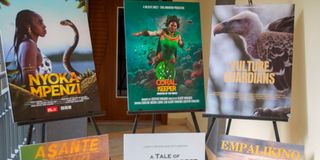
Posters of films that were screened during the launch of 'Justice for Nature'.
What you need to know:
- Elephant and rhino poaching in Kenya has significantly declined, with poaching of elephants down by 80 per cent and that of rhinos by 90 per cent.
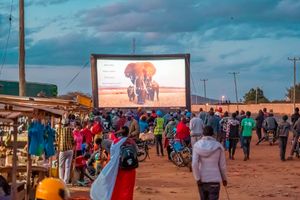
For too long, Kenya’s wildlife stories have been told by outsiders. The country’s breathtaking wildlife and landscapes have been showcased to the world through the lenses of foreign media houses like BBC, National Geographic, among others. But now, a new movement is emerging—one where Kenyans themselves are telling their own conservation stories with authenticity and local insight.
Spearheaded by renowned conservationist Dr Paula Kahumbu, CEO of WildlifeDirect and Whitley Gold Award winner, ‘Justice for Nature’ is a groundbreaking initiative that empowers Kenyan filmmakers to document environmental issues through short films.
The initiative was launched the last weekend of May at St. Christopher’s International School, Nairobi with a showcase of six short films, each highlighting critical environmental justice issues. Among the panellists were Kenyan luminaries such as Yvonne Adhiambo, an author, and Dr Dino Martins, an entomologist, evolutionary biologist and director of the world-renowned Turkana Basin Institute, among others.
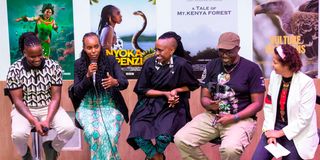
Thige Njuguna, Mary Mumbi, Kiki Ng’ok, Albert Nyakundi and Dr Paula Kahumbu at the ‘Justice for Nature’ premiere at St. Christopher’s International School in Nairobi. Courtesy WildlifeDirect.
Dr Kahumbu needs no introduction in the conservation scene; having led a successful campaign to end the poaching crisis in Kenya — ‘Hands Off Our Elephants’ — that contributed to her winning the Whitley Gold.
She received the prestigious Gold Award from the Whitley Fund for Nature in 2021 for her outstanding leadership of Africa’s conservation movement. The award worth £100,000 acknowledged her pioneering approach to protecting the country’s wildlife.
Dr Kahumbu spearheaded the national movement at a time cases of elephant and rhino poaching were on the rise. She roped in the civil society, corporations, government agencies and other conservation organisations. Since then, elephant and rhino poaching in Kenya has significantly declined, with poaching of elephants down by 80 per cent and that of rhinos by 90 per cent.
After securing the funding, Dr Kahumbu faced a dilemma — the original plan for the money did not materialise, and she risked returning the funds if no viable project was launched. “My initial idea was to set up an environmental justice desk, that is a hotline, to address conservation matters such as human-wildlife conflict, securing spaces for wildlife and empowering citizens to advocate for environmental matters in Kenya,” said Dr Kahumbu at the screening of the films selected for the launch of ‘Justice for Nature’. “But that did not work out and I sat on the money, mulling what to do with it.”
Eventually, she got the breakthrough idea: let Kenyans tell their own environmental stories through film.
She approached the board of Whitley Awards again to explain her project and got the nod. That’s when the project shifted to a creative storytelling platform. Five short films were produced, covering themes like vultures, snakes, bees, mountains, and coral reefs—all told from a Kenyan perspective.
Snake handler
‘Nyoka Mpenzi’, produced by Thige Njuguna, featured Mary Mumbi in a real-life documentary, a young girl from Nakuru slums who became enchanted with snakes when she saw a real one on a visit to the snake farm in Baringo. She later became a certified snake handler, defying societal expectations.
Today, Mumbi works at Watamu Snake Farm and is one of the few certified Kenyan snake handlers– which means she can ‘catch’ venomous snakes like cobras and adders without injuring herself or the reptile.
She narrates that her career choice initially shocked her mother and neighbours, who believed that she had joined a cult. But over time, her mother’s fear turned to curiosity, then pride. By the end of the film, she even asks for photos of Mumbi’s snake catches—a powerful shift in perception.
Thige won a scholarship from BBC to do his Masters degrees in wildlife filmmaking, including Pauline Kyalo whose film, ‘Asante Nyuki’, also premiered.
The animation ‘Coral Keepers’ shot by Nyakundi brothers stands out because of its multilingual approach (Dholuo, Kiswahili, English).
It features a young mother in a headscarf depicting her Swahili heritage quietly filming the atrocities of an oil company she is working for after her son falls ill from polluted water.
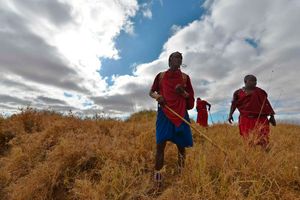
Also screened was ‘Empalikino’, an award-winning short film produced during WildlifeDirect’s annual wildlife film training programme for African filmmakers. The film follows Dalton, a Maasai tribesman grappling with the challenges of co-existing with lions in Ol Kinyei conservancy in the Mara. He is charged with ensuring the safety of his community’s cattle while also acknowledging the lion’s role in the ecosystem. It’s a compassionate film touching on forgiveness, acceptance, and the enduring struggle for harmony in a shared land of the lion’s freedom versus the livelihood tied to cattle.
“‘Justice for Nature’ is for all of us to champion,” stated Timothy Owase, CEO of Kenya Film Commission.
Dressed in a colourful psychedelic shirt to compliment the vibrancy of the occasion, he emphasised the importance of story-telling. “It’s the glue that binds us,” he said. “Story-telling is the catalyst for growth and development. We tell stories to change society. We want to see film clubs formed in schools and film hubs in counties for youngsters to tell their stories. Master classes should be started for adults.”
Mr Owase related the launch of ‘Justice for Nature’ to the ‘Orange Economy’, also known as the Creative Economy. “It is the emerging industry using culture, creativity, and intellectual property to generate economic growth. It is the driver of innovation, job creation, and cultural preservation in a rapidly digital world that includes music, film, fashion, design, performing arts, gaming, and digital content creation.” Next goal? A wildlife filmmakers’ association to professionalise and expand Kenyan nature documentaries. “We don’t have a wildlife filmmakers’ organisation yet,” stated Dr Kahumbu.
“But with a room-full of storytellers and young filmmakers, the future looks bright and the next five years may see the launch of a vibrant wildlife filmmakers’ organisation that speaks about justice for nature.”
The event also saw the launch of Mazingira911.org, a website designed to host films and facilitate citizen reporting of environmental crimes.
rupitheafricantrotter.wordpress.com