Marco Rubio's mixed signals on Kenya Ebola centre spark concern

US Secretary of State Marco Rubio.


On Wednesday, US Secretary of State Marco Rubio addressed the Senate Appropriations subcommittee in the United States and made a statement that contradicted his earlier position.
"We cannot and will not allow any cases of Ebola to enter the United States," Rubio had said earlier.
But before the Senate, he said something different: "If an American who will be flown to Kenya tests positive at any time while in that facility, we will remove them from Kenya and send them to the nearest treatment facility, either in Europe or in the home or in the United States, to be treated for Ebola."
He added, "We're not actually asking Kenya to set up treatment for Americans. If there are any Americans who are exposed, potentially exposed, they will be transferred to this facility for observation. If they test positive at any time while in that facility, we will remove them from Kenya."
Americans with confirmed Ebola will be transferred to the United States. The same United States that "cannot and will not allow" Ebola cases to enter.
Senior infectious disease specialists are asking critical questions about what this contradiction means and what it reveals about a dangerous misunderstanding of Ebola.
Prof Shem Otoi Sam, a leading infectious disease modelling specialist and senior scientist, laid out the problem clearly:
"The entire premise of the Laikipia quarantine facility is built on a fundamental misunderstanding of the 21-day incubation period and when someone actually becomes infectious," Prof Sam said in an interview.
He added: "The US wants to watch Americans in Kenya, but that makes no sense if you will move them to America while they are still contagious. You cannot protect America by bringing infected people to America."
He explained how a 21-day incubation period is not a waiting period where a person is safe. It is a period where a person can be extremely infectious while showing no symptoms.
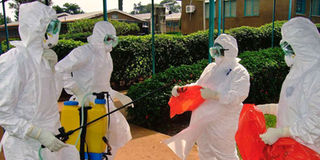
Health officials in the Democratic Republic of Congo.
The expert said that within the first one to seven days, a person is exposed but may feel fine. However, the virus is multiplying inside their body. On days 8-14, the person is now highly contagious. Viral load is at peak levels. Yet most people still feel completely healthy. There is no fever, no symptoms and no sign of infection.
Days 15-21: If infection occurred, symptoms may or may not appear. But the person remains contagious. Only after day 21, with a negative test, can a person be considered safe to release.
"The critical problem with transferring an American from Kenya to the United States during this window is that you are not transferring a 'safe' patient," Prof Sam explained. "You are potentially transferring someone who is highly infectious but asymptomatic."
The professor added: "The statement makes no sense from an epidemiological standpoint.”
The World Health Organisation has made clear that countries face a binary choice during Ebola outbreaks. The first option is to treat in-country if someone is exposed and potentially infected, and they remain isolated in the country of exposure. If they test positive, they are treated in-country with full biosafety level 4 precautions. This prevents international spread.
The second option given by the WHO is that to prevent exposure, countries should keep nationals out of outbreak zones. “Do not allow them to work in affected regions. This prevents the need for urgent evacuation.”
Also, countries should transfer only in exceptional cases “Some countries have agreements to transfer critically ill patients, but only after they have been isolated and confirmed negative, or with extraordinary biosafety measures in place. And only with the receiving country's explicit consent.”
“What the Trump administration is proposing, of transferring Americans who test positive during the contagious window to US treatment facilities, is not standard protocol. It is not endorsed by WHO. And it carries significant epidemiological risk even to the holding countries,” said Prof Shem Otoi Sam.
While the US and Kenya debate the Laikipia Air Base facility, the actual Ebola outbreak is escalating in DRC and Uganda.
According to WHO Director General Dr Tedros Adhanom, the DRC has confirmed 344 cases, including 60 deaths across 24 health zones in three provinces. Uganda has 15 confirmed cases and one death.
Also Read: 20 flights so far: US experts arrive at Kenya Ebola facility despite court order, protests
"WHO's risk assessment remains unchanged: very high at the national level, high at the regional level, and low at the global level," Dr Tedros said. "Our ultimate measure of success is not whether we stop this Ebola outbreak. We will. The DRC has extensive experience with Ebola and has stopped 16 previous outbreaks. The real measure of success is what we can do to prevent the 18th outbreak and the 19th."
Democratic Republic of Congo and Uganda (active transmission) are considered the highest priority, with Kenya, where the controversial facility is being built, classified as a Tier II, high-risk country. Yet Kenya's government has not fully explained how the facility reduces Kenya's actual risk.
“If Americans are being evacuated to the US during their contagious window, the facility does not protect Kenyans. It protects Americans.” Prof Shem Otoi Sam said.
Follow our WhatsApp channel for breaking news updates and more stories like this.