More SHA money is flowing, but are patients getting better care?
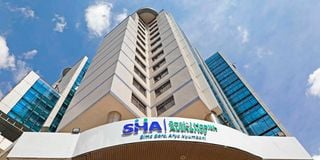
The Social Health Authority building in Nairobi.

What you need to know:
- SHA disbursed Sh21.36 billion to counties in the 2025/2026 financial year, up from Sh12.7 billion the previous year.
- Growth comes even as a number of Kenyans continue to complain about not getting services in hospitals across the country.
The Social Health Authority (SHA) disbursed Sh21.36 billion to counties in the 2025/2026 financial year, up from Sh12.7 billion the previous year, a jump of nearly 70 per cent.
New payment data shows that the shift to Universal Health Coverage through the Social Health Insurance Fund (SHIF) is producing measurable results, with the financing system growing sharply in both scale and reach over the past year.
That growth comes even as a number of Kenyans continue to complain about not getting services in hospitals across the country.
Still, for a programme that has faced scrutiny over payment delays and uneven disbursement in its early years, the data marks a rare alignment: rising registration, rising collections, rising disbursement and rising service delivery, all moving in the same direction.
Nationally, between July 2025 and April 2026, SHIF paid out a total of Sh65.42 billion across 4,718 facility payment records spanning all 47 counties, financing inpatient, specialised and high-cost care as a core pillar of the UHC agenda.
In March and April 2026 alone, SHIF disbursed Sh25.37 billion, equal to more than 63 per cent of the Sh40.05 billion paid out over the preceding eight months combined. That surge signals a financing system that is not just growing but moving faster as processing systems mature.
Behind the totals sit some striking service numbers. SHIF has supported 1,080,052 safe deliveries, backed by free delivery services in primary healthcare facilities, with teen mothers able to access care once they obtain a temporary identification.
The Fund has financed 949,608 inpatient admissions, including 19,444 critical care patients and 7,000 mental health admissions, and supported 220,097 surgical procedures, ranging from minor operations to specialised theatre work.
On catastrophic and chronic care, the numbers are equally telling. Some 43,661 cancer patients are currently accessing treatment through the Fund, with the government having expanded oncology cover from Sh550,000 to Sh800,000.
Overseas treatment benefit
About 14,800 patients have accessed dialysis services, most of them chronic cases receiving two sessions a week, care worth more than Sh1.14 million a year per patient if paid out of pocket.
The overseas treatment benefit, capped at Sh500,000 per eligible patient, has been reintroduced, with nine international facilities now contracted and one patient already referred for treatment abroad.
Public, faith-based and private providers all draw from the Fund, with private facilities accounting for the largest share of payments at 49 per cent, followed by government facilities at 31 per cent and faith-based providers at 20 per cent.
The gains, according to Ahmed Abdullahi, chairperson of the Council of Governors, extend to hospital-level financing too.
"Collections under the Facility Improvement Financing (FIF) Act rose from Sh16.9 billion to Sh24.01 billion, surpassing the annual target set for the year. The Act applies to referral hospitals," he says.
The growth in funding comes alongside a sharp rise in registration. "The number of Kenyans enrolled under the scheme has grown to 30.1 million, up from 18 million, an increase of more than 12 million people in a single year," says the State of Devolution report by the Council of Governors.
"Taken together, the numbers point to a health financing system gaining both scale and momentum: more Kenyans covered, more money moving through the system, and referral hospitals collecting above what they were expected to," says Dr Mercy Mwangangi, chief executive officer, SHA.
Dr Mwangangi paints a picture of a health system that, despite significant challenges, has registered measurable progress since the transition from the National Health Insurance Fund to SHA.
Primary healthcare services
"Free primary healthcare has been rolled out across all counties, with more than eight million Kenyans already accessing services without paying at Level Two and Level Three facilities. The 'Lipa SHA Pole Pole' initiative has also gained traction, with over 600,000 active payers," she says.
The authority has designated green-labelled facilities, SHA-contracted Level 2, Level 3 and selected Level 4 facilities, where patients can walk in, receive care and walk out without paying for covered primary healthcare services.
These services include outpatient consultation, diagnosis and treatment of common illnesses, basic laboratory tests, essential medicines, preventive and promotive health services, and referral to higher-level facilities when specialised care is required.
Follow our WhatsApp channel for breaking news updates and more stories like this.