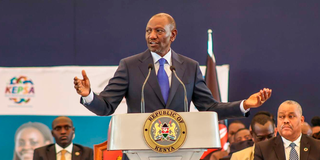
President William Ruto has rejected calls to revive the National Health Insurance Fund (NHIF), insisting that the Social Health Authority (SHA) has outperformed its predecessor and warning that attempts to reverse the reforms would undermine access to healthcare.
Speaking at State House Nairobi on Saturday, Dr Ruto said SHA disburses an average Sh12 billion a month to hospitals, compared with Sh5.6 billion released by NHIF over a three-month period, as he sought to defend the health scheme against growing criticism.
President Ruto said Sh170 billion had been disbursed to health facilities across the country in the past one-and-a-half years, with Nairobi hospitals receiving Sh32 billion.
“Those asking us to return to NHIF are threatening the health of our people. If they want to know whether SHA is working, they should ask the Community Health Promoters,” the President said.
He revealed that by next week, hospitals will have received Sh12 billion for services rendered this month, noting that medical equipment worth Sh10 billion have been procured and installed under the Government's health reforms.
His defence of SHA came as he announced that the Government will begin paying medical insurance for all 107,000 Community Health Promoters, placing the frontline workers at the centre of the health reforms he has sought to protect.
The National Government, he said, will provide Sh390 million towards the cover, with counties expected to contribute a similar amount.
The move means that the workers who have been tasked with helping households understand and enrol in SHA will themselves be brought under the scheme.
Dr Ruto said the medical cover was recognition of the critical role played by CHPs in the Government's shift from curative to preventive healthcare.
“Those who dedicate themselves to the health of the nation must also enjoy the dignity of health cover for themselves and their families,” he said.
Dr Ruto described the frontline health workers as the backbone of Kenya's healthcare system and key to the Government's shift from curative to preventive healthcare.
"Community Health Promoters are the first point of contact between Kenyans and their health system. Before patients reach a dispensary, health centre or hospital, they first meet you in their homes," he said.
The President's renewed defence of SHA comes amid continued political debate over the transition from NHIF, with the Government seeking to convince Kenyans that the new system is delivering better outcomes while opponents have raised concerns over its implementation.
Dr Ruto urged Kenyans to judge the reforms by their impact rather than political rhetoric, maintaining that the new scheme had improved the flow of funds to health facilities.
President Ruto said the CHPs would have an even bigger role as SHA expands, including helping households register for the scheme, educating them on available services, making referrals and promoting preventive healthcare.
"You are not simply supporting healthcare reform. You are leading it from the frontlines," he said.
The President also appealed to Kenyans to reject tribalism and all forms of division in favour of national unity.
Cabinet Secretary for Health Aden Duale said Kenya's UHC programme has earned international recognition, with the World Health Organisation and several African countries looking up to Kenya as a model.
Mr Duale explained that the CHPs' initiative has become a benchmark for other countries seeking to strengthen primary healthcare systems.
He added that previous governments had attempted to implement UHC without achieving the current level of success, adding that CHPs have enabled early detection of conditions such as hypertension, diabetes and obesity through household screening.
On his part, Nairobi Governor Johnson Sakaja said investing in primary healthcare significantly reduces overall healthcare costs.
"For every $1 spent on primary healthcare, about $14 is saved in the overall health budget," he pointed out.
"For a long time, people used to go to hospitals. Today, Community Health Promoters are taking healthcare to the people," he added.