New guardians of Tsavo: Students mentored to take charge of conservation

African Wildlife Foundation Associate Director for Conservation Education and Youth Leadership Simangele Msweli awarding one of the winners for the Shujaaz Zone Competition.

What you need to know:
- Where wildlife was once seen as a threat, learners are now questioning harmful traditions and recognising their role as stewards.
The Tsavo ecosystem, home to Kenya’s largest elephant population, faces persistent threats from human-wildlife conflict, poaching, and deforestation. For years, conservation has been largely the domain of government agencies and NGOs, with local communities often sidelined due to limited awareness and resources.
To flip the script, a transformative initiative is now by empowering the community’s most vital asset — its youth — to become active guardians of their natural heritage.
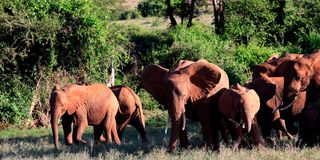
A group elephants feeding at Taita Hills Wildlife Sanctuary within the Tsavo West National Park in Taita Taveta CountyTsavo.
The African Wildlife Foundation (AWF), in partnership with the Wildlife Clubs of Kenya (WCK), is mentoring learners to become advocates against harmful practices and active protectors of local biodiversity.
More than 250 learners from 137 schools across Tana River, Kwale, Kilifi, Kitui, Makueni, Taita Taveta, and Kajiado counties are being equipped to shape the future of the Tsavo conservation area.
Through Shujaaz Zone Competition, a year-long initiative aimed at promoting conservation awareness, they are using essays, poems, photography, and drama to highlight environmental issues and propose local solutions.
The initiative’s impact was celebrated at a recent award ceremony in Voi. Sub-county Director of Education Omari Mokaya noted: "It has given the learners a sense of responsibility and a clearer understanding of the environmental challenges facing their communities.”
AWF’s Associate Director for Conservation Education and Youth Leadership, Simangele Msweli, emphasised the strategic importance of engaging the youth. “For conservation to succeed in Africa, it must be led by Africans. And with 70 per cent of the continent’s population under the age of 35, we must engage this demographic meaningfully,” she said.
Ms Msweli noted that Kenya’s youth make up 75 per cent of the population, a figure that highlights the need to invest in young leaders.
The results are already visible. Where wildlife was once seen only as a threat, students are now beginning to see it as part of their heritage.
Ms Msweli said the learners are already taking action in their homes and communities by speaking against harmful practices that significantly impact conservation efforts.
“They are learning that conservation is not just about protecting animals, but also about securing their own future," Ms Msweli explained.
"Some are questioning practices such as eating wildlife like dikdiks. Others are recognising the role of bees and butterflies. These are signs of leadership.”
Young advocates
The programme uses posters, activity books, and continuous mentorship to teach students how ecosystems function. A key goal is to build a self-sustaining network of young advocates.
The Shujaaz Zone Competition is part of a four-year AWF-WCK programme supported by Bob and Emmy King.
It seeks to strengthen school-based wildlife clubs and promote African-led conservation, building a network of young advocates who continue their work beyond the classroom.
Ms Msweli said mentorship is a key part of the initiative where the learners are being connected to youth networks that allow them to stay involved even during school holidays.
“We want them to have a community where they can continue championing conservation action,” Ms Msweli said, highlighting youth networks that keep students engaged even during holidays.
The competition included categories such as art and photography, poetry and essays, freestyle, and special awards for the best wildlife club patron and best club project. The entries reflected the learners’ understanding of local issues and their commitment to finding solutions.
The initiative comes at a critical time. Zainab Salim, assistant director for Human-Wildlife Coexistence at the Kenya Wildlife Service, warned of the tangible consequences of harmful practices.
“It is unfortunate that men cut down trees while women use firewood to cook. We are seeing the impact,” she said, urging communities to plant trees and protect wildlife.
“If we take care of the biodiversity, cases of human-wildlife conflict will reduce. If we don’t, we will lose both the animals and the balance they bring.”
By planting the seeds of stewardship in the youngest generation, this initiative is cultivating a future for Tsavo where conservation is not an external mandate, but a community-led legacy.