No touching, no viewing: Inside country’s first Ebola burial
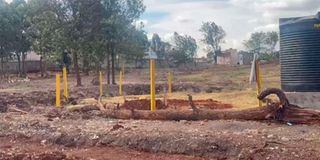
Gravesite of Kenya’s first Ebola patient, who travelled from the Democratic Republic of Congo through Uganda before arriving at Jomo Kenyatta International Airport in Nairobi.


At about 2.30 pm Tuesday, the vehicle carrying the body of Kenya’s first Ebola patient arrived at Lang’ata Cemetery in Nairobi for his final journey.
There was little ceremony.
At the edge of the Islamic section of the cemetery, a small group of mourners stood wearing masks, keeping their distance from the grave. Nearby, a fire burnt beside a freshly dug mound of soil, with flames being part of the burial protocol.
The fire was being used to destroy materials that had come into contact with the body during the burial, in a carefully controlled process designed to prevent the spread of the deadly virus.
The Nation exclusively visited the cemetery to observe how the burial of an Ebola victim is conducted and how health authorities were implementing the strict protocols designed to protect mourners, burial workers and the wider public.
A man dressed in a full hazmat suit complete with protective boots later approached a red Toyota Fielder parked nearby.
The vehicle had been used to transport the patient from Jomo Kenyatta International Airport to Nairobi Hospital.
He carried what appeared to be a tank of fumigation liquid and sprayed the inside of the vehicle, thoroughly disinfecting it after the patient had been transported in it.
The scene offered a glimpse into the extraordinary precautions being taken following Kenya’s first confirmed Ebola case.
An official from the Ministry of Health, who spoke to the Nation on condition of anonymity, explained that the precautions begin immediately after death. Adding that the body of the deceased must be buried within 24 hours.
The body is first cleaned and disinfected by a trained Ministry of Health official. Family members are not allowed to handle the body, and there is no viewing.
The body is then wrapped in several layers of protective material before being transported directly to the burial site. Only the dead patient and the driver are allowed inside the vehicle transporting the body, according to the official.
At the cemetery, a small number of family members may be allowed to witness the burial, but they must maintain a safe distance as the body is lowered into the grave.
The grave is required to be at least six feet deep.
Once the grave is filled, materials used during the burial, including protective clothing such as hazmat suits and gumboots, are destroyed at the site. The precautions were evident at Lang’ata.
Security around the burial site was tight. Shortly before the burial, a group of men who had attempted to document the proceedings were removed from the area.
One of the family members told the Nation that relatives had been given strict instructions not to speak to the media.
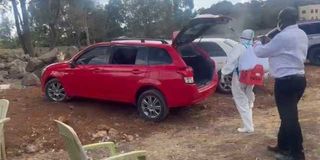
A medical officer sanitises a car believed to have picked up an Ebola patient from the Jomo Kenyatta International Airport.
In an interview with Nation, Health Services Director-General Patrick Amoth explained that a Safe Dignified Burial (SDB) should be accorded to any patient who dies from Ebola, adhering to public health guidelines that help reduce further transmission.
The safe and dignified burial practice was established by the World Health Organization in 2014 during an Ebola outbreak.
It emphasises the need to include family members and encourage religious rites as an essential part of safe burials.
He says the body must be well wrapped, with no viewing or touching.
“While we are cognizant of cultural and religious practices, a burial is limited to a small number of family members who can witness the burial. The burial is usually done as fast as possible, regardless of their religious beliefs. Ideally, the burial should happen within 24 hours,” he says.
In the Democratic Republic of Congo, which is the epicentre of the ongoing Ebola outbreak, cultural practices for burial rites have been a major impediment to containing the disease.
In the context of SDB, most cultural practices require relatives to wash or prepare the body for burial; however, this is not permissible for patients who have died from Ebola because of the risk of infection.
In another review of the Bundibugyo virus Ebola outbreak, scientists published in the Lancet said that there are several documented incidents where families and community members have contested burial procedures, including threatening burial teams and forcibly opening coffins to inspect the body.
“Although epidemiologically high-risk, such actions reflect deep uncertainty and mistrust regarding the handling of deceased relatives and the perceived opacity of burial processes,” they say.
“Burial practices, therefore, represent a critical interface where biomedical imperatives and social meanings directly collide. Mistrust may be further reinforced by misinformation and local interpretations of the disease,” they add.
An article published by Gavi, the vaccine alliance, shows that during the 2014–16 West Africa Ebola epidemic, funerals were identified as an important source of infection in affected communities.
This is confirmed in a 2015 study published by the US Centres for Disease Control and Prevention in the journal Emerging Infectious Diseases.
“Contact with corpses during mourning and funeral practices, which can include bathing the body and rinsing family members with the water, or during the removal and transportation of bodies by burial teams has resulted in numerous infections,” shows the study.
“Humans who die of Ebola Virus Disease typically have high levels of viremia, suggesting that most fresh corpses contain high levels of infectious virus. Family members exposed to EVD patients during late stages of disease or who had contact with deceased patients have a high risk for infection,” they explain.
Follow our WhatsApp channel for breaking news updates and more stories like this.