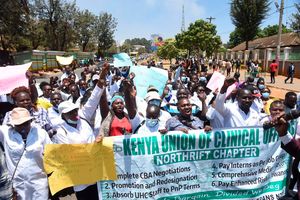
Patients stranded in Nairobi hospitals as doctors’ strike enters day seven
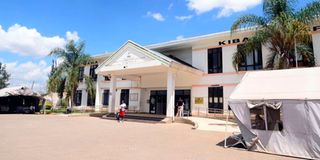
Mama Lucy Kibaki Hospital in Nairobi.

What you need to know:
- KMPDU officials in Nairobi lament that their employer has been giving them unprecedented salary cuts. They also cite dismissals, chronic salary delays, delayed promotions and unpaid gratuities.
The winding queues at the outpatient section of Mama Lucy Kibaki Hospital are testament to the crippled services orchestrated by the ongoing doctors’ strike in Nairobi County.
This comes days after the Kenya Medical Practitioners, Pharmacists and Dentists Union (KMPDU) issued a strike notice for their Nairobi branch members.
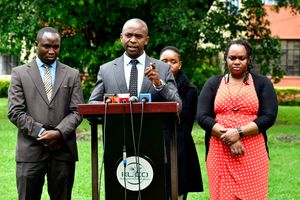
KMPDU officials in Nairobi lament that their employer has been giving them unprecedented salary cuts. They also cite dismissals, chronic salary delays, delayed promotions and unpaid gratuities, adding that members who are yet to be fully employed get confirmation letters after waiting for months.
The doctors, through their officials, say their efforts to resolve the issues have become futile, and this has affected their normal operations in a bid to provide quality healthcare to patients.
Nation.Africa visited two main hospitals where patients appeared stranded on benches, with evident slow services and long waiting hours.
At Mama Lucy, we meet Esther Wambui, who has been in and out of hospital for two weeks now with her sick child. The child’s fever had spiked, and he had diarrhoea.
“I have been queuing here since morning and no one has attended to me. It is now almost 3.30pm and there are no doctors. Most of those who are available look like students. We are staying longer in the hospital than usual,” she told Nation.Africa.
Caroline Nzilani is also not sure if she will get a chance to see a doctor. Like Esther, she arrived at the hospital on Monday morning but her sick child has not been attended to.
“We have been told that the queues are not moving because only two nurses are on call. We have been affected by this strike because the more we wait, the more the child’s condition worsens,” she said.
“I would like the government to pay the doctors in good time so that we can save time. I am supposed to be at work but I have stayed out of work the whole day,” she added.
Dr Esther Odede, the deputy medical superintendent at the facility, said that on a normal day, they have about 109 consultants, medical officers and pharmacists –but the strike has greatly reduced this number.
“There have been disruptions in several departments, but we are putting in measures to minimise those disruptions. The hospital has locum workers and those are the ones we are utilising to deliver the affected services,” she said.
Dr Odede added that the inpatient, critical areas, specialist clinics and the accident and emergency departments have been affected the most.
“I would like to encourage open dialogue from both the union and the employer so that this can be resolved. It will be a win-win for both sides because at the end of the day, our focus is the patients and we want the best outcome for them,” she said.
Hellen Nyambura has been going to Mbagathi for some time now because of her sick two-year old who has a congested chest.
“I came here at 8am. It’s now 5pm, but my baby has not been stabilised. She has been put on oxygen but she is still unsteady. I have been given drugs and asked to go home but she is still not okay. I don’t know what to do because there is no doctor here,” she said.
Mbagathi Hospital Chief Executive Alexander Irungu told Nation.Africa that their hospital is still offering services albeit not as usual.
“We have to put in place contingent measures even when some of our staff are on strike. In Mbagathi, we have 53 consultants but only 12 of them came in today. We have 42 medical officers but only five reported to work,” he said.
Just like Mama Lucy, Dr Irungu said that their facility is beefing up the numbers with locum doctors
“Specialised services, like the specialist outpatient clinics and some elective surgery procedures, are the most affected services. The outpatient department is running well with locum workers, but you know after these patients are admitted, it is the consultants who come to review them,” he said.
He said that so far there is no death associated with the ongoing strike.
“In a normal cycle, patient numbers are usually low towards the weekend and that is when the strike started. We have realised that we have a gap and that is why we have engaged locum medical officers,” explained Dr Irungu.
Dr Irungu assured that for cases like maternity, when a mother comes without any complications, a midwife can comfortably attend to them. In cases of emergencies, consultants who are on standby will be called to work.
“This profession of medicine is of a higher calling, in as much as we are agitating for a better working environment and other rights, the life of a person comes first. There is no leadership of a union that would let neonates die,” he said.