Revealed: Finsprint, the private firm pocketing SHA billions
Social Health Authority signage at Mutuini Hospital in Dagoretti South Sub-County, Nairobi, on August 27, 2025.

When Ms Janet Onyango’s hospital stopped receiving payments from the Social Health Authority (SHA) three months ago, she visited the agency’s offices hoping to have the issue resolved.
But SHA officials, she told the Nation, said they could not fix the problem. Not because the money was unavailable or her claims had been disputed.
“I was told they could not fix the problem since they are not in control of the system,” said Ms Onyango, who declined to identify her medical facility for this story.
Instead, she was referred to a company called Finsprint.
Ms Onyango had never heard of Finsprint. The company does not feature in SHA’s public communications. It was not mentioned when SHA was launched with fanfare as the government’s flagship universal health coverage programme.
She visited Finsprint’s offices in Kilimani, Nairobi, where she was told the money had not reflected in her bank account because of an error in her account details.
“Someone had pressed the space bar between the digits of my bank account number. A single keystroke. The payment had bounced,” Ms Onyango told the Nation. “Many hospitals have been complaining about not receiving their money. If no one follows up, then the money goes back into the system.”
She showed the Nation the message sent to her by the company explaining why the money had not reflected in her account.
Once the correction was made, she was asked to confirm the payment with her bank.
“This is how I got that payment made,” Ms Onyango said.
At the centre of the system is the government’s Digital Health Agency (DHA), which forms the backbone of the technology.
DHA is a semi-autonomous government institution established to oversee the development, operationalisation and maintenance of a Comprehensive Integrated Health Information System.
The system manages critical digital infrastructure for seamless health information exchange. DHA acts as a one-stop shop for health-related data. It hosts and runs the technology behind information exchange, serving government agencies, healthcare providers, as well as technology vendors and developers.
According to an insider, DHA controls the payment platform, including the onboarding of healthcare providers. It effectively controls every aspect of SHA’s operations.
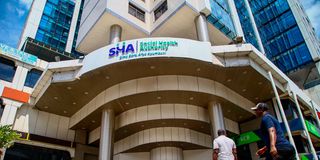
The Social Health Authority building in Nairobi.
Below DHA in the chain are operations handled by a consortium led by Safaricom, which partnered with Konvergenz Network Solutions and the UAE’s Apeiro Limited to supply a Sh104 billion digital system.
Apeiro Limited was given control of e-claims processing by Safaricom under a contract worth more than Sh5 billion. It runs the platform that links SHA payments to hospital bank accounts.
“Apeiro is in charge of the Hospital Information Systems and claims verification. They decide the amount of money hospitals receive,” the insider said.
When a hospital submits a claim, it first goes to SHA for review. Doctors and clinical officers paid by SHA but supervised by DHA review the claims before approving or rejecting them.
Approved claims are then forwarded to Konvergenz Network Solutions for further approval.
Public procurement records show that Konvergenz has, over the years, secured government contracts for cybersecurity and computer-related supplies.
But Konvergenz does not make payments directly either. It has subcontracted e-claim payments to Finsprint, the company Ms Onyango said SHA officials referred her to.
Finsprint controls the payment gateway. It holds the banking details of every hospital in the system because it is the entity that transfers the money to hospitals’ accounts.
Once the firm receives the amount payable to each hospital, it reportedly deducts two per cent, described as logistics costs, before remitting the balance to the hospital’s bank account, unless there is a hitch such as incorrect account details, as happened in Ms Onyango’s case.
Dr Brian Lishenga, who spoke to the Nation before resigning as secretary-general of the Rural and Urban Private Hospitals Association of Kenya on Friday, said members had never been given an explanation for the two per cent deduction.
“We are rendering services to patients, SHA is supposed to pay us, and then we are told that two per cent of what we are owed is being deducted for logistics. Logistics to do what? Nobody has ever sat us down and told us where that money goes or who it goes to,” Dr Lishenga said.
“Is this even legal? Were hospitals consulted before this deduction was introduced? Because from where I sit, that is not something we agreed to,” he added.
Another hospital administrator, who runs a mid-level facility in Nairobi, said the deduction had become a source of quiet frustration among facility owners who felt they had no avenue to challenge it.
Since its inception, SHA says it has paid health facilities Sh146 billion. Assuming the private company handled all these claims, the two per cent deductions would amount to about Sh2.9 billion.
According to a search conducted by the Nation at the Business Registration Service on July 1, 2026, Finsprint Limited is a private company incorporated on July 12, 2020, with a nominal share capital of Sh100,000.
The company has two directors: Issa Sheikh Mohamed of Nairobi and Abdulhakim Ibrahim Sheikh of Mombasa. Mr Ibrahim holds 425 of the company’s 1,000 shares. Mr Mohamed is also one of the owners of Konvergenz Network Solutions.
The remaining 575 shares, representing the controlling stake, are held by a company known as Impactsoft Technologies Group Limited. Registry documents identify Impactsoft as a Kenyan entity but provide no address.
The two Finsprint directors did not respond to the Nation’s questions on the company’s role in paying hospital claims, when it signed the contract, with whom, and for how long.
“We have so many companies on this digital superhighway,” the DHA insider said.
The insider described a system in which SHA officials have no visibility into why a hospital has not been paid, no ability to intervene, and no authority over the companies actually moving the money.
“We cannot complain to SHA because SHA says it is not their system. We cannot complain to the company because we were never officially introduced to them. So who do we take this to? We are just watching money leave our claims and go somewhere we cannot account for,” Ms Onyango said.
“All along, we have been made to understand that it is SHA making these payments, then our members are being sent to other people to ask about their payments. Why was it not made public that they are officially managing the claims so that hospitals are aware?” Dr Lishenga asked.

The Rural Private Hospitals Association of Kenya chairman Brian Lishenga.
Since its launch, SHA has been presented to Kenyans as the government’s own system — a public institution collecting contributions, processing claims and paying hospitals. Documents seen by the Nation and a recent Auditor-General’s report, however, reveal a far more complex reality.
The Sh104.8 billion system is run, at nearly every critical point, by the private consortium. The government neither owns nor controls the system. All intellectual property rights belong to the consortium.
Auditor-General Nancy Gathungu flagged this in a damning audit report, noting that the contract for the SHA system was procured without competitive bidding, contrary to constitutional and statutory requirements.
The report concludes that the contract is not in the public interest.
The Auditor-General’s findings add a financial dimension to what the insider described as an operational problem.
For every Sh100 Kenyans contribute to SHA, Sh2 goes directly to the owners of the private system. For every Sh100 claimed by a hospital, another Sh5 goes to the same private entity. The consortium also charges 1.5 per cent for tracking services.
The Auditor-General said the fees divert billions of shillings that should otherwise be used to settle medical bills.
Over the 10-year life of the contract, the private consortium is projected to collect Sh111 billion from member contributions, health facility claims and track-and-trace charges.
The audit found that the procurement process bypassed competitive bidding, which the Auditor-General flagged as a breach of constitutional and statutory requirements.
Earlier, Safaricom and its consortium partners hired a new firm to address critical failures in the SHA claims portal.
Savannah Informatics was contracted by Safaricom to provide a portal for processing claims submitted by private health facilities.
The new firm was brought in to ease mounting pressure from private hospitals and the public.
Questions nevertheless remained over long-term planning, cost transparency and the future of Kenya’s healthcare reimbursement framework. Similar concerns continue to surround the current arrangement.
When the Nation sought SHA’s response, the agency said in a statement: “SHA pays contracted hospitals directly from the funds it manages.”
The statement cited Section 36 of the Social Health Insurance Act, which provides: “The Authority shall make payments to a contracted healthcare provider or healthcare facility upon submission of a claim by the Claims Management Office.”
“SHA makes payment after the Claims Management Office submits a claim,” the agency said.
It added that Section 35 establishes the Claims Management Office within SHA, whose mandate includes reviewing, processing and validating claims, assessing them against the approved benefits package, issuing pre-authorisations, undertaking quality assurance and detecting fraud.
SHA said the digital health consortium only provides the technology supporting claims processing. It does not approve claims, control SHA funds or pay hospitals.
The agency said the parties’ roles are governed by a Service Level Agreement that sets service standards, resolution timelines, reporting requirements and escalation procedures.
The response, however, did not address several of the Nation’s specific concerns, including those relating to Finsprint.
It also did not explain why Ms Onyango said SHA officials told her they could not resolve her payment problem and instead referred her to Finsprint.
Health Cabinet Secretary Aden Duale also did not respond to the Nation’s queries.
Follow our WhatsApp channel for breaking news updates and more stories like this.