Hospitals across the country are struggling under the weight of unpaid claims amounting to nearly Sh27 billion.
A report by the Controller of Budget (CoB) shows that the Social Health Authority (SHA) owed county health facilities at least Sh26.87 billion as of March 31, more than three times the Sh8.29 billion that was outstanding at the end of December 2025.
The ballooning debt comes despite repeated assurances by President William Ruto that SHA is working and that health facilities are being reimbursed promptly.
When the authority was launched in October 2024, it was hailed as a transformative model that would guarantee all Kenyans affordable and accessible healthcare. It replaced the National Health Insurance Fund (NHIF) with the Social Health Insurance Fund (SHIF).
But the CoB report paints a grim picture of health facilities teetering on the brink of financial collapse.
The report revealed that Nakuru County bears the biggest burden of the debts as it is owed Sh2.81 billion by the Facility Improvement Fund, of which Sh2.4 billion is owed by SHIF and Sh432.9 million by the defunct NHIF. Kakamega County follows with Sh1.3 billion owed, with the defunct NHIF accounting for Sh241.4 million as of March 31.
Nyeri is owed Sh632 million by SHIF and Mombasa Sh596.7 million, where SHIF accounts for Sh357.1 million and NHIF Sh239.6 million.
Kiambu is owed Sh474.8 million by SHIF, Garissa Sh429.48 million by both SHIF and NHIF, Bomet Sh421.69 million with NHIF accounting for Sh54.2 million, Homa Bay Sh390.3 million and Bungoma Sh358.5 million.
Kajiado County is owed Sh343.8 million, Kitui Sh333 million, Siaya Sh287.47 million, Kisumu Sh282.39 million, Elgeyo-Marakwet Sh197.86 million, Migori Sh185.4 million, Nyandarua Sh183 million, Tharaka-Nithi Sh173.1 million, Kericho Sh165.7 million, Embu Sh163.74 million, Busia Sh134.8 million and Kwale Sh127.3 million.
Others are Baringo (Sh98.3 million), Marsabit (Sh85 million), Machakos (Sh68.25 million), Narok (Sh67.4 million) and Samburu (Sh4 million).
Some 19 counties did not submit their data to the CoB; these are Nairobi, Taita-Taveta, Nyamira, Nandi, Murang’a, Meru, Mandera, Makueni, Isiolo, Kilifi, Kirinyaga, Laikipia, Lamu, Tana River, Trans Nzoia, Uasin Gishu, Vihiga, Wajir and West Pokot.
Speaking on June 13, Interior Principal Secretary Raymond Omollo said over 31 million Kenyans had registered under SHA, and 11,034 health facilities contracted. He went on to state that more than Sh147 billion had been paid out in claims by SHA since its launch in October 2024 to support healthcare access across the country.
However, only some 4.8 million Kenyans have been contributing to the authority, with four million being salaried and 890,000 from the informal sector, leading to a total collection of Sh70 billion.
Kenya Medical Practitioners and Dentists Union and Rural Private Health Association have criticised SHA for failing Kenyans due to unpaid claims and poor governance. For instance, by August 2025, they said SHA had paid roughly Sh53 billion against Sh96.2 billion in claims.
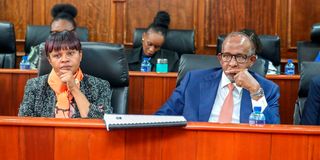
Appearing before the Senate County Public Accounts Committee on June 16, Homa Bay Governor Gladys Wanga revealed that her administration is owed some Sh350 million by SHA.
Although the governor told the committee chaired by Homa Bay Senator Moses Kajwang’ that reimbursement by SHA has been an improvement on the earlier system by NHIF, she said there is need for the authority to settle claims within reasonable timelines to ensure continuity of services.
“Every treatment you file the claim, but the money doesn’t necessarily come back to you on time. SHA owes us approximately Sh350 million for the health facilities in Homa Bay,” said Ms Wanga.
Nairobi Senator Edwin Sifuna said the situation showed there is a problem with SHA despite Kenyans having had to part with Sh104 billion for a system to support the authority’s operations.
“The money you are owed is almost a third of the collections being made by your health facilities. It shows there is a problem if you cannot have the money reimbursed on time,” said Mr Sifuna.
Kitui Senator Enoch Wambua added: “You and I, or every Kenyan worker is not in arrears in their contributions to SHA, so there can never be an explanation why the government is holding onto Sh350 million. Imagine that it is just one county.”
“If SHA was working in Homa Bay or Kitui, the first person to know is the patient visiting a facility. We don’t need to tell them it is working,” he added.
Senator Kajwang’ went on: “What we must demand from Health Cabinet Secretary Aden Duale is an explanation of why the Sh350 million remains undisbursed to the facilities.”
Makueni Governor Mutula Kilonzo Jnr said his administration is owed a substantial amount of money for the 160 Level 2 and 3 health facilities in the county, amounts which they are in the process of reconciling with the arrears from 2025.
He said the delay in reimbursements is a big issue that has created many challenges, including difficulties in procurement of commodities, purchase of equipment and hiring and paying employees.
“We thought the system will be smooth but it is not. I think where there is no fraud flagged, SHA should pay promptly,” said Mr Mutula.
Nyeri Governor Mutahi Kahiga said the huge amounts owed “has a big impact because we are not able to pay Kemsa [Kenya Medical Supplies Authority] in order to access its services, including drugs” .
National Assembly Majority Leader Kimani Ichung’wah last week launched a scathing attack on governors, accusing them of sabotaging SHA. He claimed they are collecting money from health facilities and spending it on other county activities.
“It is not SHA that is not working; it is your theft and greed that we cannot satisfy,” said the Kikuyu MP.
However, SHA has been dogged by a myriad of challenges, including operational inefficiencies and fraud claims. The glitches in the SHA system, including delays with One-Time Passwords (OTPs), have sometimes persisted for almost a week, forcing health facilities to revert to manual processes, affecting service delivery in the process.
OTPs are used to obtain patients’ consent before retrieving their biometric details, authorising providers to access the SHA portal, approving medical procedures and dispensing medication.
Sometime last year, the Ministry of Health suspended 40 health facilities across Kenya from the national health insurer’s providers list, with 1,188 fraud files involving forged records and inflated claims submitted to the Directorate of Criminal Investigations for action.
In February this year, Mr Duale revealed that more than Sh12.7 billion worth of suspicious claims had been rejected between April and November last year alone, with private health facilities leading in fraudulent reimbursement claims. He said that private facilities account for 59 per cent of the already flagged reimbursement claims, followed by county health facilities, which accounted for 21 per cent or Sh2.6 billion. Faith-based health facilities had claims worth Sh1.4 billion flagged, while national referral hospitals accounted for Sh1.1 billion or 9 per cent.
The CS said 58 per cent of the rejected claims are due to missing records, including facilities submitting claims for reimbursement without attaching claim forms, some of the attached claim forms having the same handwriting, birth notifications not provided for maternity claims, and some facilities presenting outrageous numbers for Caesarean operations.
He said that the digital system run by SHA has been able to detect and reject such claims through the use of artificial intelligence-driven claims management.