Ruto leads Africa's climate push in Ethiopia as continent seeks Sh167 trillion goal
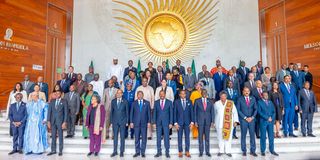
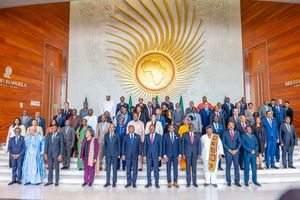
President William Ruto (front, fourth from right) and other presidents and heads of government during the second Africa-Caricom summit in Addis Ababa, Ethiopia.


In Addis Ababa, Ethiopia
The second Africa Climate Summit (ACS2.0) opened in Addis Ababa, Ethiopia, with one resounding message: Africa is not waiting to be saved; it is forging homegrown solutions to deal with climate change.
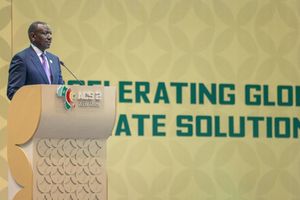
African heads of state, government representatives and thousands of delegates representing various outfits are participating in Africa’s largest climate gathering, which runs until Wednesday, September 10. It is themed, “Accelerating Global Climate Solutions: Financing for Africa’s Resilient and Green Development.”
ACS2.0, which is anchored on showcasing Africa-led solutions in areas such as renewable energy, adaptation, and scaling-up resources to unlock climate finance, echoes the message of the inaugural summit, ACS1, held in Nairobi two years ago, to position Africa as the “torchbearers” of impactful climate action.
The 2023 conference concluded with the adoption of the Nairobi declaration, which included positioning key sectors like renewable energy, trade and industry as the foundation of climate-positive growth.
Further, it formed a common position for the global climate negotiations held later that year, COP28. The declaration also called for reforms to the international financial architecture and a range of new global taxes to fund climate action.
Nairobi declaration: What's the progress?
The road from Nairobi to Addis Ababa tells a complicated story, one of progress marked by rising ambition yet shadowed by a widening gap in delivery.
In his opening address, Dr Abiy Ahmed, Prime Minister of Ethiopia, declared a fundamental shift in Africa’s climate narrative, stating that the continent’s story should not begin with what it lacks but “with what we have.” He outlined Africa’s vast assets, including its youngest population, the fastest-growing solar belt, and the planet’s last remaining carbon sinks in its ecosystems. “We are not here to negotiate our survival,” he said. “We are here to design the world’s next climate economy.”
President William Ruto, who also chairs the Committee of African Heads of State and Government on Climate Change, in his speech, celebrated the progress made in ACS1, saying, “Our potential is recognised, our voice is heard and our solutions are being deployed.”
During the opening ceremony, President Ruto also launched “Africa’s Journey of Climate Action and Partnership”, a report that details the progress made since 2023 and the challenges that still abound. While Africa has deepened regional cooperation, sectors like energy still lag.
The Nairobi declaration set a goal of 300 Gigawatts of renewables by 2030. Yet, the report reveals, the installed renewables rose by just 4.4 gigawatts between 2023 and 2024, hitting the 67 gigawatts mark.
President Ruto asserted that asserted that realising the vision of ‘Climate Positive Growth’ requires action on two fronts: “Africa must exercise its agency decisively, urgently, and coherently,” and “the international system must dismantle the structural barriers that continue to hold the continent back.”
On his part, Mahmoud Ali Youssouf, Chairperson of the African Union Commission, focused on the severe inequities in the global climate crisis. He noted that while Africa contributes less than four percent of greenhouse gas emissions, it continues to face disproportionate impacts.
Aligning with the summit’s theme, the chairperson declared that “climate finance must be fair, significant and predictable.” He called for a genuine loss and damage fund with sufficient resources and for carbon credits to be managed by an independent international body, not polluting states.
He also urged that the vulnerability of African nations, exacerbated by debt and an unequal financial architecture, “must be redressed through climate justice and genuine cooperation”, including the provision of financial resources, technology, and expertise to implement the continent’s adaptation plans.
ACS2 comes at a critical point with just two months to the global climate negotiations, COP30 in Belem, Brazil. Also, just a month after the SB-62 meeting in Bonn, a gathering meant to lay the groundwork for the November negotiations. Observers said that the Bonn conference ended with glimmers of hope but also gaps in trust in the roadmap to ensuring that developing countries secure US dollars 1.3 trillion annually by 2030 from developed nations, money owed due to historical greenhouse gas emissions.
Many outcomes
It is expected that the summit will deliver many outcomes, including the adopted Addis Ababa Declaration that will present a unified African voice ahead of COP30 in Brazil and beyond.
The solutions, civil societies insist, must be anchored on those that do more good than harm.
“A successful ACS2 must renew Africa’s climate and development vision. It must inspire the spirit of optimism and confidence about the future of our continent and its people. It must address Africa’s major challenges, notably hunger, poverty, conflict, debt, energy poverty, and infrastructure deficiencies.
"Thankfully, Africa has immense potential, and this summit must resolve the paradox of lack in abundance - the most arable land, mineral resources, abundant renewable energy potential, and a vibrant and educated human capital. If ACS2 can renew our commitment to Agenda 2063 and plan for its implementation, this summit will have exceeded expectations,” offers Mohamed Adow, Power Shift Africa executive director.
Emmaqulate Kemunto, Africa Regional Campaigner at ActionAid International, says: “At this Summit, we need Africa’s heads of state and policymakers to ensure that the deals and commitments made deliver a just transition for Africa, by Africa. This means, for instance, committing only to climate financing mechanisms, partnerships and pathways that centre the needs and rights of the people of Africa and not of polluting countries and corporations.”
In a response to the central theme of the second Africa Climate Summit, a coalition of the continent’s largest financial institutions has committed to mobilising an unprecedented $100 billion towards financing Africa’s resilient and green development.
The landmark announcement, made at a side event on Africa’s Green Growth and Industrialisation Agenda presided over by President William Ruto, signals a seismic shift towards domestic resource mobilisation. It directly answers the summit’s urgent call to “accelerate global climate solutions” by transforming African ambition into bankable projects.
“This was never just an energy target. It was an economic strategy,” he stated, framing the massive green investment as a pathway to “sovereignty” and a competitive place in the modern global economy. He hailed the banks' commitment as a critical step in overcoming fragmented investments and scaling up homegrown solutions.
Joshua Oigara of Stanbic Bank declared, “We’re mobilising resources within the continent,” outlining an immediate plan to assemble $15 billion. This is part of the broader nine-figure pledge. Furthermore, Oigara committed to increasing Stanbic’s own green lending portfolio from 20 percent to 35 percent by 2028, asserting, “There is magical capital and resources on the continent.”
The consortium, which included banking giants Equity Bank, Afreximbank, Ecobank, and Kenya Commercial Bank (KCB), was commended by Principal Secretary for Energy Alex Wachira. “For Kenya, this initiative is central to accelerating our shift towards clean energy systems,” he said, “while unlocking opportunities for green jobs and industrial growth.”