State agency KNCHR declares nurses’ strike a human rights crisis as death toll rises

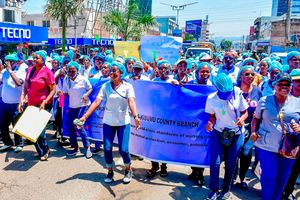
Nurses from Kisumu, Siaya, Homa Bay and Migori counties take part dancing, chanting and singing during a joint procession in Kisumu on August 27, 2026, in solidarity with the ongoing nurses’ strike.

The Kenya National Commission on Human Rights (KNCHR) has declared the nationwide nurses' strike a "national public health and human rights crisis", saying that it is "deeply concerned" that the dispute has escalated "from a labour dispute into a national public health and human rights crisis", requiring urgent intervention at the highest levels of the national and county governments.
In a press statement, Claris Ogangah, the commission's chairperson, noted that the disruption threatens the rights of patients to life, the highest attainable standard of health, emergency medical treatment and dignity.
The human rights state agency spoke as the Every Woman Every Newborn Everywhere (EWENE) dashboard showed that 15 mothers, 28 neonates and 83 babies born immediately before, during or after birth had died between Monday and Saturday this week.
The EWENE dashboard is a tracking tool used by governments and health organisations to monitor and compare maternal and newborn health indicators.
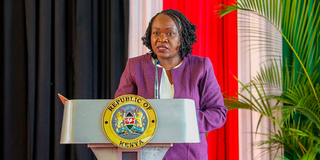
Kenya National Commission on Human Rights (KNCHR) Chairperson Claris Ogangah during the presentation of the Framework for Reparations for Victims of Human Rights Violations at State House, Nairobi on June 15, 2026.
“The Commission calls upon the Kenya Medical Practitioners and Dentists Council (KMPDC), in collaboration with the Ministry of Health and relevant county health authorities, to urgently and independently verify the reported deaths and their circumstances; establish whether mortality during the strike exceeds the levels recorded during the corresponding period in 2025 and other relevant baseline periods; and make its findings public. While an independent assessment is needed to establish the causes of the reported deaths, the situation requires urgent action to prevent any further loss of life," said Ms Ogangah.
KNCHR grounded its intervention in Article 43 of the Constitution, which guarantees every person the right to the highest attainable standard of health and provides that no person may be denied emergency medical treatment. The Constitution, it noted, "also protects the right to life and the inherent dignity of every person."
"The continued disruption of health services exposes patients to preventable suffering, indignity and loss of life, and undermines the realisation of universal health coverage. Health services must remain available, accessible, acceptable, of adequate quality and affordable, particularly for low-income households, indigent persons and other vulnerable groups. When public hospitals cannot provide essential services and patients are compelled to seek costly private alternatives, the right to health is placed beyond the reach of those who need it most," said Ms Ogangah.
At the same time, Ms Ogangah affirmed the rights of the striking health workers, noting that they have constitutional rights, including the rights to fair labour practices, fair remuneration, safe and optimal working conditions, dignity, collective bargaining and lawful industrial action.
Ms Ogangah stated that "nurses are the backbone of healthcare delivery and must be accorded working conditions and compensation commensurate with the vital and often high-risk services they provide."
The national government and county governments, said the commission's chairperson, "must honour collective bargaining agreements concluded with nurses and other health workers, including the 2017 CBA."
"The continued disconnect between the two levels of government and among state agencies in resolving these obligations is unacceptable and must be addressed without delay. The Commission is further concerned by reported threats, intimidation and attacks against nurses exercising their right to peacefully demonstrate and present petitions. The prolonged dispute cannot be allowed to develop into a wider public health emergency," said Ms Ogangah.
"Patients must be placed at the centre of the negotiations and response. The Commission is particularly concerned about the disproportionate impact on expectant and new mothers, newborns and neonates, children, older persons, persons with disabilities, patients with chronic illnesses and other marginalised groups. These groups require heightened protection and continuity of essential services, including maternity, neonatal, emergency, ICU, dialysis, oncology, trauma, ambulance and referral care," she added.
The Commission has now issued eight specific calls to action. It urged the Ministry of Health, working with county governments, to immediately coordinate a national emergency response to guarantee continuity of essential and emergency services, including maternity, neonatal, ICU, dialysis, oncology, trauma, ambulance and referral care, and to publish an accurate assessment of affected services. The Commission also called on the Council of Governors and County Governments to honour the constitutional right to collective bargaining by fulfilling their obligations under the 2017 CBA and other applicable agreements, to urgently restore essential health services, activate contingency staffing and referral mechanisms, and ensure alternative arrangements do not impose prohibitive costs on patients who cannot afford private healthcare.
KNCHR's intervention lands nearly six weeks into a strike that has already left a documented trail of maternal and newborn deaths.
Nurses have been on strike for 42 days. Laboratory officers, public health officers, nutritionists, pharmaceutical officers, clinical officers and Universal Health Coverage (UHC) workers have been on strike for nearly 50 days.
"Far fewer women are reaching our facilities at all, and those who do face much higher risk. We are working to obtain updated facility data so that we can show the full picture of the mothers who are now delivering outside the healthcare system and our facilities, which are unrecorded and still unsupported," said Collins Ajwang, president of the National Nurses Association of Kenya.
The nurses’ dispute dates back to 2017, when a six-month strike ended with a return-to-work agreement that promised a Collective Bargaining Agreement (CBA) within a month. Nearly a decade later, union officials say the agreement and broader return-to-work formula remain unimplemented. They accuse the Council of Governors, Salaries and Remuneration Commission (SRC) and Ministry of Health of delaying the process.
The Council of Governors disputes the union’s position, saying the 2017 deal was a Memorandum of Understanding rather than a CBA and that implementing the nurses’ demands would cost counties about Sh6 billion annually. COG Health Committee Chairperson Abdulswamad Shariff Nassir said the strike is not about delayed salaries or promotions, but the 2017 agreement and the absorption of Universal Health Coverage workers.
Counties have offered to double nurses’ risk allowance from Sh3, 850 to Sh7, 000, but say union demands exceed allowances paid to other health cadres. They also say UHC workers are being absorbed permanently and that counties are working on career progression guidelines.
With a court process challenging the strike underway, the Kenya National Commission on Human Rights has urged all parties to negotiate urgently, honour court orders and ensure essential health services continue. It has also called for alternative healthcare access, independent verification of reported deaths and predictable funding for county health services.
Follow ourWhatsApp channel for breaking news updates and more stories like this.