Step up Ebola screening in Busia, truck drivers ask State
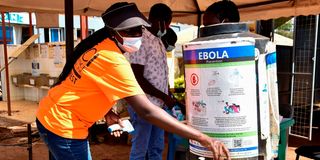
A medical worker controls the sanitisation point for travellers accessing port health services at the Busia One Stop Border Post.

What you need to know:
- For long-haul truck drivers moving between Kenya, Uganda, and beyond, the journey is fraught with health risks and minimal localised medical infrastructure.
- As one of the busiest land crossings between Kenya and Uganda, Busia is flagged as a high-risk transit hub for potential cross-border transmission.
A week after Kenya confirmed its first imported case of Ebola, anxiety remains at the busy Busia border. While official reassurance flows from health authorities, the reality on the ground tells a story of unease, porous routes, and frontline workers and truck drivers navigating a high-stakes crossing with little to no active screening.
For the thousands who cross the border daily for trade, work, and sustenance, the atmosphere is defined by a mix of confusion and fear.
For long-haul truck drivers moving between Kenya, Uganda, and beyond, the journey is fraught with health risks and minimal localised medical infrastructure. As one of the busiest land crossings between Kenya and Uganda, Busia is flagged as a high-risk transit hub for potential cross-border transmission.
Benson Muthike, a truck driver plying these routes, explains that the initial panic over the outbreak left drivers feeling entirely exposed. Muthike notes that despite travelling vast distances across borders where exposure is high, rigorous medical checks at transit points are sparse.
“Especially as drivers here on the road, because of that panic regarding last week’s Ebola announcement, we ask the government to show more care. We ask both sides where we are coming from and where we are going to pay careful attention. I haven’t seen anyone asking questions, checking my temperature, or anything else; I haven’t seen it,” said Muthike.
Sharing this frustration is fellow truck driver Juma Minani, who points out that while health protocols exist on paper, implementation along major transport corridors remains inconsistent.
“As drivers, our safety is not guaranteed, meaning there is no hospital... if you as a driver get a problem, you treat yourself. The government should help us and put recognised hospitals along the road so that if a problem happens, people can get help nearby,” says Minani.
On the residential side of Busia, anxiety is mounting as locals watch cross-border movement occur largely unmonitored away from the main highway.
Frank Okaka, a resident, emphasises that the public needs aggressive civic education to understand the threat and bridge the information gap.
“I would like to urge our government to look after its citizens because citizens are crossing casually on foot. The government should also sensitise people and provide training because many do not know about Ebola,” says Okaka.
Gabriel Opakasi, Chairperson of the Busia Traders Union, acknowledges that while formal screening is visible at customs checkpoints, informal entry points remain wide open.
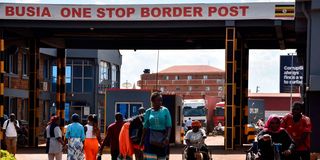
Members of the public walk past the Busia One Stop Border Post crossing-point between Kenya and Uganda on October 8, 2026.
“We have a major problem because people cross through panya (unofficial) routes that are not currently screened,” said Opakasi.
Opakasi stresses that local traders and residents are exposed unless screening apparatuses are scaled up to cover boat landings, rural paths, and informal footbridges.
Lucia Waruguru, a resident, echoes the call for heightened screening, noting that public compliance relies entirely on visible, consistent government action.
“Now we see people washing hands and authorities putting strategies in place, but because this is serious, the government must test people so that we stop fearing this disease.”
Another resident, Frank Okoko, expressed concern over the volume of unchecked movement along the border, calling for intensified public awareness campaigns.
“There needs to be civic education about the ongoing screening exercise. Some people do not understand the severity of the disease and are putting lives at risk by bypassing health checks,” he said.
“Screening should not be limited strictly to the border line. Authorities should conduct random checks on passengers inside public transport vehicles like matatus,” he said.
The concerns come following continuous assurance by Health Cabinet Secretary Aden Duale that Kenya has intensified surveillance and enhanced screening at 15 points of entry following regional concerns about Ebola.
The CS has ruled out closing Kenya’s borders to maintain the free flow of goods and people, but urged the public to be vigilant.
“Kenya remains open. In line with World Health Organization advice, there are no restrictions on travel, trade, transport or public gatherings, and no lockdown is in place. Airports, seaports and border points are operating normally, with enhanced health screening. Kenya continues to welcome visitors, investors and partners, and will keep the international community informed through regular, transparent updates,” said CS Duale.
Health experts, however, raised concerns about the need for enhanced screening at the border, following the reported case.
“This case carries a hard lesson. Screening at the border is necessary, yet it is not enough. A patient who passed port screening was ultimately identified because a clinician at a health facility suspected a viral haemorrhagic fever and acted on it,” said Peterson Wachira, National Chairperson for the Kenya Union of Clinical Officers (KUCO), in an earlier statement.
On October 11, the Health Cabinet Secretary said, “All 122 contacts of the imported case have been listed and verified, with 108 already placed in quarantine, being monitored daily, and none have developed any symptoms thus far.
Tracing of the remaining contacts is continuous, working with international partners where needed, and surveillance is active around the clock.
As of October 11, of 293 samples tested from 289 alerts, only the confirmed case has been positive. To date, 667,675 travellers have been screened at 26 points of entry.”
Additional reporting by George Odiwuor
Follow our WhatsApp channel for breaking news updates and more stories like this.