The converts: How reformed midwives are ending maternal deaths
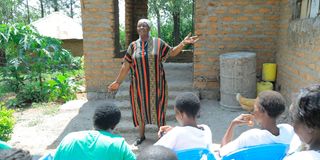
Hellen Achieng, a reformed traditional birth attendant, speaking to members of Yiero En Mari Women group at her home in Wiga Village, Homa Bay County on October 1, 2025. The team shares health messages meant to save lives.

What you need to know:
- In Kenya, the 2022 Kenya Demographic Health Survey indicates that 89 per cent of deliveries were conducted under the care of a skilled birth attendant. But that leaves 11 per cent exposed to risk.
- The11 per cent deliveries were conducted under the care of unskilled persons exposed the women to non-hygienic practices, making it unsafe to the mother and baby.
The afternoon sun beats down mercilessly across Homa Bay County, but beneath the sprawling branches of a tree in Wiga village, a cool breeze offers respite. Here, dozens of middle-aged women sit on plastic chairs, their attention fixed on Hellen Achieng as she speaks with the quiet authority of someone who has seen both triumph and tragedy in equal measure.
Among the listeners is Eunice—not her real name—her pregnancy evident, her presence at this gathering marking a turning point. She has been invited to learn about skilled delivery, and the women of Yiero en Mari, a name that translates from Luo as "the choice is yours," are determined to ensure she makes an informed one.
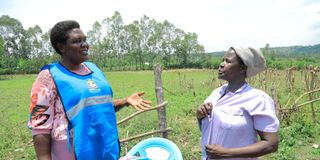
Community health promoter Winnie Aketch (left) talking to Mary Adoyo about health issues in Akele Village in Homa Bay County on October 1, 2025.
At 52, Ms Achieng stands before the group not as the traditional birth attendant (TBA) she once was, but as something perhaps more powerful: a convert with a mission. Her message is simple yet profound.
"Anything can go wrong when you choose to deliver under the care of an unqualified person," she tells the gathering, her voice carrying decades of experience. "For a mother's safety and that of the baby, a hospital should be our first resort."
The irony is not lost on her. For nearly 20 years, Ms Achieng was the person pregnant women turned to when hospital doors seemed too far away or too forbidding. Now, she spends her days undoing that legacy, one woman at a time.
A practice born of necessity
Ms Achieng's journey into traditional birth attendance began in 1986, shortly after she sat her Form Four national exams. A local non-governmental organisation offered training on how to attend to delivering women, and she embraced it. In her early 20s, she began a career that would define the next two decades of her life.
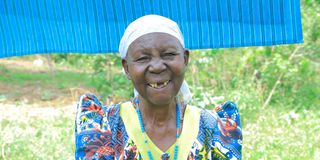
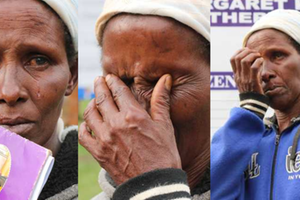
Damaris Nyadianga, a reformed traditional birth attendant.
From her home, she offered a full spectrum of maternity care. Women would arrive during pregnancy, and she would massage them—a practice meant to relieve body pains and position babies correctly for birth. When their time came, they would deliver in her care and leave with their new-borns in their arms. "I would also massage the women, a practice that would relieve them from general body pains and also help put the baby in the right position ahead of birth," she recalls.
At the time, her services filled a desperate gap. Maternal deaths from unskilled delivery were alarmingly common. The nearest facility, Homa Bay Teaching and Referral Hospital, remained out of reach for many due to poor roads and lack of transport. The alternative, Ogande Health Centre, only operated during daylight hours.
"Many deliveries would happen late in the night," Ms Achieng explains. "We, therefore, remained the only hope to the women, especially those from humble backgrounds." But hope, she learned, was not enough.
The hidden dangers
Despite her training, Ms Achieng and her fellow traditional birth attendants lacked essential equipment. They worked without gloves, exposing mothers, new-borns, and themselves to infection.
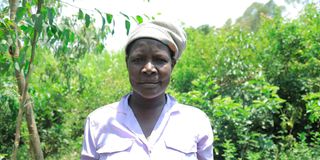
Mary Adoyo. She lost her daughter during delivery in 2019 due to postpartum hemorrhage.
As HIV rates climbed in the community, the risks multiplied. Previous studies revealed that mother-to-child transmission of HIV in the early 2000s stood at 25 per cent, though this has since dropped to 7.28 per cent in 2024, according to data from the Centre for International Health, Education and Biosecurity Kenya.
The technical challenges were equally daunting. When a baby was in breech position, Ms Achieng and her peers often lacked the skills to turn it, leading to suffocation and death. Women who suffered prolonged labour but couldn't afford care at equipped facilities would lose their lives and their babies. "Another major challenge was heavy bleeding, which resulted in multiple deaths," she says, her voice heavy with the weight of memory. "In such situations, we would be helpless. There was nothing we could do to save the women."
The community did not welcome these deaths. Cases were reported to authorities. Neighbours turned hostile. The job, once seen as noble, became increasingly dangerous. "Over the years, the job only got riskier," Ms Achieng admits. "I had to quit over fears of landing in the hands of authority over maternal deaths."
In the early 2000s, she finally walked away, taking a position as a matron at a neighbouring school. But her desire to help pregnant women never faded. It simply transformed.
A new mission
Rather than attend deliveries, Ms Achieng decided to prevent the complications she had witnessed. She would advocate for skilled delivery—births attended by trained medical professionals in equipped facilities. "We played our part at the time when skilled health workers were limited," she reflects. "Over the years, however, we have had more hospitals being constructed, equipped with the provision of skilled hospital staff. As TBAs, we are never in a position to handle delivery complications, and that only puts the lives of the women at risk."
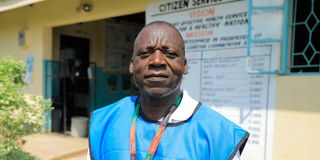
Tobias Mangiti, a Community Health Promoter.
The group she helps lead has become a quiet force for change. Through their health talks on maternal health, more than 50 women from different groups in Wiga Village who were initially opposed to skilled delivery have since given birth in health facilities across the county. After hours of training, the women gather to share their progress, to plan their next steps and to celebrate their victories.
"We are also looking forward to seeing Eunice experience her first skilled delivery next month, thanks to our continued awareness creation," Ms Achieng says with evident pride. Her efforts, combined with those of other reformed traditional birth attendants and maternal health initiatives, have helped Homa Bay County achieve a remarkable milestone.
"Homa Bay has achieved a monumental milestone, having reported zero maternal deaths over the last five years," declared Governor Gladys Wanga during a past event. "This is the power of unified action. When leadership, health workers, and communities unite, we save lives."
The stakes are high
The importance of skilled delivery extends far beyond individual stories. Dr Laura Oyiengo, a maternal and new-born health specialist at the United Nations Children's Fund, explains that skilled delivery ensures pregnant women are attended to by health staff trained to conduct deliveries in a safe and hygienic manner. When complications arise, these professionals can identify and manage emergencies in a hospital setting.
Dr Onyango Ndong'a, an obstetric gynaecologist at the Kisumu County Referral Hospital, puts it more bluntly: "The essence of modern obstetrics and skilled delivery is to prevent maternal morbidity and mortality, and similarly prevent neonatal morbidity and mortality." The risks of unskilled delivery are well-documented. Dr Ndong'a cites studies from parts of Africa showing an increased risk of maternal mortality by up to 32 per cent, increased risk of postpartum haemorrhage by up to 25 per cent, neonatal mortality by up to 15 per cent, and birth asphyxia by up to 18 per cent during unskilled delivery.
"Unskilled attendants might fail to identify early signs of abnormal labour, leading to a protracted labour path resulting in birth asphyxia, leading to neurological conditions," he explains.
The World Health Organization (WHO) cautions that every woman should have access to skilled care during pregnancy and delivery to ensure the detection and management of complications. The agency estimates that one woman dies needlessly of pregnancy-related causes every minute, representing more than half a million mothers lost each year.
Another eight million women experience lifelong health consequences from pregnancy complications.
Every woman, rich or poor, has a 15 per cent risk for complications around the time of delivery, the agency notes.
Progress and persistent gaps
Globally, the picture is improving. Unicef data from 2023 revealed that Sub-Saharan Africa and Southern Asia have made the greatest progress in increasing coverage of births assisted by health professionals. Since 2000, coverage of births by skilled birth attendants in Sub-Saharan Africa has grown by over 30 percentage points. Health professionals assisted 86 per cent of births globally in 2023.
Yet, gaps remain. Only 74 per cent of births in Sub-Saharan Africa were attended by a medical doctor, nurse, or midwife. More troubling still, only 64 per cent of births were delivered in health facilities in the region.
The projections are sobering. Sub-Saharan Africa will experience a 15 per cent increase in the number of annual births between 2020 and 2050. If current coverage of skilled delivery stays the same, approximately 141 million births in sub-Saharan Africa will occur without the assistance of skilled health personnel between 2022 and 2030. "Skilled health personnel, including medical doctors, nurses and midwives, are trained to handle normal deliveries safely," a Unicef report noted. "They are also able to recognise warning signs for complications and refer mothers to emergency care in case of complications like haemorrhage or sepsis, which are the leading causes of death among mothers during and after childbirth."
In Kenya, the 2022 Kenya Demographic Health Survey (KDHS) indicates that 89 per cent of deliveries were conducted under the care of a skilled birth attendant. But that leaves 11 per cent exposed to risk.
"The remaining 11 per cent deliveries conducted under the care of unskilled persons exposed the women to non-hygienic practices, making it unsafe to the mother and baby," Dr Laura says. "If a complication arises, the chances of the death of mother and baby are high. There is also a risk that the mother and baby will not receive the recommended post-delivery care."
The price of a single night
For Mary Adoyo, 52, from Kanyada in Homa Bay County, these statistics are more than numbers. They are the story of her daughter's death.
Marren Akinyi was 20- years-old and diligently attending antenatal care clinics at Homa Bay County Referral Hospital. But when labour began one rainy night towards the end of 2019, the roads were impassable. Unable to reach the health facility, Marren opted to visit a traditional birth attendant within the locality. By morning, she had delivered a baby girl.
That evening, when Ms Adoyo went to visit her daughter (Marren) at the TBA's home, she found her lying in a pool of blood. "She asked me to hold the baby while saying she was tired in a faint voice," Ms Adoyo remembers. These were the last words she heard from her daughter.
Ms Adoyo immediately contacted her village Community Health Promoter, who arranged for Marren to be referred to a health facility. But it was too late. She was declared dead on arrival. Health experts determined she had succumbed to postpartum haemorrhage, severe bleeding after childbirth. She arranged for her daughter's body to be preserved at the hospital mortuary, then travelled home as the custodian of her granddaughter.
"The first night was one I will never forget," she says. "The new-born could not stop crying due to hunger. Meanwhile, the only meal I could offer was warm water."
She continued feeding the baby warm water the following day before managing to purchase baby formula. But the product was expensive, forcing the family to resort to cow milk.
"We would get two small glasses of cow milk daily for Sh20," Ms Adoyo recalls. The expense burdened a family already struggling financially. She found herself unable to engage in farming, the sole economic activity that sustained her household, in order to care for the young one. The baby's sickly nature added to the challenges.
Despite everything, little Marren Akinyi, named after her late mother, has continued to grow and thrive.
"I still believe that had we sought delivery at a health facility, my daughter would have been alive today to take care of her baby," Ms Adoyo says, fighting back tears. "I am, however, determined to ensure my granddaughter's well-being. She reminds me of my late daughter."
She pauses, then adds a haunting detail: "I suffered an almost similar challenge while delivering. After realising I had lost a lot of blood, the doctors had administered an injection that helped stop the bleeding. I am alive today, thanks to the doctor's interventions."
A global crisis
WHO estimates that postpartum haemorrhage tops the list as the leading cause of maternal deaths, followed by preeclampsia and eclampsia, infections, complications arising from unsafe abortion, and obstructed labour.
The numbers are staggering: 260,000 women died during and following pregnancy and childbirth in 2023. Ninety-two per cent of all maternal deaths occurred in low and middle-income countries. Sub-Saharan Africa and southern Asia accounted for 225,000 of these deaths—87 per cent of the total. Sub-Saharan Africa alone accounted for around 70 per cent of maternal deaths, equivalent to 182,000 lives lost.
Kenya's maternal mortality ratio currently stands at 355 per 100,000 live births, according to the 2022 KDHS.
Prof Moses Obimbo, a consultant obstetrician and gynaecologist, explains that skilled delivery is crucial for handling complications including excessive bleeding, obstructed labour, and uncontrolled blood pressure. Unskilled attendants, he notes, tend to underestimate blood loss, delaying recognition and referral.
Nearly all postpartum haemorrhage-related deaths are preventable if skilled birth attendance, essential products including blood, and functional referral systems are in place, he argues. "The SDG 2030 on Sexual and Reproductive Health aims to ensure everyone can access these services by 2030," Dr Ndong'a points out. "The fact that
141,000,000 women will still not have access to basic SRH services is ominous." The implications extend beyond individual tragedies. For development to occur, Dr Ndong'a argues, the population must be healthy. Unskilled labour poses a risk of death and loss of manpower. Unskilled deliveries, he says, tether a country to a cycle of poverty and indignation.
Reformed allies
Recognising the power of reformed traditional birth attendants, Homa Bay County is now working with them to improve maternal health indicators.
Tobias Mangiti, a Community Health Promoter from lower Kanyango, explains that they once trained alongside TBAs on the importance of hospital delivery. He had three TBAs in his community unit. One has since died; the other two have reformed.
"Whenever a pregnant woman visits the individual in need of delivery services, we can coordinate ourselves and ensure the women get to an equipped health facility," Mr Mangiti says. "Through our household visits, we are also able to identify pregnant women and refer them to a health facility to kick-start ANC clinics."
Among the reformed TBAs in his village is 78-year-old Damaris Waduma, who learned birthing skills from her mother. Ms Waduma abandoned her tools of trade in 2017 after practising for more than 52 years. She now advocates for skilled delivery. Since 2017, she has only massaged pregnant women to prepare them for delivery, always explaining why she no longer assists with births.
"During interactions, the women would share their fears of delivering at a health facility due to poor treatment by the skilled workers," she says. "I am, however, always ready to make them aware of the dangers of delivering at home, which has really helped."Unlike Ms Achieng, Ms Waduma says she was fortunate never to experience a single case of maternal mortality during her years of practice. She credits safety precautions, including referring women to health facilities immediately after birth for further medical attention.
"Currently, we also have Wiga Hospital, which operates both day and night, attending to the delivery of women to prevent home births," Ms Waduma notes. "The health facilities are equipped to diagnose the women in case of any pregnancy risk. The experts can also tell the position of a baby and recommend caesarean section and administer drugs to stop heavy bleeding."
The road ahead
Dr Ndong'a warns that declining donor funds and partner support spell doom for maternal outcomes. While modern obstetrics technologies and training to eliminate preventable adverse maternal outcomes are important, most advances are costly and out of reach for developing economies. "I, however, believe that our governments can re-prioritise health as a matter of national importance and improve financing to bridge the gap left by dwindling donor support," he says.
Dr Laura, who has lauded counties that have managed to reduce maternal deaths to zero for several months in a row, urges that the same efforts be made towards reducing new-born deaths. She points to the enactment of the Social Hospital Authority and the Facility Improvement Fund, which open up domestic resources for maternal and new-born health service delivery, as reasons for optimism.
"Though donor funding is reducing, the country is on a good trajectory to close gaps that withdrawal of donor funding may bring about," she says.
Prof Obimbo advocates for innovations within the healthcare system, including his initiative on the roaming blood bank to increase access to life-saving blood.
"Domestic resource mobilisation is the way to go," he says. "The country should focus on increased and protected funds for maternal and new-born health from the Social Hospital Authority. Strengthen data systems to prioritise investments and encourage communities to take up SHA."
Back in Wiga village, as the afternoon shadows lengthen, the meeting under the tree draws to a close. The women of Yiero en Mari gather their belongings, their conversations continuing as they prepare to leave. Somewhere among them is Eunice, armed now with knowledge that could save her life and that of her unborn child.