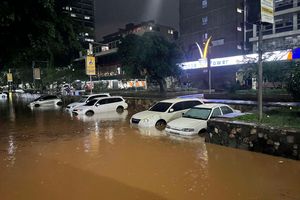
The heavy toll of floods on pregnant women and newborns
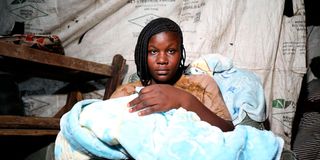
Cradling her child, Angela Peninah shares her experience as a mother navigating the aftermath of floods in Hazina, South B, Nairobi on March 12.


What you need to know:
- In the wake of sudden, violent floods, a humanitarian crisis is unfolding for the most vulnerable.
On a Friday night inside a pub in Nairobi’s Hazina Village, strangers took turns holding a week-old baby. The seats were too wet to sit on. The music had been switched off. They stood there until morning.
The baby’s mother, Angela Penina, 18, had waded through floodwater that was almost shoulder-high to get there. She had held her daughter above her head the entire way.
She is the baby’s only parent.
Angela lives a few metres from Ngong’ River in a single-room tin-roof house in Hazina Village, South B, on the Mukuru-Hazina side across from Mukuru-Kayaba. On that Friday evening, she was making chapati when she noticed the rain was getting heavier. It was around 8pm.
“It was sudden, there was no warning,” she says.
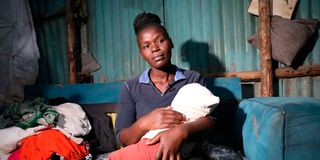
Millicent Lukeleshia reflects on the toll of flooding on families during an interview in Hazina, South B.
Water began seeping in under the door. At first it seemed like nothing. Then it kept coming. When Angela opened the door, it gushed in. There was no time to wait, no time to save anything. The dinner she had been making was swept away. Her first thought was her daughter, who had been sleeping inside.
“When I stepped out, I found the narrow alley had become a river,” she tells Healthy Nation. She lifted her daughter above the water, like some would when giving a heave offering, and moved. Even with the water at her shoulders, she kept her daughter up. The baby was a week old.
A few metres away, a night pub was open and fully operational. It was on slightly higher ground, so less water had made its way inside. Angela made her way there.
“My baby was just crying,” she recalls.
The revellers came out to help carry the baby as Angela tried to shield her from the rain and rising water. The pub managers put off the music. People who did not know her took over, one after another, through the night.
“We took turns to carry my baby. She was calm after some time. The managers were so empathetic. We could not sit because the seats were wet. We stood the whole night, holding the baby, taking turns with strangers,” she says.
“They took care of my child like their own.”
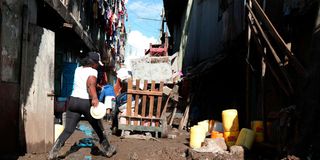
A woman carefully steps through the thick mud left behind by floodwaters in Hazina, South B, Nairobi on March 12. The flooding has severely disrupted daily life, destroyed homes, and raised concerns about health risks for local residents.
Angela says the experience broke her despite the help she received that night. The gratitude and the grief arrived together.
“I started thinking about why my child was born at such a time. I have no job. My child now has no clothes,” she says.
A well-wisher gave her a blanket. It is the only warm item the baby has had.
When Healthy Nation visits their house, the seats are still wet. Their household items, which had been floating in the floodwater, are now back in place, but the house is damp and smells musty, the lingering aftermath of the flood.
Angela has wrapped her daughter up to protect her from infection. Both mother and baby have developed flu. The baby’s condition had improved slightly by the time of the interview, but Angela is still unwell.
They now sleep on the floor at a neighbour’s house. They are not sure when their own house will be habitable again.
“We moved to this home last year and it is the first time we have witnessed the impacts of floods,” she says.
On the day of the visit, Angela has eaten nothing but porridge since morning, given to her by a well-wisher. She does not have the means to source food or prepare it.
“Someone just gave me the porridge out of pity. My child depends on me for food and now I have to take whatever I get,” she says.
Her sister’s story
Angela’s older sister, Millicent Lukleshia, also has a young child, a son, aged eight months. She had stepped out to buy vegetables just before the rains started and had not finished her errand when she saw the water coming. She ran back to the house.
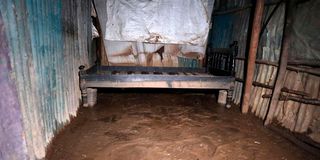
A bed sits abandoned inside a house filled with thick mud after flash floods swept through Hazina, South B.
“I got to our house when the water had already made its way inside. I panicked. I thought he had drowned. I did not see him at first glance. My sister had put him on the bed so I took him and left the house to go to a neighbour who lives in a safer place.”
She dropped her son at the neighbour’s and went back into the flooded house to retrieve his birth notification and hospital documents. By then, the sofa sets were already floating. She could not save anything else.
Since that day, she has not been able to change her clothes or her son’s. She has no new clothes for either of them.
“I have been stressed. Any time I remember that incident, I feel like my son had a near-death experience. It makes me cry sometimes,” she says.
Her son caught a cold and has been coughing endlessly. Millicent is his only parent. She cannot afford Sh450 to buy drugs over the counter and cannot afford to go to hospital. Her son has been crying and she cannot tell exactly what is wrong with him. Millicent herself has a sore throat and barely gets enough food to feed herself, let alone enough to feed her son as well.
“We do not have any place to sleep so we are cohabiting at a neighbour’s and we sleep on the floor,” she says.
She pauses, then adds: “I will be okay. If my child gets better, I will be okay. He is my only worry.”
620 households displaced
In Nyakach, Siaya County, Yvonne Adhiambo gently soothes her two-month-old son to sleep while her two-year-old daughter demands food. Once little Kellian is asleep, she lays him on a papyrus mat covered with sheets for extra comfort inside a church, then turns to her daughter. She shares the church with 30 other women and children, all displaced by the same rains.
She has not had enough breast milk since they were forced to leave home.
“He won’t be asleep for long. I haven’t had enough milk to breastfeed him since we moved to the camp,” she says. Her son cries often, and she says it is because he is hungry.
For her daughter Sasha, Ms Adhiambo is making porridge from what remains of a one-kilogramme donation of maize flour received two days earlier. It will be the child’s first meal of the day. It is already 10am. She says she deliberately delays meals — it is the only way to manage the hunger in the camp.
“Since we came here on Saturday, we have only received a donation of one kilogramme of maize flour and a loaf of bread. Whether we eat or not now depends on well-wishers,” she says.
Until March 6, Ms Adhiambo had been managing. A vegetable farmer in Nyong’ong’a, Nyakach, she fed her family from her produce and sold the surplus to neighbours. That changed on Saturday night when River Miriu burst its banks and flooded the surrounding villages.
Nyong’ong’a Assistant Chief Fred Koga says 620 households have been displaced by the flooding. The affected families are sheltering in six evacuation centres across the area, most of them churches. The centres, he says, offer nothing beyond a roof. They are not equipped to attend to the needs of flood victims.
The numbers at just one of the six centres illustrate the scale of need. At Nyamwalo SDA Church, there are 33 lactating mothers, 60 children under the age of five and 23 chronically ill people.
The only food donation the victims have received so far came from the Regional Commissioner. Mr Koga says the area is malaria-endemic and that several latrines have been submerged, exposing residents to waterborne disease. Children under five are at risk of missing routine vaccinations and of malnutrition due to lack of proper meals.
“We need a supply of mosquito nets, water treatment, and, if possible, community health promoters should randomly visit the camps offering health talks and treatment,” he says.
Ms Adhiambo left her home at around 9pm on that Saturday night.
“I left in haste, unable to save most of my belongings. The least I could do was save my children,” she says.
Inside the camp, she found a corner, spread a mat and went to sleep, unsure of what the next day would bring. The following morning, a neighbour lent her a mosquito net with a request for it to be returned once the flood victims received humanitarian aid. As at March 10, no further aid had come.
“I should be returning the mosquito net today and I do not know what will be the fate of my two children,” she says. Her own mosquito net had been swept away by the floods.
The camp has no access to clean water, leaving the displaced residents vulnerable to waterborne diseases. Her son has a routine clinic appointment on March 23, but nearby health facilities, though not marooned, are unreachable due to the flooded roads.
“Unless we benefit from a health outreach, he is likely to miss vaccination.”
This is not the first time Ms Adhiambo has been in this position. Over a year ago, she and her first-born daughter, then aged one, were forced to live in the same camp for more than two months after a heavy downpour. The health toll that time was relentless.
“We had to constantly treat malaria, running nose and diarrhoea cases. My biggest fear right now is that the situation is likely to repeat itself,” she says.
Seven months pregnant, alone
Rose Atieno, 38, is seven months pregnant. She is from Sango Rota village in Nyakach. Since moving to the camp, she has had persistent headaches, dizziness and blurry vision.
Going to hospital is not an option. The roads are impassable. Getting to the nearest health facility would cost her Sh400, money she does not have. Her husband died a few weeks ago. Her vegetable farm, her only source of income, was washed away by the floods.
During her routine antenatal appointments, she was unable to receive a mosquito net because her health facility was out of stock.
“I only carried some of my iron and folic acid supplements while the rest were destroyed by water,” she explains.
The mother of four has had no access to healthy food or clean drinking water since moving to the camp. She relies on financial support from close family and friends while hoping things will change. Her house, she says, is on the verge of collapsing, which means that even after the floodwater recedes, she may have nowhere to return to.
While this is not her first displacement by floods, it is the first time she is navigating it while pregnant.
“My house is also on the verge of collapsing, and that can only mean I might stay here longer — even after my child is born and the water level subsides,” she says.
Hundreds more displaced
The situation is not limited to Kisumu County. In Homa Bay and Migori counties, hundreds more families have been uprooted by the same rains. Homa Bay County Assistant County Commissioner Shadrack Too says over 500 households have been displaced, among them 33 pregnant women and 199 lactating mothers.
For pregnant women, children under five, and breastfeeding mothers, the long rains are not just an inconvenience. They are a health emergency.
Brown Ashira, a public health consultant and secretary-general of the Kenya Environmental Health and Public Health Practitioners’ Union, says the most vulnerable members of society pay the heaviest price when floods hit.
“For the vulnerable group, a cold spell is not just discomfort. A flooded road is not just an inconvenience. And contaminated water is not just a risk — it can be fatal,” he says.
Pregnant women, he says, are particularly exposed. Cold and damp conditions raise the risk of respiratory infections at a time when a woman’s immune system is already naturally suppressed to protect the growing baby. Flooding cuts women off from antenatal clinics, disrupting the routine check-ups that catch complications early. And when labour begins during a flood, getting to a health facility can become impossible.
“The consequences of delivering without skilled care can be devastating for both mother and child,” he says.
Children under five face a different but equally serious threat. Their immune systems are still developing, leaving them with little defence against the waterborne and vector-borne diseases the rains bring.
“Cholera, typhoid, and diarrhoea can dehydrate a small child to a life-threatening state within hours. Malaria, which surges when mosquito populations explode after heavy rains, remains one of the leading killers of children in this age group,” Mr Ashira says.
Breastfeeding mothers, he adds, carry a double burden — their own health compromised by cold, illness, and displacement, while their ability to feed and protect their infants depends entirely on staying well themselves.
“When the rains come, the most vulnerable do not simply get wet. They get sick. And without urgent, targeted protection, some do not recover,” he says.
What research shows
Researchers say the conditions described by these women mirror patterns seen in flood-affected communities worldwide.”
A study published in the scientific journal One Earth shows that after a flooding episode, child deaths in low and middle-income countries increase significantly.
“In the long term, exposure to floods can lead to disease and/or malnutrition if children live in an unsanitary environment contaminated by microbes, toxic chemicals, or moulds,” the study notes.
The evidence from other affected countries shows how quickly health deteriorates in the aftermath.
The evidence from other affected countries shows how quickly health deteriorates in the aftermath of floods.
In Bangladesh, which experienced one of the deadliest floods last year, diarrhoea was the most common cause of death among flood victims. Respiratory tract infections followed closely. These are the same conditions already appearing in evacuation centres in Nyakach and Hazina Village.
The study also documents the toll on pregnant women. Flood exposure affects both the physical and mental health of expectant mothers and is linked to adverse pregnancy outcomes, including preterm birth and low birthweight.
Researchers say practical solutions exist. Improvements in urban planning and timely flood-warning systems could reduce vulnerability. For communities that already lack early warning infrastructure, however, those recommendations often arrive too late.
A separate analysis by Save the Children examining the El Niño that swept through the Horn of Africa found that floods and landslides affected approximately 600,000 children across Kenya, Somalia and Ethiopia.
The organisation’s 2024 report documented how rising hunger created conditions for a spike in waterborne diseases, with cholera hitting children the hardest. About 27,000 cholera cases were recorded across the three countries in 2024.
In Somalia alone, almost 60 per cent of those cases were among children under five.
It is the same age group now sitting in evacuation centres in Nyakach, waiting for mosquito nets that have not arrived and clinic appointments they cannot keep.