The mango wars: Tradition pits Ukambani farmers against profits
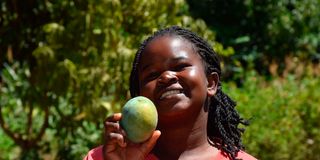
Mary Mutio holds a Ndoto mango in Matetani Village, Machakos County, on January 16, 2026. While indigenous varieties have reigned here for generations, improved mangoes are increasingly finding their place in local farms and markets.

What you need to know:
- For more than a century, Katwii and Ndoto mangoes have reigned supreme in Kangundo.
- Mango lovers praise them for their sweetness, while growers celebrate the indigenous varieties for their resilience against climate shocks such as drought and their resistance to common pests.
Between January and March, motorists travelling along major roads in Kitui, Machakos, and Makueni counties find themselves spoilt for choice as vendors line the highways with makeshift stalls filled with mangoes arranged in colourful displays. The brisk mango business marks the climax of the season in this semi-arid region, where mangoes evoke a deep sense of communal pride.
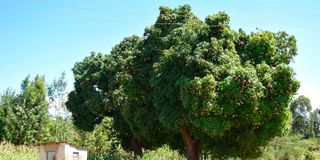
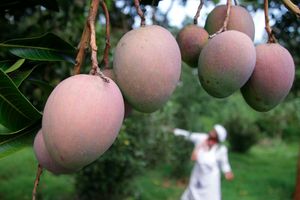
An indigenous mango tree in Matetani Village.
"Our main mango season starts in February when the Katwii and Ndoto varieties mature," says Mary Mutio, who sells the fruits in Matetani Village in Kangundo Sub-county. She refers to two popular indigenous mango varieties that have remained a staple in the region for decades.
A kaleidoscope of colours greets visitors at Mutio's makeshift stall, which showcases the diverse mango varieties produced in one of the country's most significant mango-growing belts. A spot-check by nHealthy Nation reveals that this semi-arid region, better known for avocado and coffee farming, is also home to the highest concentration of mature indigenous mango trees, at least in Machakos County.
For more than a century, Katwii and Ndoto mangoes have reigned supreme in Kangundo. Mango lovers praise them for their sweetness, while growers celebrate the indigenous varieties for their resilience against climate shocks such as drought and their resistance to common pests. However, growing pressure on farmers to commercialise mango ventures has sparked a spirited pushback, one that often manifests in strained family relationships.
"These are not just mango trees," said Grace Mbithi during a recent interview with Healthy Nation in Wamani Village. She was explaining her reluctance to replace her overgrown Ndoto mango trees with hybrids. "These particular mango trees are a memory of my late father-in-law, Pastor Joel Mbunga, who planted them more than 100 years ago.
They also provide the coolest shade under the sun."
Her son, Wellington Musyoki, 46, has however defied his mother. The taxi driver has modernised a section of the family orchard by grafting some indigenous mango varieties with improved types such as Apple and Tommy Atkins. In some cases, he has combined two different mango varieties on a single rootstock, creating a spectacle and improving the family fortune.
"A mature indigenous mango tree produces at most a sack of fruits. On average, a sack of indigenous mangoes fetches Sh1,500. A mature Apple mango tree produces around 300 mangoes a year, which translates to 120 kilos and fetches Sh2,500," says Musyoki.
Vendors and mango lovers are the biggest beneficiaries of the raging mango supremacy battle in Kangundo. The competition between indigenous and improved varieties allows them more time to sell and enjoy the king of fruits.
"Tommy Atkins matures in April, when we have exhausted all other mangoes. A piece fetches up to Sh30," says Mutio.
The mango supremacy battle has gotten the region talking, and it is deeply linked with the history of the fruit in the area.
"In Kangundo, members of the African Inland Church (AIC) were the early adopters of mangoes. Christian missionaries under the African Inland Mission introduced the fruit to this region in the late 1800s," explains Aron Wambua, a retired AIC pastor who grows indigenous mango varieties in Matetani Village.
Wambua is among the smallholder farmers who have refused to embrace improved mango varieties. He argues that varieties such as Apple are susceptible to attacks by the African fruit fly, a notorious mango pest. At the same time, he says, producing improved mango varieties is a costly venture that requires the use of pesticides to manage pests.
However, agronomists believe the misgivings towards improved mango varieties in the region have everything to do with the sentimental value farmers attach to indigenous ones.
"When missionaries introduced mangoes in Kangundo, the plan was evangelism, not unlocking economic growth. A mango tree at the homestead of a native meant he had accepted Christianity. Many homesteads, therefore, have at most three mango trees, which were grown by their grandparents. Such a population of mango trees does not make economic sense," says Sila Mbolu, an agronomist and chairman of the Mango Producers Association in Machakos County. He operates tree nurseries in Machakos Town and Tala Township.
Mbolu has witnessed a growing interest in improved mango varieties across Kitui, Machakos, and Makueni counties. However, he remains concerned that mango production in Machakos County has remained low over the years.
According to the Agriculture and Food Authority, Machakos County produces approximately 20,000 metric tonnes of mangoes annually on around 2,500 hectares of farmland. This is far below the approximately 250,000 metric tonnes that neighbouring Makueni County produces each year on about 20,000 hectares.
Agronomists attribute this disparity, in part, to the sentimental value farmers in Kangundo Sub-county attach to indigenous mango varieties, a factor they believe contributes significantly to low production in Machakos.
Mangoes, a major source of Vitamins A and C, are primarily used to produce juice and smoothies, and are also eaten fresh. Some entrepreneurs have found additional value by turning them into crisps, jam, jellies, and pickles. Agronomists recommend improved mango varieties, which are highly sought after in the market.
"Marketing indigenous mango varieties is not easy. High levels of fibre make them unpalatable and difficult to process. Yet some mango farmers are still holding onto indigenous varieties, claiming they are sweeter and more adapted to harsh climate. In Kitui County, some farmers dismiss improved mango varieties as a preserve of the rich," says Dr Benjamin Muli, an agricultural entomologist who teaches at South Eastern Kenya University.
Dr Muli advises extension officers to be creative when championing improved mango varieties in order to secure significant buy-in from farmers. At the same time, he recommends an integrated pest management strategy that combines pesticides with organic methods to control pests.
"When you talk of improved mango varieties, you are talking about innovations. Farmers are always reluctant to take the risks associated with embracing innovation. The extension system should identify the right category of early adopters. When those adopters succeed, the innovation diffuses through the community. At the community level, farmers should come together to create a pest-free zone by deploying collective action in pest management."