Protest victim back in hospital after bandages found inside body
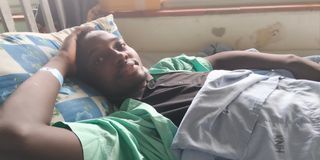
Dominic Wambua, 25, on his hospital bed at Kenyatta National Hospital on September 23, 2025. Wambua shot during this year's Saba Saba protests.

Dominic Wambua was wheeled into the operating theatre for surgery on August 30, on the same day his elder sister walked down the aisle. At 4pm, as doctors finished stitching his belly, Dominic's life was restored—but the price was a moment he'd never get back: not seeing his sister get married.
“It haunts me to this day,” Wambua says from his hospital bed at Kenyatta National Hospital.
His journey began on July 7, when the Saba Saba protests in Ongata Rongai left him with a gunshot wound to the abdomen. The carpenter was shot on his way home after a long day's work.
“I made the mistake of passing through the crowd to get to the other side of the road and got hit,” he recounts. “I wasn't protesting. The bullet hit me from the front and exited through my back.” He underwent his first surgery that same day and was discharged 10 days later.
The wound appeared to heal externally, but internally, something was wrong.
“I started feeling pain inside, and a swelling near the front scar was so painful it left my left leg temporarily paralysed,” he says. “The exit wound also came apart, and when I probed it with my fingers, I pulled out a bandage. It had been left inside me during the first surgery.”
After going to a nearby hospital where a second bandage was removed, Wambua returned to Kenyatta National Hospital. He was readmitted on August 26 and underwent a second surgery on August 30.
“I was readmitted and underwent a second surgery. After the procedure, I was informed the swelling contained pus,” he explains. “They told me if I had waited one more week, it would have spilled its contents into my stomach cavity, which would have been fatal.”
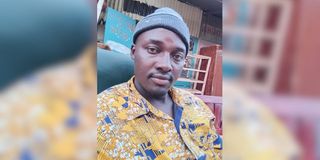
Dominic Wambua, 25, who was shot and injured during this year's Saba Saba protests.
As his condition worsened, the smell from his wound was so bad that he began to isolate himself.
“I would only speak to my parents, and when they left, I locked myself in the house,” he says. “I lost weight drastically, lost friends, and became suicidal.”
His medical documents confirm his ordeal, noting that he complained of pus drainage from the surgical site. An examination found an active discharge of pus, indicating an infection that required immediate medical attention to prevent serious complications. The documents further stated that his condition would be managed through surgical debridement, a procedure to remove dead or infected tissue that can trap bacteria and hinder healing.
By removing this tissue, the risk of life-threatening infections is lowered, stimulating the wound's healing process and allowing for the growth of new, healthy tissue. It also provides a clear view of the wound bed, enabling a thorough assessment of its depth and the presence of foreign objects.
“Since the wound was already open from the back, they pried open the front section and cleaned the hollow space that was left,” Wambua said. “It stayed that way until it started healing, then the front was stitched and the back was dressed.”
A doctor, who didn't want to be named, identified the gauze as an abdominal gauze when shown the picture of what Wambua had pulled from his body—a type of large surgical sponge used to absorb blood and other fluids during major abdominal surgeries, such as a Caesarean section.
The doctor speculates that the gauze was left behind because the medical staff in the operating theatre may not have checked thoroughly. They note that the gauze was likely superficial enough for the patient to pull it out themselves.
Wambua's radiology report showed that he suffered a severe, comminuted (shattered) fracture of the left iliac bone. The broken bone fragments had been displaced from their original position and were embedded in the muscles of the buttock, the inner pelvis, and the front of the abdomen.
The findings also showed that a clearly defined solid object that didn't belong in the body was found embedded inside the iliacus muscle on the left side of the pelvis. The object was made of hard material and may have been there for some time, possibly from a prior injury or surgery.
The report also showed that there was a complex, infected pocket of fluid (an abscess) that had formed along the path of an old injury. The infection contained gas bubbles, suggesting the presence of gas-producing bacteria. The accumulated fluid followed a track from the left lower abdomen, through the pelvis, and into the buttock, which is consistent with the path a projectile would have taken.
“They wanted to discharge me before I had fully recovered, but I refused to go because the wound was still fresh,” he says.
As a result, his bill accumulated to Sh211,900. Thankfully, the Social Health Authority paid Sh171,000, leaving him responsible for the remaining Sh40,900.
Wambua now feels the loss goes beyond just time.
“I am a professional carpenter who specialises in building seats, and when I was admitted, I had to close my shop,” he says. “There's nobody standing in for me right now.”
His life, saved at a high price, now faces the quiet struggle of recovery and rebuilding.
Wambua is now urging the government to hasten the compensation process for victims of protests, saying it will help him rebuild his life.
“Once I am discharged, I will go home to strategise on how to get my life back on track. Compensation would come in handy in helping us regain our footing,” he says.
A Victims' Compensation Panel was established in the country on August 26 to provide justice and reparations for those who have been injured or lost their lives. The panel was created following widespread calls for accountability and reparations for the use of excessive force by law enforcement during protests.
While the move has been welcomed by some, human rights organisations have stressed that compensation alone is not enough. They advocate for a comprehensive package that includes financial compensation to assist victims and their families with medical bills and other related costs. They also call for a process to publicly acknowledge the abuses that occurred, legal reforms to ensure police are held accountable and future violations are prevented, and rehabilitation support for those with physical and psychological trauma.