They were once elephant fodder. Now, pumpkins are the green gold
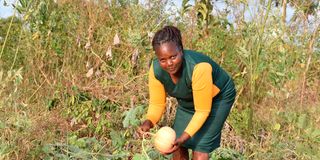
Mercy Mbithe harvests pumpkins in Kalimani Village, Makueni County on June 21, 2026. The region has seen a significant boom in production of the once-neglected orphan crop, now gaining popularity among farmers.

What you need to know:
- Soil covering, a critical ecological service associated with crop production, has made pumpkins even more valuable.
- To enhance soil health for sustainable crop production, agronomists advise farmers to intercrop conventional crops with pumpkins.
On a sunny June afternoon, Mercy Mbithe scours her farmland in Kalimani Village, Makueni County for mature pumpkins. In this region bordering Chyulu Hills National Park, one must be careful to avoid rattling venomous snakes lurking under thick heaps of crop residue.
"The pumpkin landscape has changed significantly in the last two years," she told Healthy Nation after harvesting three small pumpkins. "It is funny how we are struggling to access pumpkins for domestic use. Two years ago, our granaries brimmed with them."
Mbithe is among a handful of traders who comb the Makueni pumpkin belt between March and June for mature pumpkins, which they sell in Nairobi. A kilo fetches up to Sh15, and the business has significantly improved household incomes for smallholder farmers. At the peak of this year's pumpkin season, she delivered 40 tonnes of fruit to the market every week.
"The demand for pumpkins in Nairobi is insatiable. Our customers fall over one another for the indigenous pumpkins, citing their unique flavours," she said.
The boom follows a surge in production of the orphaned crop in the semi-arid region, once plagued by elephant attacks that destroyed fruit trees and snacked on maize, pigeon peas, and pumpkins. The region has since breathed a sigh of relief after the Kenya Wildlife Service, David Sheldrick Wildlife Trust and Makueni County government joined hands to seal off Chyulu Hills National Park with a solar-powered electric fence.
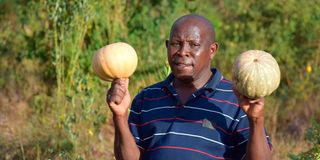
Where pumpkin growers once filled granaries for hard times, or sliced surplus to feed livestock, they now struggle to meet demand. "Today, we are struggling to fill the tens of trucks which crisscross our region in search of pumpkins," said Joshua Kiamba, a Baptist Church pastor who grows pumpkins in Muumoni Village.
At the centre of the pumpkin craze is a spike in demand for the orphaned crop, which has started to receive significant attention from environmentalists and nutritionists across the country. Nutritionists say the fruit is rich in antioxidants, carbohydrates, proteins, and assorted vitamins. The leaves are a popular vegetable, rich in iron, calcium, and vitamin C, while pumpkin seeds are highly nutritious chicken feed, packed with protein, vitamin E, and zinc.
Soil covering, a critical ecological service associated with crop production, has made pumpkins even more valuable. To enhance soil health for sustainable crop production, agronomists advise farmers to intercrop conventional crops with pumpkins.
"We need to go back to growing pumpkins to make our soils versatile. Besides being highly nutritious, pumpkins are cover crops which complement crop residue and mulching in reducing soil erosion, regulating soil moisture, and insulating soil microorganisms against direct sunlight," said Lydhia Kiswii, an agronomist at Cereal Growers Association, a non-governmental organisation that promotes climate-smart agriculture.
She spoke at a recent conference on drylands agriculture and food systems in the face of climate change at Lukenya University in Makueni County. The two-day conference, which coincided with World Day to Combat Desertification and Drought, brought together government officials, scholars, development experts, and smallholder farmers to accelerate efforts towards making drylands arable by exploring practical pathways to enhancing the resilience of arid and semi-arid lands to climate change.
The forum came at a time when the government is betting on drylands, estimated to form between 80 and 90 per cent of the country's land mass, to fight back against the effects of climate change. Agriculture Cabinet Secretary Mutahi Kagwe set off the discussion by putting the resilient drylands conversation into perspective.
"Drylands hold more than 70 per cent of the national livestock production and more than 90 per cent of our wildlife," he said in a speech delivered by Laban Langat, a senior official at the Ministry of Agriculture. "There is a need to make sure that drylands deliver socioeconomic development in the face of climate change."
Lukenya University Vice Chancellor Judith Wafula called for more action and less talk. "We should now start talking about how much of the drylands we have converted to arable land," she said.
The university has received accolades for embarking on an ambitious landscape restoration drive of growing 10 million forest and fruit trees in Kambu Sub-county by 2032, which has restored hope in the semi-arid region, ravaged by drought, wanton charcoal production, and elephant attacks.
The interplay between agriculture and wildlife has come under sharp focus as counties embrace agroecology, which is big on environmental conservation. Makueni has joined Murang'a, Nakuru, and Vihiga counties in adopting agroecology policies.
"Indigenous crops withstand erratic rainfall. They are friendly to the environment because they are less susceptible to common pests and diseases," said Mika Mukoko, an agroecology champion who frames the farming model as the panacea to food insecurity, biodiversity loss, and environmental conservation. He operates a vibrant demonstration plot near Luanda Township in Vihiga County.
To enhance the frontline role of farmers in the fight against drought, the government and NGOs have intensified calls for them to grow drought-tolerant crops such as cowpeas, mung beans, pigeon peas, and sorghum, which are adapted to harsh climatic conditions.
Cynthia Wakhungu, who teaches climate action at the Technical University of Kenya, has singled out drought-tolerant crops such as sorghum and teff as a practical pathway to making drylands resilient in the face of climate change. She has called on policymakers to strengthen climate-resilient value chains in drylands by improving production, market access, value addition, and financial inclusion to enhance food security and livelihoods.
"The hope of Africa's food security lies in the drylands. We need to put more emphasis on making drylands arable because they have the potential to produce all the livestock feed the continent needs," said David Maina, a livestock fodder production expert at the African Union InterAfrican Bureau for Animal Resources.
In addition to growing pasture grass to make drylands more resilient to erratic rainfall and drought linked to climate change, agronomists and environmentalists recommend aggressive rainwater harvesting, efficient irrigation systems, productive use of renewable energy, and recycling of biomass and food waste.
In Kalimani and Muumoni villages, Kiamba and Mbithe have set their sights on making more money from pumpkins by significantly expanding the acreage under the crop in response to growing market demand and the attention it receives from agronomists, environmentalists, and nutritionists. They have seen the promise of intercropping pumpkins with beans, cassava, maize, and pigeon peas in guaranteeing food security and enhancing livelihoods in the neighbourhood.
They also keep chicken, cows, goats, and sheep. The diversity is strategic, they said.In case one value chain fails due to climate change, a farmer can turn to the others.