When Wilfred Mbithi Kimotho bought his farm in Ilalambyu village, Kyuso Sub-county, Kitui County, the ground was dry, cut by deep gullies from erosion. Today it holds 2,000 pixie trees and 1,500 tissue-culture banana plants, and he employs two permanent workers and five casuals.
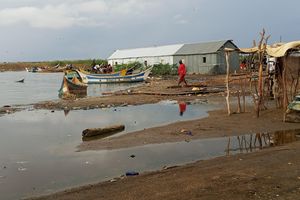
What changed was water. In 2025, he built a subwell in the bed of the Thunguthu seasonal river. It is 2.4 metres in diameter and three metres deep, reinforced with metal bars and kokoto and cast in bricks, at an estimated cost of Sh150,000 to Sh170,000. Water seeps in through capillarity and slowly fills it overnight. By day, he pumps it onto his four-acre farm, spending about Sh3,000 a week on petrol.
Before that, he relied on shallow wells, and they kept failing him. People and livestock polluted them, and at other times they caved in, making it tiresome to keep digging them up. The subwell solved that, and the water let him fix the land itself. Napier grass planted in terraces slowly stopped the erosion, he says, and the once-deep gullies have filled up, restoring his farm and feeding his livestock. All this, he says, would have been impossible without access to water.
His yields have increased, and the farm looks very different from his neighbours’. The fruit trees and bananas have made it cool, and he finds walking in it after a long day therapeutic. His family’s nutrition has improved, too.
“Instead of bread, our breakfast these days is mostly from pumpkins that now grow among the fruit trees”, he says. He knows of about ten others in his community who are thriving in agriculture through similar subwells.
Mbithi says nobody regulates water use in his community. In his account, the Water Resources Authority (WRA) goes after people with boreholes. “Authorities try to regulate by going after those who have sunk boreholes. And these are few since borehole water there is mostly alkaline and unfit for farming”, he says. According to him, WRA seeks to license borehole owners but has asked nothing of the subwells mushrooming in the area.
Nguma Kani, Director of Irrigation Quality Assurance and Licensing at the State Department for Irrigation, describes the same pattern across Kenya’s irrigation sector. Farmer-led irrigation, where individuals put small pumps directly into rivers or shallow wells, “operates almost entirely outside the formal licensing framework,” Kani says, leaving such smallholders out of national water accounting databases and basin water balances. Where permits are issued, he says, the lack of mandatory real-time metering means actual withdrawals far exceed permitted limits during peak dry seasons: “Accountability vanishes because authorities cannot prove over-abstraction without field measurement data.”
Plenty for the farm, little for the home
Mbithi’s farm uses an average of 5,600 litres on irrigation days in the dry season. His family, by contrast, uses about 80 litres a day from a rock catchment whose water is often unclean and sometimes turns green. “This is the same source used by a quarter of the Ngai and Kimanyaru sublocations, by Kyuso market, which has 3,000 to 4,000 people, and by Kyuso Boys High School, with 700 learners”, he observes. "The water point is far away."
“The government should invest in sand dams and subwells so people can farm and grow economically,” he advises. His village is fertile, he says, as he saw after adequately irrigating his farm, yet most community members either leave their land unused or sell it.
He also wants fair distribution to enable households to operate well. The government distributes seeds in the community, he says, but most recipients have no way to grow them.
“Some even wash and cook the seeds, and those who plant often see their crops dry up for lack of water before harvest”, he concludes.
Neighbours without a sub-well
In the same sub-county, Ronald Ngala of Kalole Village makes a three-kilometre trip every second day to a shallow well dug into a dry riverbed. His five donkeys haul the water home, ten 20-litre jerrycans a trip, 200 litres in all, none of it treated. It must serve his household and his livestock, which, besides the donkeys, include 13 goats and two cows.
Ngala shares the well with two other community members, who lock it with a tin lid because additional users would dry it up, and heavy use can leave it too dirty. About ten other shallow wells sit in the same riverbed, each owned by three, four or five people. Ngala says he has seen no government intervention, despite promises of water. With piped, treated water, he says, he would farm vegetables for his family and for a living.
A governance gap, not a money gap
Mbithi and Ngala are the kind of story the Kigali Communiqué on Systems Transformation sets out to name. Issued on August 20 at the Africa Water and Sanitation Systems Leadership Symposium, it notes that 418 million people across Africa still lack basic drinking water and 779 million lack basic sanitation, and calls this a governance and performance gap, not a capital gap. Infrastructure matters, it says, but in large measure it is only the beginning. Its commitments fall into three registers: what the sector must do for itself, what governments must decide, and what the continent carries forward.
Three things stand out from the document: cutting non-revenue water, extending regulatory oversight to small-town and rural operators, and positioning water as a strategic economic asset. Leparan Tialal, CEO of the Water Services Regulatory Board (WASREB), says extending regulation to small-town and rural providers will need simplified regulatory models, digital monitoring systems, stronger partnerships with counties and targeted capacity building.
The continental deadline is the UN Water Conference in Abu Dhabi from December 8 to 10, preceded by the Water, Sanitation and Irrigation conference that the Ministry of Water, Sanitation and Irrigation is holding with Nation Media Group on October 22 and 23.
In Ongata Rongai, Kajiado County, Jane Wairimu’s trouble is timing. Her neighbourhood has access to piped water, but unpredictably. She has water four days a week in good weeks, one or two in others. The worst is when water arrives while she is at work in town and nobody is home to refill the tanks. She has bought many storage tanks, and jerrycans take up most of the space in her house. She wishes the water governing bodies in her area would announce pumping days.
"They don't announce," she says, "so I guess and wait. I am now considering moving to a neighbourhood where water flows adequately."
Her experience sits against a national picture that the Communiqué’s non-revenue water commitment targets. Kani puts non-revenue water, water lost to leaks, illegal connections or unmetered consumption, at approximately 45 per cent of urban piped water.
“Kenya’s biggest water sector challenge is not infrastructure, but utility performance,” says Tialal, listing high non-revenue water, weak asset management and inconsistent governance among the constraints.
WASREB, which licenses water service providers and approves tariffs, has made faster non-revenue water reduction a priority for the Road to Abu Dhabi process. Tialal says efficiency gains and better revenue collection should come before tariff adjustments, keeping water affordable while utilities become financially sustainable.
Inconsistent supply from service providers has pushed many Kenyans in urban and rural areas towards private groundwater, according to a 2020 study in the Hydrogeology Journal by researchers from the University of Aberdeen, the British Geological Survey and the WRA. Its focus is the aquifer beneath Nairobi, which hosts more than six million people and supplies about 60 per cent of the region’s water needs.
Groundwater levels there have fallen at a median rate of about six metres a decade since 1950, and average levels under Nairobi City County dropped 36 metres between 1950 and 2015. Pumping rose about tenfold between 1977 and 2017, in step with population growth, while rainfall showed no significant trend. The study identifies demand as the dominant driver. It expects a shortfall between supply and demand before mid-century unless boreholes are drilled deeper and further from the city, and finds that capping abstraction and piping in water from outside the catchment would slow the decline.
Kani frames water as an economic question, and a scarce one. He cites annual renewable freshwater per person falling from 647 cubic metres in 1992 to 452 cubic metres, as projected in the Water Master Plan 2030. Kenya spends over Sh520 billion, about $4 billion, a year on food imports, he says, and around 80 per cent of the country is arid or semi-arid. He says governance frameworks must empower smallholders through decentralised micro-irrigation, affordable solar pumps and farm-level storage such as water pans and earth dams. That is close to what Mbithi has been asking for from a dry riverbed in Kyuso.
Tialal sets the test for Abu Dhabi. “For Kenya,” he says, “success will not be defined by the adoption of new declarations, but by measurable improvements in sector performance and service outcomes.”