Unsung heroes: Kenyan researchers who change the health landscape
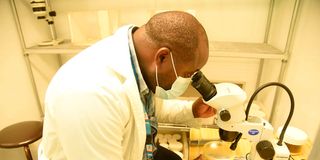
Laboratory technologist Jonstone Ingonga researching on eggs of sand fly that spread Leishmania parasite into humans through a bite at Kenya Medical Research Institute headquarters in Nairobi.

What you need to know:
- In the space of non-communicable diseases, Kemri nerds are constantly looking to identify our risk factors; find solutions for prevention, treatment and cure; and keep track of new innovations in that space, constantly looking for how best these will be adapted for our populations.
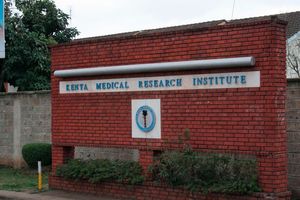
The past few months have been rather gloomy in the health research space in Kenya. It all started with withdrawal of the USAID funding, bringing to a halt some ongoing research programmes in the country, especially in our lead public research institute, the Kenya Medical Research Institute (KemriI).
This was further aggravated by the proposed 2025-2026 budget, where its authors appear not to have any idea about what health research means to this country. Basically, the budget made it clear that Kenya’s leadership is being quite short-sighted because strangling health research is pretty much a threat to national security!
Circling back to the impact at Kemri, the sudden cutting off of USAID funds took out almost 40 per cent of the institution’s budget. While common sense dictates that as a country, we should immediately look for means to plug the deficit, in our wisdom, we go on and pretty much fail to allocate even the bare minimum that we have previously put in to this key institution.
Maybe we need a reminder of what the quiet nerdy persons in Kemri do quietly behind closed doors. Just like most nerds worldwide, these amazingly brilliant humans remain fairly faceless in our country even as they win huge awards on international platforms. Truly, the fact that locally we have no idea who they are is a good indication of why our policy decision-makers fail to realise the importance of their work.
Kenya has always taken centre stage with regard to HIV research and evidence generation. In simple terms, the advances made in HIV care have squarely depended on our local research, influencing practice worldwide. For two decades, our local researchers at Kemri, AMPATH, our local universities and professional associations have led the world in how we care for our HIV-positive populations, from ensuring the anti-retroviral drugs provided are not only appropriate, but that the regimens adopted are up to date, in line with evidence. As a result, our HIV care guidelines change yearly to adopt to the changing environment, battle drug resistance and address new challenges.
Child health space
The maternal and child health space is a core area of research that urgently trickles down to immediate impact. Keeping mothers alive through pregnancy and childbirth; and babies alive and healthy for the first 60 months of life is the backbone of a healthy nation.
Disease surveillance depends on a timely, efficient and accurate diagnosis of disease-causing organisms, being able to map out the affected geographical areas, populations and timelines. This is the basis for planning, resource allocation, and control measures. This is a cornerstone function for Kemri. We may not see it, but Kemri is constantly scanning our environment for threats such as anti-microbial resistance emerging microbial mutations and adaptations; outbreaks; epidemics; pandemics; and overall disease patterns.
Some of these include areas of concern are malaria, HIV, tuberculosis; viral infections such as influenza, respiratory syncytial virus and Covid-19; sexually transmitted infections; hepatitis; and diarrhoeal diseases.
In the space of non-communicable diseases, Kemri nerds are constantly looking to identify our risk factors; find solutions for prevention, treatment and cure; and keep track of new innovations in that space, constantly looking for how best these will be adapted for our populations.
As an overarching area of research, Kemri also looks at our health systems, working on innovative ways to strengthen them. This is manifested in their areas of health systems learning; supporting UHC by providing the evidence and insights needed to shape its delivery; and supporting community-centered approaches to achieve health equity.
Health research is the backbone of healthcare delivery. It Is not a by-the-way aspect of the larger commitments of any government to health service delivery. It is important to note that health research is not a preserve of the Ministry of Health. It speaks to security, both internal and external; taking note that highly communicable diseases can easily cross borders and put our local populations at risk; and the ever-pending threat of microbes being employed as biological weapons that can wipe out masses in just one puff.
Health surveillance helps in decision-making with regard to a country’s economy. It is important understand that a healthy population is critical to building an economy. But where a large percentage of the population is pulled out from nation-building because they remain indisposed, they become a large expenditure drawing from an economy that they have no capacity to contribute to. This affects a country’s economic growth; and forms the basis for how we calculate health economic measures such as quality adjusted life years.
As a country, let us take a minute and reflect on our heroes who do great work behind closed doors without recognition. These men and women hold the ship tightly to keep us on course at all times. Therefore, we do not threaten this core function unless we are declaring that their highly sensitive contribution does not matter.
We have long depended on donor support for research and this needs to come to an end. Donor funding also comes with conditions that may not be the most responsive to our needs as a country. We need our research agenda to be locally driven, based on our priorities, and answering our own questions. We should be focusing on creating an enabling environment for our amazing nerds to continue in their nation-building mission.
In order to achieve this, we have to fund our research institutions appropriately. We must ensure that the research policies in place are addressing our gaps, and that once they are in place, they are fully implemented. Monies budgeted for research must not only be appropriately adequately, but must also be disbursed fully and in a timely manner to keep our research programmes running.
Finally, we need to demystify medical research to the general population; to understand the role it plays in our communities. It is time to put in place a system that recognises our researchers for their efforts. Let us put their faces on the front pages and acknowledge them for their critical achievements. Let us not wait for the world to do this for us. Otherwise, how else will our children aspire to become researchers when they have never seen them?
Dr Bosire is a gynaecologist/obstetrician