US heart doctor who fell in love with Kenya to be honoured as national hero
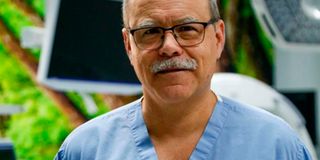
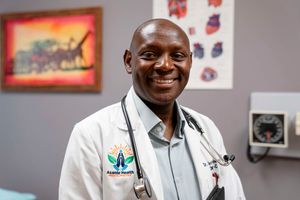
Dr Russell White, chief of Surgery and cardiothoracic surgeon at AGC Tenwek's Cardiothoracic Centre. He has been nominated as a national hero ahead of the Mashujaa Day celebrations.

What you need to know:
- In recognition of his exceptional service and profound impact, he has been nominated as a National Hero for the upcoming Mashujaa Day celebrations next month.
When Dr Russell White is not holding a surgical scalpel to make the life-saving initial incision on an open heart, he enjoys transforming ordinary wood into works of art. A gifted craftsman who loves making wooden gifts by hand for people he cares about, Dr White has passions that extend far beyond the operating room. He also has a deep, lifelong love of music, so deep that he formally enrolled in music training during his university years alongside a passion for running.
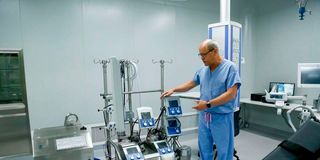
Dr Russell White at Tenwek Hospital in Bomet.
Though his musical path shifted over time, his dedication to healing never did. Today, Dr White serves as a renowned cardiothoracic surgeon at Tenwek Hospital in Bomet County, mending hearts both literally and figuratively.
In recognition of his exceptional service and profound impact, he has been nominated as a National Hero for the upcoming Mashujaa Day celebrations next month.
“I stopped singing, but I still play some musical instruments like the piano, and a few others. I now enjoy singing at my local church. My favourite Kenyan song is by Reuben Kagame, the one whose message comes from Psalm 23,” he tells Healthy Nation.
In 1992, when he was only 28, he packed his bags and set out for Kenya with the hope that he would stay for only seven months and then return to the US, where he had trained as a general surgeon.
He came with his wife and his 12-month-old child. When the seven months elapsed, he travelled back to the US, and later to England, where he trained as a cardiothoracic surgeon. This means that he can perform operations on organs inside the chest, including the heart, lungs, and oesophagus.
When Dr White was younger, his father also travelled to the Democratic Republic of Congo as a missionary doctor. But he says that even if it seems like they were cut from the same cloth, his father mainly worked as a doctor and did not train others. Dr White, on the other hand, came to Tenwek Mission Hospital with the goal of passing down knowledge to local doctors and empowering them to be the next generation of homegrown cardiothoracic surgeons.
“I looked around and there was no clear answer about where I should go. Tenwek was known as one of the largest mission hospitals. At that time, the nursing school was active, but they had not yet started training doctors. When I got there, I thought, this place looks like fertile soil; we could grow something here,” he says.
“At that time, it was an old-fashioned hospital, and I realised that I would be practising surgery in an old-fashioned setting, but it challenged me: together, we could make that place better,” he adds.
The hospital had one surgeon when Dr White arrived. They worked together for only five days, and then the other surgeon left Dr White alone for three weeks.
“I was still in my training, so I had to dig deep to handle things I had never done before,” he says.
He enjoyed working there despite the challenging conditions. After completing his training in England, he came back to Kenya in 1997 and continued to work at Tenwek. He has never looked back. Three years ago, Dr White became a Kenyan citizen and now holds dual citizenship.
“I love Kenya and how joyful the people here are,” he says.
Even though he had trained as a heart surgeon, he could not practise as one in 1997 or for many years afterward.
“We had no specialists of any type. We did everything, from orthopaedics and urology to gynaecology, plastic surgery and neurosurgery. It was an exciting and very challenging time,” he shares.
“That was before the days of the internet, before YouTube videos you could watch to learn how to perform an operation you had never done before. We depended heavily on textbooks and on applying the principles we knew well from our surgical training,” he says.
Dr White says that for many years, even though he had training in heart surgery, people still did not believe it was possible to operate on the heart. Heart-related operations were first attempted in the 1940s and actualised in the 1950s, when scientists discovered how to stop the heart, perform an operation, and then bring it back to life.
“The issue with the heart is that you need a great deal of equipment and a high level of training among your staff. You also need expensive consumables to do heart surgery,” he says.
“At that point, I didn’t think there were enough patients who needed heart surgery to make it worth bringing in equipment, training, and covering the other expenses involved. I just didn’t think it was worth it,” he adds.
It was an old paediatrician at Tenwek Hospital who kept bugging him with the many cases he received involving children presenting with symptoms of rheumatic heart disease.
This is the most common heart condition, especially among children in Africa, despite being preventable. It begins with a Streptococcus infection, a bacterial infection of the throat that presents as a sore throat and sometimes fever. Patients also have pain when swallowing, but if they are seen in good time and diagnosed correctly, antibiotics can make them better. He advises the country to take advantage of free screening for heart conditions.
“What happens is that the patient’s body starts recognising the valve of the heart as foreign tissue, so it attacks and destroys it, leading to heart disease,” he says.
In 2008, he performed his very first heart surgery in Kenya. He remembers that case clearly, saying he did “a very old-fashioned operation” that did not use a heart-lung bypass. A heart-lung bypass is a machine used during heart surgery to stop the heart from beating while ensuring that blood is still flowing.
“In 2008, we didn’t have any of those machines, or even the people who knew how to run them. We call them perfusionists,” he says.
They used an old technique in which they did not stop the heart from beating. In fact, they placed a finger inside the beating heart and then passed a metal tool called a dilator to break open a heart valve, because the valve was too tight and that prevented blood from flowing as it should.
“That’s a very anxiety-provoking operation because there is no backup. It is no longer done these days. We explained to the patients how risky it was. We did 15 of them and the patients did very well. That encouraged me to keep going and invest in heart surgery,” he says.
Dr White says that the presentation of heart diseases has changed over the years. There are two types: congenital heart diseases (those people are born with) and acquired heart diseases. He says that among acquired heart diseases, those caused by lifestyle changes are increasing compared with previous years, especially coronary artery disease.
He says that is because of the westernisation of our diet. Diets that produce coronary artery disease are high in saturated fats, cooking fats and fried foods.
“You know, 50 years ago, that type of diet really didn’t exist very much in Kenya. Now, if you drive through Nairobi, you can see restaurant after restaurant producing high-fat foods, which will lead to increased coronary artery disease,” he says.
He says that he appreciates being honoured by the President, but he only does his work to fulfil God’s purpose.
“I feel like God has given me abilities and skills, and I should share those skills with the people who need them,” he says.
“I hope that the honour draws attention not so much to me but to what God is doing at Tenwek Hospital. We’re doing things now that I could not have imagined 10 years ago. It just blows my mind sometimes when I think of what we’re doing, which is at a state-of-the-art level for the world. We’re doing cases as complicated as anyone in the world is doing, and we’re getting excellent results, and this is a result of the many people who went before me.”
His plan is to introduce robotic surgery as an option for treating heart conditions.
“I was trained in the day when robots were not even an idea, so my personal experience with robots is exceedingly limited. As recently as six months ago, if you’d asked me,
‘Do you think we should bring robots to Kenya?’, I would have said no,” he says.
He notes that most people have a misconception about what robotic surgery is. He also says that not all cases can be done using a robot, but a significant number could be.
“It is not an intelligent machine; it’s a tool that takes large motions of the surgeon’s hands and fingertips and turns them into very tiny, precise motions. So when we’re doing things like coronary artery bypass surgery, the robots make it look like a 3D picture that is 10 times magnified,” he explains.
“It is absolutely precise, and I can place the sutures exactly where I want them to be, so I think the surgical skill or surgical accuracy improves. There is also no need to open the chest, which means less recovery time,” he says.
Since 2018, Dr White and his team have trained about seven cardiothoracic surgeons, and two more will graduate later this year.
“They are exceptionally trained. I wouldn’t sign them off for their board exams if I were not confident that they would operate on me if I got a heart condition. I have no plans to stop doing it as long as God gives me breath,” he says.
On this World Heart Day, Dr White says that keeping your heart healthy means eating well, exercising and avoiding smoking at all costs.
“Prevention is important, as is screening for diagnosis,” he says.