What it really costs Kenyans to fight cancer: A shilling-by-shilling breakdown
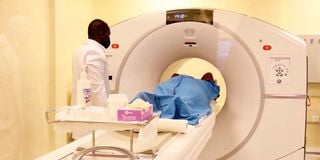
A patient undergoes cancer screening at the Integrated Molecular Imaging Center located at the Kenyatta University Teaching Referral and Research Hospital on January 10, 2022.

What you need to know:
- The review concluded that the primary challenge for Kenyan cancer patients is not the unavailability of treatment per se, but rather how treatment is priced, stocked, and financed.
A single course of chemotherapy can cost Kenyan cancer patients the equivalent of up to five months' wages, and over half of breast cancer patients abandon treatment entirely due to financial constraints. These are among the key findings of the most comprehensive review to date on the economic burden of cancer care in Kenya.
Published in the journal ecancermedicalscience, the scoping review synthesised data from 60 studies conducted between 2018 and May 2025. These included pharmacy surveys, hospital cost analyses, patient interviews, and government policy documents. The review aimed to provide a holistic picture of access to cancer medicines, financial hardship, and quality-of-life impacts for patients with the five most common cancers in Kenya: breast, cervical, prostate, colorectal, and oesophageal.
Also read: Nine years, three tumours, two transplants: One family's fight against a cancer that keeps returning
The review concluded that the primary challenge for Kenyan cancer patients is not the unavailability of treatment per se, but rather how treatment is priced, stocked, and financed.
In public hospitals, the cost of treating stages I to III breast and cervical cancer ranged from approximately $1,340 to $1,540 (Sh173,288–Sh199,152). In private facilities, however, the same treatment could cost between $7,500 and nearly $11,900 (Sh969,900–Sh1.5 million). Given that roughly seven out of 10 Kenyans rely on the public health system, the researchers emphasised that such price disparities exacerbate survival inequalities, effectively determining outcomes based on economic means. Even the cheapest generic cytotoxic drugs were largely unaffordable when purchased out-of-pocket without subsidies.
Cost, however, is only half the issue. The review found that essential cancer medicines were stocked in fewer than half of public health facilities nationwide. Official surveys reported a general availability rate of just 44 per cent for a set of 24 essential medicines. Morphine, a critical drug for palliative pain relief, was available in only about 15 per cent of facilities. Stockouts were frequently attributed to procurement delays of four to eight months at the Kenya Medical Supplies Authority (Kemsa), which often forced patients to seek care from more expensive private providers.
Annual out-of-pocket expenditure on cancer treatment varied widely, from roughly $1,300 to nearly $12,700 (Sh168,103–Sh1.64 million), according to the studies reviewed. For 20 per cent to just over 50 per cent of affected households, these expenses exceeded 40 per cent of non-food income, a threshold classified as catastrophic health expenditure.
To cope, patients and their families resorted to borrowing money, selling assets (reported by 73 per cent of respondents), seeking support from churches or community fundraising, or discontinuing treatment. In one study cited, 53.8 per cent of breast cancer patients stopped receiving care due to cost, and 91.2 per cent reported that the diagnosis had a significant broader financial impact on their household.
The burden of cancer in Kenya extends well beyond finances. Where quality of life was assessed, scores were consistently low, and researchers directly attributed this to both financial distress and late-stage diagnosis. Across the reviewed studies, roughly seven in 10 patients were diagnosed at stage III or IV, a point at which treatment becomes less effective and more costly.
The review also examined Kenya's 2023 health insurance transition from the National Hospital Insurance Fund (NHIF) to the Social Health Authority (SHA).
However, evidence on the reform's impact remains limited: only two of the 60 studies directly addressed the post-2023 SHA system, making it premature to draw firm conclusions about its effectiveness.
Nevertheless, the researchers found that NHIF had significant shortcomings. The fund covered only between nine per cent and 17 per cent of the population at various points, with informal-sector enrolment as low as 27 per cent. Coverage was typically restricted to inpatient services, leaving patients to bear the costs of medication, transport, and diagnostics out-of-pocket. In one study, nearly 45 per cent of NHIF beneficiaries reported receiving lower reimbursements than expected.
SHA's design includes a cap of KES 800,000 for cancer treatment and diagnostics under its Emergency, Chronic and Critical Illness Fund, alongside fixed tariffs that researchers believe could meaningfully reduce costs if fully operationalised. However, the review's authors caution that persistent infrastructure gaps, workforce shortages, and weak procurement systems may undermine its effectiveness, challenges that have similarly hindered reforms in other settings.
The authors call for several policy interventions, including price regulation on cancer medicines, pooled or regional procurement to reduce costs, expanded SHA coverage, and stronger cancer registries. They note that 64 per cent of existing records lack basic staging data, which is essential for tracking treatment outcomes.
They also highlight a significant gap in the evidence base itself: most research is concentrated in urban centres such as Nairobi, Eldoret, Kisumu, and Mombasa. Only six of the 60 studies captured rural experiences, despite rural patients likely facing the most severe barriers to both diagnosis and treatment.