Why Kenyans trust a swarm of flies more than an official stamp when buying meat, and the safety risks
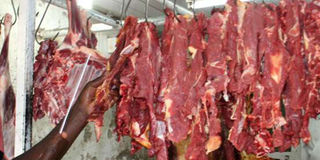
Meat displayed in a butchery. A butchery should have good space for hanging and displaying meat, with transparent viewing material such as glass, and should be secured from flies.

What you need to know:
- In 2024, authorities in Bomet uncovered a trade in sick and dying cattle being slaughtered and sold into local markets, with traders reportedly buying ailing animals cheaply from farmers before pushing the meat into the food chain undetected.
- In October 2025, the Ministry of Health's Principal Secretary for Public Health, Mary Muthoni, publicly warned that uninspected meat was reaching consumers, and cautioned that butchery operators and inspection officers were found colluding to bypass safety checks.
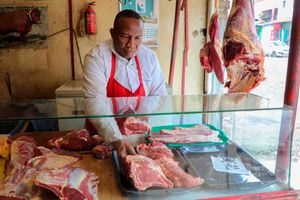
At an open-air butchery on the edge of a Nairobi estate, a swarm of flies hangs over the display table, rising and settling on the carcass each time a hand reaches past it. Most customers do not wave them off. If anything, the flies are read as a good sign. "Hii ni nyama safi, hata inzi wanajua" (this is clean meat; even the flies know it) is the kind of remark you still hear at butcheries across the country, half-joke, half-genuine conviction.
The reasoning, passed down more as folk wisdom than fact, is that flies avoid meat treated with chemicals or preservatives. If the insects are swarming, the meat must be natural and untampered with. This belief persists because it fills a real gap: most Kenyans have no way to verify what has actually been done to the meat they buy. So, they read the signs in front of them: the flies, the colour, the smell, the butcher's face, and decide who and what to trust.
Also read: Food scientists warn of rising contamination as adulterated milk, unconventional meats spread
When customers ask for tender meat or call their butcher for home delivery, nobody asks where the animal came from. Nobody asks how old the carcass is, or whether the deep red of the meat is a sign of freshness or simply of how the light hits the display counter. But how much does that man, or the supply chain behind him, actually know about what he is selling?
Peter Kamau, a butcher, says that a butcher who buys carcasses directly from a slaughterhouse can usually speak with some authority about cut anatomy, which muscle group a piece comes from, how it should be cooked, and roughly how it will behave in a pot or on a grill. Many in his profession, he adds, can also tell you which abattoir supplied the animal and sometimes which region it was raised in.
"What we usually cannot tell you is what happened to the animal before slaughter, its exact diet, whether it received veterinary drugs, or how long ago it was killed, unless the butcher is unusually meticulous about record-keeping. And crucially, in Kenya's meat trade, very little of that information is independently verified once it leaves the farm gate," says Kamau.
Kenya does have a formal grading system. Under the Kenya Meat Commission Act, carcasses processed through KMC and similar graded facilities are sorted into categories such as "choice", "standard", and "commercial", based on conformation, fat cover, age, and dentition. The Kenya Bureau of Standards (Kebs) has also approved a wider set of specifications covering pork, poultry, and bovine cuts, along with standards meant to help processors and supermarkets authenticate the source of meat and screen for fraud.
The problem is reachability. Formal grading applies mainly to meat that passes through licensed, Kebs-linked processing chains, including large abattoirs, select supermarkets, and export-oriented producers. Much of the meat sold through neighbourhood butcheries and open-air markets moves through a far less documented path, governed in principle by the Meat Control Act (Cap. 356) but policed unevenly on the ground.
That gap has consequences. In 2024, authorities in Bomet uncovered a trade in sick and dying cattle being slaughtered and sold into local markets, with traders reportedly buying ailing animals cheaply from farmers before pushing the meat into the food chain undetected. In October 2025, the Ministry of Health's Principal Secretary for Public Health, Mary Muthoni, publicly warned that uninspected meat was reaching consumers, and cautioned that butchery operators and inspection officers were found colluding to bypass safety checks. By December 2025, the Directorate of Veterinary Services was again warning counties of a seasonal spike in illegal meat trade, flagging the risk of harmful micro-organisms and drug residues in meat slaughtered outside licensed, inspected channels.
Poultry has had its own scares. In late 2024, consumer groups raised the alarm after unlabelled chicken products, some allegedly smuggled in from Uganda, turned up in supermarkets without the origin, expiry, or compliance information that KEBS labelling rules require.
Kenya's meat market has, in recent years, developed a visible premium tier: butcheries and farms marketing beef as grass-fed, organic, free-range, or dry-aged, often at several times the price of ordinary cuts. These claims are not necessarily false. Some producers do genuinely raise animals on pasture, skip growth hormones, or age carcasses in cold rooms for weeks before sale, and the country's small but growing regenerative-farming and boutique-butchery scene has built real followings on exactly that promise.
But unlike the Kebs-administered grade mark stamped on inspected carcasses, terms like "organic", "grass-fed", and "premium" are not backed by a single, independently policed certification system specific to Kenya's meat sector. A butcher or supplier can print those words on a label largely on their own word. Internationally, food-safety researchers have documented the same weakness in far more regulated markets, noting that grass-fed claims can go unchecked at the farm level and that words like "natural" are among the most widely used and least defined terms in the entire meat industry. In Kenya, where formal traceability infrastructure is thinner still, the burden of verifying such a claim falls almost entirely on the buyer's trust in a specific supplier's reputation, not on any regulatory seal.
Meat inspection in Kenya is governed primarily by the Meat Control Act (Cap. 356) and its subsidiary regulations, which set out a two-stage process carried out by veterinary officers and meat inspectors: ante-mortem inspection (before slaughter) and post-mortem inspection (after slaughter).
Ante-mortem inspection occurs when animals arrive at the slaughterhouse and again just before slaughter, typically at the unloading ramp or in the lairages (holding pens), where adequate lighting must be available for a thorough examination.
Dr Richard Kirui, a veterinary doctor, explains that the vet observes the animals' general behaviour, nutritional status, cleanliness, wounds, and any signs of disease or abnormality. Officers record disease symptoms that could affect the animal's overall health or reduce meat quality, the presence of notifiable infectious diseases or signs suggesting one is developing, and details such as species, sex, colour, age, behaviour and body temperature.
"Inspectors also watch for respiratory issues, posture problems, abnormal discharges, swellings, and unusual smells. Any animal that looks suspect is set aside and tagged rather than slaughtered with the healthy herd. It is isolated, tagged 'suspect', and slaughtered separately, either in a casualty block or after the normal animals have been processed. No animal that has entered the lairage can be removed or slaughtered without written permission from the inspecting officer, which keeps the record trail intact," he says.
He explains further that once the animal is slaughtered and the carcass dressed, the post-mortem examination follows. At this stage, the vet or meat inspector physically examines the dressed carcass, organs and lymph nodes for lesions, parasites, abscesses, discolouration, or other signs of disease that would not have been visible while the animal was alive—such as tuberculosis lesions, liver flukes, cysts, or abnormal odours. "Carcasses and organs from the same animal are kept together during this process so any problem found in one part can be traced back correctly," he adds.
"If a carcass passes, it receives an official mark of approval, such as an ink brand, burning brand, or similar device, placed on specified parts of the carcass, organs and other parts as required. Each inspecting officer has a personal number and is required to stamp every approved carcass on both sides, and is personally responsible for keeping their stamp locked away when not in use. This is meant to prevent fraud or unauthorised stamping. If a carcass fails inspection, it is condemned and kept out of the human food chain," he adds.
Locally, this work is carried out by veterinary doctors assisted by trained meat inspectors, with their specific duties spelt out in the Meat Control Act.
The clearest, most enforceable signal a shopper can look for remains the basic one: an official inspection stamp on the carcass, confirming it passed ante- and post-mortem veterinary inspection at a licensed slaughterhouse, as required under the Meat Control Act. Authorities have repeatedly urged the public to buy only from licensed butcheries displaying that stamp, precisely because it is the one claim that is legally defined and, at least on paper, independently checked.
Parliament amended the legal framework this year through the Food and Feed Safety Control Co-ordination Act, which took effect in July 2026. It folds meat safety oversight into a wider coordination structure and introduces provisions for auditing the traceability systems that slaughterhouses and meat marketers are required to maintain. Whether that translates into tighter enforcement at the butchery level, rather than just at the export-grade end of the industry, is the question consumer advocates say will determine whether Kenya's meat counters become more trustworthy, or simply better regulated on paper.
A 2024 study published in Frontiers in Sustainable Food Systems, led by researchers from the Swedish University of Agricultural Sciences and the International Livestock Research Institute in Nairobi, offered rare documented evidence of how ordinary Kenyans actually decide whether meat is safe to buy. It confirms that the fly-swarm belief is real, widespread, and traceable to a specific moment of public alarm.
The researchers spent months in 2023 running focus groups and interviews with vendors, consumers and food-safety officials in Nairobi and Machakos markets.
They found that shoppers rarely have any real way to verify food safety, so they lean on visual folk cues instead. Flies were one of the clearest examples: several consumers told researchers that a butchery with no flies around it was the suspicious one, since houseflies were believed to avoid meat that had been "poisoned" with chemical preservatives. The study traces this belief partly to a 2017 Daily Nation investigation into chemical meat preservation that stirred public anxiety at the time and appears to have hardened into lasting folk wisdom.
The same shoppers, the study found, tend to equate freshness with safety more broadly, judging meat mainly by blood colour, texture and how long it has been sitting out, while viewing refrigeration itself with suspicion. Many believe vendors chill meat not to preserve it but to disguise the fact that it has already gone bad. Other informal signals included watching how many customers a stall was drawing, since a busy butchery was assumed to be selling through its stock quickly, and looking out for delivery vehicles marked "meat" in red lettering.
Underneath all of this, the researchers found, trust in a specific vendor often mattered more to buyers than any safety consideration at all. Loyalty to a known butcher, the ability to ask him questions, and access to credit outweighed hygiene or sourcing concerns in shaping where people actually bought their meat. Vendors themselves admitted they usually cannot trace meat beyond their own immediate supplier and keep no records of where it came from before that.
The one credible signal that did emerge from the research was the official inspection stamp confirming that a carcass passed through a licensed slaughterhouse—the same stamp veterinary authorities have repeatedly urged the public to look for. But even that, the study found, is unevenly understood, with many consumers unsure which butcheries actually source from inspected chains and which do not. Experts interviewed for the study also pointed to a deeper structural problem: Kenya's food-safety law for informal markets still rests largely on the broad, decades-old Public Health Act, which sets no specific standards for meat, and formal inspection capacity remains concentrated in the export and supermarket sectors rather than the neighbourhood butcheries where most Kenyans actually shop.
Perhaps most strikingly, the study found that consumers and vendors alike rank chemical contamination as the food hazard they fear most, ahead of bacteria, even though food-safety experts and global disease-burden data consistently show the opposite: biological hazards like bacteria cause far more foodborne illness in practice than chemical residues do.
Another cross-sectional study conducted in 2025 across peri-urban Nairobi, specifically Kangemi, Huruma, Kawangware and Waithaka, reveals a stark disconnect between butchers' high awareness of official meat inspection rules and the actual microbial safety of their shops. Spearheaded by researchers from Maseno University and the International Livestock Research Institute (ILRI), the assessment evaluated food safety knowledge, attitudes and practices alongside microbiological handprint cultures taken before and after meat handling. The study is titled Knowledge, Attitude, and Practices, Hand Hygiene, and Preferred Food Safety Interventions of Butchers Operating in Nairobi County, Kenya.
The demographic profile of the 192 respondents analysed shows a predominantly young, male workforce. Nearly 97 per cent of the butchers were men, with over 42 per cent aged between 20 and 30 years. Although more than half reported over five years of experience in the meat trade, systemic gaps in training and formal compliance were widespread: 76 per cent had never received formal food safety training, nearly three-quarters lacked mandatory medical health certificates, and 99 per cent were completely unfamiliar with standard guidelines like the WHO's "Five Keys to Food Safety".
Knowledge gaps and persistent food safety myths further complicate the picture. While knowledge of formal regulatory steps was exceptionally high, with 98.4 per cent aware that meat must be government-inspected before sale, misconceptions were common. Over 64 per cent falsely believed chemical residues in food are the primary cause of cancer, nearly 55 per cent mistakenly believed raw meat should be washed under a tap before cooking, and more than 65 per cent incorrectly assumed cockroaches carry more disease than flies.
Infrastructure limitations further compound these risks. Upon receiving carcasses, primarily from the Dagoretti slaughterhouse, all surveyed shops hung meat at room temperature. Unsold meat was left hanging at ambient temperatures overnight in nearly 60 per cent of shops before being moved to a freezer the following day, and only 1 per cent maintained a continuous cold chain. Additionally, over a third of the outlets sold ready-to-eat items such as mutura, soup and roasted meat alongside raw cuts.
These operational vulnerabilities were directly reflected in the microbiological findings. Standard tests measuring bacterial contamination on butchers' hands showed levels far exceeding the acceptable public health threshold. Prior to handling meat, 64 per cent of butchers already exhibited heavy bacterial growth. After handling meat, heavy contamination spiked to 85.5 per cent, while low growth dropped to a mere 1.5 per cent. Researchers noted that these high contamination rates were driven mainly by structural deficits rather than individual intent, citing a lack of running water for proper handwashing and the widespread practice of using a single reusable cloth towel to wipe hands, counter surfaces and equipment.
When presented with potential solutions, butchers strongly favoured traditional, supportive measures while rejecting modern market-driven or technological mechanisms. Over 78 per cent endorsed government-led public awareness campaigns, and 40.6 per cent supported cooperative self-regulation groups. Conversely, non-governmental third-party testing was rejected by nearly 42 per cent, quality brand labels were rejected by 49.5 per cent, and hand-held consumer testing devices faced the highest opposition, with nearly 58 per cent ranking them as the worst option.
The study authors conclude that traditional classroom training and regulatory enforcement alone will not resolve hygiene risks in informal food markets.
Instead, interventions must combine targeted infrastructure upgrades with behavioural incentives.