Beef prices have sharply increased in recent months, with a kilo going for Sh750 to Sh900, up from about Sh400 in 2020.
And the impact is being felt by sellers and consumers. Butchers and traders say customers are cutting back, forcing them to rethink how to run their businesses and remain afloat.
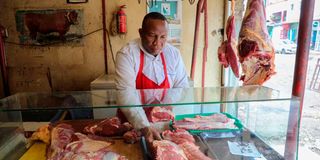
At Shade Butchery in Kawangware, Nairobi, Mr Njuguna Wahothi stands behind the counter waiting for customers.
He has been a butcher for more than a decade – long enough to witness a business that has changed in ways he could not fathom.
“Back then, a kilo of beef was Sh400. Even so, business was good because many people bought meat,” he says.
The increase in price, Mr Wahothi adds, has driven customers away. On an ordinary day, he may get few beef customers who spend small amounts, sometimes as little as Sh100.
“Sales have really gone down. It is not like in the past,” the butcher tells the Daily Nation.
During rainy seasons, suppliers raise prices, making beef hard to sell. The situation, however, changes in dry seasons. Farmers release more cattle as there is not enough feed, pushing more meat into the market.
Even then, the shifts in supply affect the setting of prices.
Mr Wahothi says he buys beef from suppliers for Sh680 to Sh700 per kilo. That leaves him with a profit of about Sh200.
Despite the high prices, customers still prefer beef over other options like matumbo (tripe), which goes for about Sh400 a kilo, or goat meat, which can cost up to Sh1,000.
A short distance away is 39-year-old Lucy Karimi. She sits quietly on a stool behind a small table at her butchery on a busy road.
Ms Karimi’s phone rests in her hands as she scrolls, passing time while waiting for customers. The butchery is open, with a clear view inside.
A large piece hangs from a hook, while on the cutting desk nearby, a few smaller pieces are neatly arranged.
It is in contrast to yesteryears, when several chunks would be on display. She now keeps it minimal.
“I only hang one. Meat is expensive and customers are few. If I bring more, it can go bad. I can’t afford such a loss,” Ms Karimi says.
Njuguna Wahothi, operator of Shade Butchery in Kawangware, Nairobi, laments the sharp drop in beef sales in this photo taken on Tuesday, March 24, 2026.
Photo credit: Dennis Onsongo | Nation
Ms Karimi, who has been in the business for 12 years, says managing the changes has not been easy.
“Sales have dropped drastically. I barely get customers these days,” she says.
Ms Karimi has made some adjustments to keep the business going. She separates her cuts and prices them differently, depending on what a customer can afford.
“Beef with bones is Sh800 a kilo while steak is Sh900,” she says.
“Some people cannot afford steak, so they go for the meat with bones.”
On slow days, she buys beef in small amounts. Ms Karimi says she has learnt to be patient even when hours pass without a customer approaching.
“It is not easy. I have been here for many years and cannot just give up,” she says.
Competition has also grown in recent years. There are at least 10 butcheries on the street Ms Karimi operates.
Lydia Mandila (left), the sales and marketing manager at the Kenya Meat Commission displays some of their products at the Meat Expo.
Photo credit: Sammy Waweru | Nation Media Group
Kenya Meat Commission (KMC) Head of Sales and Marketing, Lydia Mandila, says rising beef prices are mainly driven by changes in the weather and the cost of animals.
Ms Mandila adds that the increase in price witnessed in the last few months is closely linked to climate.
“When the rains come, farmers hold on to their animals to fatten them. This reduces supply in the market. At the same time, demand keeps rising, pushing prices up,” Ms Mandila says.
She adds that KMC plays a big role in buying, processing and distributing meat but has little control over retail prices.
This is because the meat business in Kenya is liberalised, with players operating freely in the market.
“Most butcheries in Kenya source their meat from small slaughterhouses and informal outlets. That makes it difficult for one player to control prices,” she says.
The greatest factor behind the price increase is the rising cost of animals. The situation has been extreme this year.
“Livestock prices have doubled. Ordinarily, prices go up in December and drop from January to March. This year, the rains came early, and prices are higher than what we saw in December,” Ms Mandila says.
Despite the higher prices, KMC says it has not lost customers.
sample of beef sold by Njuguna Wahothi, operator of Shade Butchery in Kawangware, Nairobi, in this photo taken on Tuesday, March 24, 2026.
Photo credit: Dennis Onsongo | Nation
“We are not focused on improving profits. We keep our margins small, almost negligible. Because of that, more customers are coming since our prices are fair,” she says.
The parastatal, in fact, reported a 20 to 25 per cent growth in sales, with a 24 per cent increase recorded in the third quarter compared to the same period the previous financial year.
To sell meat to more Kenyans, KMC introduced smaller and more affordable packaging options.
“We now even offer 250g and 500g packs,” she said.
Ms Mandila gives examples of current retail prices at KMC, which she says remain relatively fair, with matumbo retailing at Sh250 per kilogramme and beef bones going for Sh180.
Beef is priced at Sh680 per kilogramme at KMC, slightly lower than the general market rate of Sh750 to Sh900.
Even with these efforts, she says stabilising prices across the country remains difficult.
“It is important to look at how we can regulate the market so that as many Kenyans as possible get safe, quality meat, and farmers get value for their animals,” she says.
The rising prices, she adds, highlight the need for a fair and balanced system that works for everyone in the livestock and meat business.