Why Nairobi is ranked 2nd most air polluted city in Africa
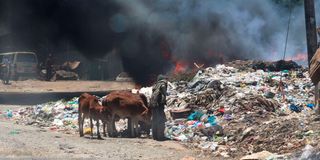
A herd of cattle feeding beside a burning pile of garbage at Mukuru Kayaba slums, Nairobi, on March 22, 2020.

What you need to know:
- Short-term exposure to carbon monoxide prevents oxygen distribution in the body, causing headaches and breathing difficulties.
- In Mathare, inhalers have become as common as mobile phones in many households, residents say.
At exactly 3.55am on August 13, Nairobi claimed an unwanted global ranking: the world’s second most air polluted city, trailing only Kinshasa and ahead of Jerusalem, according to IQAir, a Swiss air quality monitoring company.
For Mary Njoki, a 62-year-old resident of Mathare North, this statistic represents five years of dependence on an inhaler, a shuttered roadside business and a daily struggle to breathe.
“Even as we talk on the phone now, I am holding my inhaler,” Njoki says from her home, where she now makes homemade soap detergent instead of selling household items by the roadside.
“It got so bad that I decided to do this business, although it doesn’t earn me as much as the other business,” she adds.
Her doctor’s ultimatum last March was clear: relocate her business away from traffic fumes or quit altogether to save her health.
If you live in the city, chances are you’ve inhaled polluted air, laced with exhaust fumes from vehicles, smoke from burning waste, dust from unpaved roads, or even industrial emissions, making every breath a little less safe.
Maybe you’ve coughed without knowing why, frowned as a sharp stench hit your nose, or felt your chest tighten after walking through traffic.
IQAir uses AQI (Air Quality Index)—which considers various pollutants in the air and assigns them numerical values.
For instance, a score of 0–50 is considered ‘good’, 51–100 ‘moderate’ and 101–150 ‘unhealthy for sensitive groups’. Readings between 151 and 200 are labelled ‘unhealthy’, 201–300 ‘very unhealthy’, and anything above 301 is deemed ‘hazardous’.
On August 13, Nairobi’ score was 137, making the air quality ‘unhealthy for sensitive groups’.
The 2024 World Air Quality Report ranked Nairobi 83rd globally with an Air Quality Index reading of 92—a slight improvement from 79th place in 2023, but still in the ‘moderate’ to ‘unhealthy for sensitive groups’ range.
On August 21, real-time monitoring showed Nyayo Estate Gate B, Dandora Phase 4 and Jomo Kenyatta International Airport as the city’s most polluted areas.
Nairobi’s air contains PM2.5 particles—fine particulate matter that is 2.5 micrometres or smaller in diameter, so tiny that about 30 of them could fit across the width of a single human hair.
According to the World Health Organization, this is the most hazardous pollutant as it gets deep into the lungs and can cause health problems.
Other studies have linked exposure to PM2.5 to a wide range of serious health conditions, including strokes, heart disease, neurological disorders, chronic obstructive pulmonary disease and lung cancer.
But here is the alarming reality: PM2.5 concentration is currently three times the World Health Organisation’s annual PM2.5 guideline value.
Dr Jackim Nyamari from Aga Khan University’s Department of Population Health warns of devastating health impacts across age groups.
“We’re seeing lung cancer, environmental asthma and premature lung ageing,” he explains. “A 20-year-old exposed to massive air pollution develops older lungs faster, reducing life expectancy and enabling early death.”
Short-term exposure to carbon monoxide prevents oxygen distribution in the body, causing headaches and breathing difficulties.
The pollution also exacerbates menstrual pain in women, adding another layer to the health crisis.
Health impact
In Mathare, inhalers have become as common as mobile phones in many households, residents say.
Isabella Nzioki, a community health promoter in Mathare, has spent the past year educating residents about air pollution’s dangers.
With support from health organisations, her team has implemented practical measures: opening businesses after rush hour to avoid peak traffic fumes and lobbying the city’s government for regular waste collection.
“The biggest culprit here is vehicle exhaust fumes,” Isabella explains. “We pushed the city county to act and now, at least, waste is collected every other week.”
But she acknowledges these efforts only scratch the surface of a systemic crisis.
Nairobi’s toxic air stems from multiple sources converging in a perfect storm.
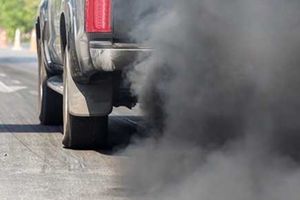
The IQAir report and other analyses attribute the city’s air quality crisis to: rising vehicle emissions from old, poorly maintained vehicles stuck in frequent traffic jams; unchecked industrial discharges; dust from the construction and road repairs; and the widespread open burning of waste, which releases toxic fumes and carcinogenic particles into the air.
The combination creates a persistent haze that blankets neighbourhoods like Mathare, where residents describe breathing as “inhaling poison daily”.
Regional crisis
Nairobi’s crisis mirrors challenges across East Africa. In the same August 13 ranking, Kampala and Addis Ababa appeared among the world’s most polluted cities, highlighting a regional emergency demanding coordinated action.
For residents like Njoki, these statistics translate into life-altering choices between health and livelihood.
As she continues her soap-making business, inhaler always within reach, thousands of Nairobians are adapting to a new reality where clean air has become a luxury.