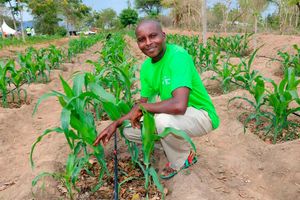
Youthful farmers turn Kajiado's sunbaked soil into an onion oasis
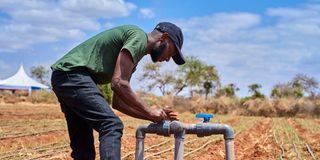
David Kamau inspects his onion crop in Emukutan Village, Kajiado County on August 28, 2025. He has deployed advanced drip irrigation technology to minimise water wastage.

What you need to know:
- The farm is a showcase of technology-driven agriculture.
- An elaborate drip irrigation system and a fertigation system have significantly reduced the need for farmhands in Emukutan.
On a blazing afternoon in Kajiado County, David Kamau, 27, and his business partner, Kennedy Muthamia, cheerfully inspect a luxuriant onion crop thriving in the sunbaked soil of Emukutan Village. Their sprawling 10-acre farmland is a standout enterprise in this in this region, traditionally known for pastoralism.
“We have started with onions. Ultimately, we plan to put the entire 10 acres on assorted fruits, herbs, and vegetables for both the local and export markets,” Kamau told Healthy Nation. “We also want to teach dryland farming in this area.”
The sight of neat onion rows stretching as far as the eye can see is a direct result of the dryland agriculture training the youthful farmers recently acquired in Israel.

David Kamau at his onion farm
Kamau and Muthamia are graduates of the University of Nairobi and Jomo Kenyatta University of Agriculture and Technology, respectively.
The farm is a showcase of technology-driven agriculture. An elaborate drip irrigation system and a fertigation system have significantly reduced the need for farmhands in Emukutan.
This technology ensures every crop receives the exact amount of water and nutrients at the right time, guaranteeing a uniform yield and minimising the wastage of vital resources.
Their inspiration came directly from Israel. "We were challenged to learn that food security isn't an issue in Israel, a country that is over 60 per cent desert," said Kamau, an agribusiness management graduate. "Smallholder farmers collaborate to grow assorted crops year-round using innovative irrigation. They either recycle water from cities or sink boreholes, which can reach depths of up to 1.5 kilometres to access groundwater."
Positioning themselves as champions of dryland agriculture, the duo believes Kenya has no excuse for food insecurity. “Our climate is favourable, the soils are rich... and we have sufficient water resources,” said Kamau, displaying the mindset change central to his Israeli training.
Tourist stopover
Their vision extends beyond farming. They hope their fully realised farmland will become a tourist stopover for visitors to Amboseli National Park, showcasing the promise of dryland farming and creating business opportunities for the local community. “This will translate to more business opportunities for the neighbouring community,” Muthamia said.
The Emukutan model farm is already making waves. Israel’s agency for international development, Mashav, and the Kajiado County government are supporting Kamau and Muthamia's determination to use the 10-acre plot as a dispersal point for dryland agriculture in Kajiado County and beyond.
Governor Joseph ole Lenku, who recently commissioned the model farm, expressed hope that it will shift the perception of agriculture among young people, moving it away from being seen as "dirty, for the poor and difficult to do.”
“We are going to be ambassadors of the good news that dryland agriculture is possible in Kajiado County,” Mr Lenku said. He sees the technology as key to transitioning the semi-arid region from water-intensive furrow irrigation, which strains the local Nolturesh water system.
“Sometimes, because of pressure from Nolturesh, we are not able to do much. But I think it is because we are not leveraging technology. Technology-driven agriculture requires a lot less water compared to conventional irrigation,” he said.
According to Eytan Hatzor, an agronomist and the head of Mashav in Kenya, approaching agriculture as a community is key for dryland farming to succeed. “It is not economical to grow crops in a plot which is less than 10 hectares. Instead of subdividing farmlands, we advise farmers to aggregate land.
“This is what happens in Israel. Smallholder farmers come together to work on a common plot. They produce and market farm produce. It is easy and economical for the government to provide public goods and services such as water, farm inputs and agronomy services when farmers are united. Small-scale farmers who sell together through a cooperative always achieve higher prices compared to small-scale farmers who sell as individuals,” he said.